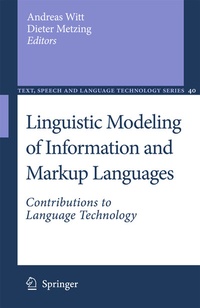
Linguistic Modeling of Information and Markup Languages
Description

This book addresses the interests of a large community of researchers in the fields of XML-based annotation techniques and corpus-based language technology. It covers the most significant recent developments in this field, from multi-layered mark-up and standards to theoretical formalisms to applications. The contributions are based on research projects at international level in text technology, computational linguistics, hypertext modeling and in the domain of standards and tools for language resources. Core topics are: strategies for multi-layered document modeling and processing, mark-up at different levels for textual resources, and text-technological information modeling.
The sections of the book offer an exhaustive coverage of many of the current topics in the fields concerned, especially: Multi-layered Markup; Markup Languages and Language Resources; Markup and Text Types; Markup Languages and Hypertext; Markup and Formalization.
The book may be seen as a contribution to very ambitious goals, connected to the development of an 'Annotation Science' (a term recently coined by Nancy Ide), for example the interoperability of different types of linguistic and textual resources, of corpora and processing tools, as well as the development of methods and annotation techniques applicable to multiple modalities and languages.
Reviews / Votes
From the reviews:
"Book contains a collection of 13 articles on various aspects of modelling of linguistic data . . It is aimed at linguists, textual scholars, creators as well as consumers of electronic language resources, and in general, at any digital humanist interested in the development of annotation methods . and in modelling of text and language resources . . It should make its way on to the shelf of any researcher who wants to stay abreast with the current state of the complex field . ." (Piotr Banski, Journal of Digital Scholarship in the Humanities, Vol. 27 (4), 2012)More details
Other editions
Additional editions