

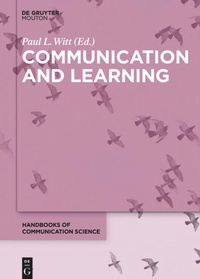
Communication and Learning
Description

In this volume, leading scholars from the fields of communication, educational psychology, and international education address what is known about the strategic role of interpersonal communication in the teaching/learning process. Instruction often involves spoken communication that carries information from teacher to learner, and in these instances the teacher's skillful and strategic use of language has a measurable impact on learning outcomes. Thus, the cumulative findings of instructional communication research are instrumental in maximizing the efficiency and effectiveness of both teaching and learning. Major sections of this volume include:
- Historical and Theoretical Foundations
- Instructor Characteristics and Behaviors
- Student Characteristics and Outcomes
- Pedagogy and Classroom Management
- Teaching and Learning Communication Across the Life-span
This handbook serves researchers, professors, and graduate students by surveying the collective findings of research and experience concerning the intentional activity of teaching and learning.
More details
Other editions
Additional editions
Person
Content
- Intro
- Preface to Handbooks of Communication Science series
- Contents
- Introduction
- 1. Learning in Response to Instructional Communication
- Fundamental Perspectives
- 2. The Evolution of Instructional Communication Research
- 3. The End(s) of Learning and the Role of Instruction: Shaping the Debate
- 4. Theoretical and Methodological Approaches to Instructional Communication
- Instructor Characteristics and Actions
- 5. Teacher Clarity: An Analysis of Current Research and Future Directions
- 6. Teacher Power and Compliance-Gaining
- 7. Instructor Immediacy
- 8. Instructor Credibility
- 9. Humor Enactment in Learning Environments
- 10. Teacher Self-Disclosure
- 11. Instructor Use of Aggressive Communication
- 12. Communicating Instructional Feedback: Definitions, Explanations, Principles, and Questions
- Student Characteristics and Attitudes
- 13. Cultural Values and Human Development
- 14. Social Identities in the Classroom
- 15. Students' Motivation to Learn
- 16. Communication Apprehension and Public Speaking Instruction
- 17. Social Perspectives on Student Learning
- Pedagogy and Classroom Management
- 18. New Technologies and Distributed Learning Systems
- 19. Instructor and Student Technology Use in the College Classroom
- 20. The Development of Online Learning in the Basic Course in Communication
- 21. Service Learning and Innovative Pedagogies
- 22. Out-of-Classroom Interactions Between Teachers and Students: Advising, Tutoring, Mentoring, and Coaching
- 23 Critical Communication Pedagogy
- Teaching and Learning Communication Across the Lifespan
- 24. Meeting Children Where They Are: Adaptive Contingency Builds Early Communication Skills
- 25. Teaching Communication to School Children and Adolescents
- 26. Teaching Communication to College and University Students: The Basic Course in Higher Education
- 27. Teaching Communication to Working Adults
- 28. Assessment of College-Level Communication Programs
- Future Directions
- 29. The Future of Communication and Learning Research: Challenges, Opportunities, and Predictions
- Biographical sketches
- Index
