

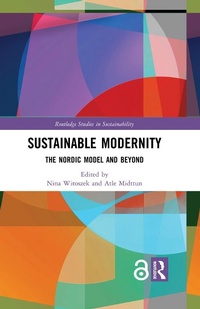
Sustainable Modernity
The Nordic Model and Beyond
1st Edition
Published on 17. April 2018
254 pages
978-1-351-76563-3 (ISBN)
Description

The Open Access version of this book, available at https://www.taylorfrancis.com/books/e/9781351765633, has been made available under a Creative Commons Attribution-Non Commercial-No Derivatives 4.0 license.
In the 21st century, Norway, Denmark and Sweden remain the icons of fair societies, with high economic productivity and quality of life. But they are also an enigma in a cultural-evolutionary sense: though by no means following the same socio-economic formula, they are all cases of a "non-hubristic", socially sustainable modernity that puzzles outside observers.
Using Nordic welfare states as its laboratory, Sustainable Modernity combines evolutionary and socio-cultural perspectives to illuminate the mainsprings of what the authors call the "well-being society". The main contention is that the Nordic uniqueness is not merely the outcome of one particular set of historical institutional or political arrangements, or sheer historical luck; rather, the high welfare creation inherent in the Nordic model has been predicated on a long and durable tradition of social cooperation, which has interacted with global competitive forces. Hence the socially sustainable Nordic modernity should be approached as an integrated and tightly orchestrated ecosystem based on a complex interplay of cooperative and competitive strategies within and across several domains: normative-cultural, socio-political and redistributive. The key question is: Can the Nordic countries uphold the balance of competition and cooperation and reproduce their resilience in the age of globalization, cultural collisions, the digital economy, the fragmentation of the work/life division, and often intrusive EU regulation?
With contributors providing insights from the humanities, the social sciences and evolutionary science, this book will be of great interest to students and scholars of political science, sociology, history, institutional economics, Nordic studies and human evolution studies.
In the 21st century, Norway, Denmark and Sweden remain the icons of fair societies, with high economic productivity and quality of life. But they are also an enigma in a cultural-evolutionary sense: though by no means following the same socio-economic formula, they are all cases of a "non-hubristic", socially sustainable modernity that puzzles outside observers.
Using Nordic welfare states as its laboratory, Sustainable Modernity combines evolutionary and socio-cultural perspectives to illuminate the mainsprings of what the authors call the "well-being society". The main contention is that the Nordic uniqueness is not merely the outcome of one particular set of historical institutional or political arrangements, or sheer historical luck; rather, the high welfare creation inherent in the Nordic model has been predicated on a long and durable tradition of social cooperation, which has interacted with global competitive forces. Hence the socially sustainable Nordic modernity should be approached as an integrated and tightly orchestrated ecosystem based on a complex interplay of cooperative and competitive strategies within and across several domains: normative-cultural, socio-political and redistributive. The key question is: Can the Nordic countries uphold the balance of competition and cooperation and reproduce their resilience in the age of globalization, cultural collisions, the digital economy, the fragmentation of the work/life division, and often intrusive EU regulation?
With contributors providing insights from the humanities, the social sciences and evolutionary science, this book will be of great interest to students and scholars of political science, sociology, history, institutional economics, Nordic studies and human evolution studies.
More details
Series
Edition
1. Auflage
Language
English
Place of publication
London
United Kingdom
Publishing group
Taylor & Francis Ltd
Target group
College/higher education
Illustrations
10 s/w Abbildungen, 5 s/w Tabellen, 10 s/w Zeichnungen
5 Tables, black and white; 10 Line drawings, black and white; 10 Illustrations, black and white
File size
16,25 MB
ISBN-13
978-1-351-76563-3 (9781351765633)
Copyright in bibliographic data and cover images is held by Nielsen Book Services Limited or by the publishers or by their respective licensors: all rights reserved.
Schweitzer Classification
Other editions
Additional editions
Book
09/2020
1st Edition
Routledge
€55.67
Shipment within 15-20 days
Book
04/2018
1st Edition
Routledge
€206.50
Shipment within 10-20 days
Persons
Nina Witoszek is a research professor at the Centre for Development and the Environment, Norway, and the Director of the Arne Naess Programme in Global Justice and the Environment at the University of Oslo, Norway.
Atle Midttun is a professor at the BI Norwegian School of Management, Department of Law and Governance, Norway; the Co-Director of the Centre for Corporate Responsibility, Denmark; and the Co-Director of the Centre for Energy and Environment, UK.
Atle Midttun is a professor at the BI Norwegian School of Management, Department of Law and Governance, Norway; the Co-Director of the Centre for Corporate Responsibility, Denmark; and the Co-Director of the Centre for Energy and Environment, UK.
Content
Foreword 1. Sustainable Modernity and the Architecture of the "Well-being Society": Interdisciplinary Perspectives Nina Witoszek and Atle Midttun 2. Cooperation, Competition, and Multilevel Selection: A New Paradigm for Understanding the Norwegian Model David Sloan Wilson and Dag O. Hessen 3. Nordic Humanism as a Driver of the Welfare Society Nina Witoszek and Oystein Sorensen 4. Individualism and Collectivism in Nordic Schools. A Comparative Approach Kirsti Klette 5. Scaling up Solidarity from the National to the Global: Sweden as Welfare State and Moral Superpower Lars Traegardh 6. Scandinavian Feminism and Gender Partnership Cathrine Holst 7. A Welfare "Regime of Goodness"? Self-interest, Reciprocity, and the Moral Sustainability of the Nordic Model Kelly McKowen 8. Challenges to the Nordic Work-Life Model in the Age of Globalized Digitalization Atle Midttun 9. Between Communitarianism and Individualism: The Nordic Way of Doing Politics Nik Brandal and Dag Einar Thorsen 10. Civilising Global Capitalism: Aligning CSR and the Welfare State Atle Midttun 11. Ecomodernity Nordic Style: The Challenge of Aligning Ecological and Socio-Economic Sustainability Atle Midttun and Lennart Olsson Afterword. Lessons of the Nordic Model: the US Perspective Jerry Lieberman and Pamela Izvanariu
