

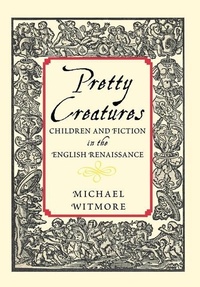
Pretty Creatures
Children and Fiction in the English Renaissance
1st Edition
Published on 5. July 2018
248 pages
978-0-8014-6355-6 (ISBN)
Description

Children had surprisingly central roles in many of the public performances of the English Renaissance, whether in entertainments-civic pageants, children's theaters, Shakespearean drama-or in more grim religious and legal settings, as when children were "possessed by demons" or testified as witnesses in witchcraft trials. Taken together, such spectacles made repeated connections between child performers as children and the mimetic powers of fiction in general. In Pretty Creatures, Michael Witmore examines the ways in which children, with their proverbial capacity for spontaneous imitation and their imaginative absorption, came to exemplify the virtues and powers of fiction during this era.
As much concerned with Renaissance poetics as with children's roles in public spectacles of the period, Pretty Creatures attempts to bring the antics of children-and the rich commentary these antics provoked-into the mainstream of Renaissance studies, performance studies, and studies of reformation culture in England. As such, it represents an alternative history of the concept of mimesis in the period, one that is built from the ground up through reflections on the actual performances of what was arguably nature's greatest mimic: the child.
As much concerned with Renaissance poetics as with children's roles in public spectacles of the period, Pretty Creatures attempts to bring the antics of children-and the rich commentary these antics provoked-into the mainstream of Renaissance studies, performance studies, and studies of reformation culture in England. As such, it represents an alternative history of the concept of mimesis in the period, one that is built from the ground up through reflections on the actual performances of what was arguably nature's greatest mimic: the child.
Reviews / Votes
The complexity and significance of Witmore's Pretty Creatures belie its title.... This is a book to be read by any scholar of the early modern period, or indeed of any period, interested in the evolving concept of fiction, explored here in a range including civic spectacles, plays written for children's companies, a Shakespeare play (The Winter's Tale) and, as an innovative test case, children's testimonies at witch trials.... It will encourage or require the continued rethinking of the presence of children as performers in much early modern literature.(Modern Philology) Witmore's analysis of the role of children as an agency of fiction breaks new ground, making this book an original, valuable contribution to understanding both the figure of the child during the Renaissance and the Renaissance debate over the nature of mimesis.
(Choice)
More details
Language
English
Place of publication
Ithaca
United States
Edition type
Digital original
Illustrations
10 halftones
10 halftones
ISBN-13
978-0-8014-6355-6 (9780801463556)
Copyright in bibliographic data and cover images is held by Nielsen Book Services Limited or by the publishers or by their respective licensors: all rights reserved.
Schweitzer Classification
Other editions
Additional editions
Book
07/2007
Cornell University Press
€55.71
Shipment within 10-20 days
Person
Michael Witmore is Professor of English at the University of Wisconsin-Madison. He is the author of Culture of Accidents: Unexpected Knowledges in Early Modern England and the coeditor of Childhood and Children's Books in Early Modern Europe, 1550-1800.
Content
- Cover
- PRETTY CREATURES
- Title
- Copyright
- Contents
- Acknowledgments
- Note on Modernization
- Introduction
- 1 Ut Pueritas Poesis: The Child and Fiction in the English Renaissance
- 2 Animated Children in Elizabeth's Coronation Pageant of 1559
- 3 Phatic Metadrama and the Touch of Irony in English Children's Theater
- 4 Mamillius, The Winter's Tale, and the Impetus of Fiction
- 5 The Lies Children Tell: Counterfeiting Victims and Witnesses in Early Modern English Witchcraft Trials and Possessions
- Epilogue
- Index
