

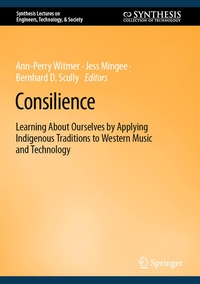
Consilience
Description

This series of essays, written by scholars and practitioners of engineering and music after visits to indigenous communities in Bolivia and Sierra Leone, illustrate the experiences, conversations, and insights that arose from consilient research. As the authors and contributors dive more deeply into each other's Western traditions of expertise, a surprising commonality emerges between music and technology - a commonality rooted in ignorance toward the power of indigeneity. This is an unexplored area of inquiry in both engineering and music. Each discipline follows rigorous traditions in Western academic institutions that have not only disregarded but have demeaned ancestral and indigenous traditions. By bringing together diverse artists and engineers, this exploration examines how engaging with non-Western knowledge can alter the understanding of Western experts in any field.
More details
Other editions
Additional editions
Persons
Ann-Perry Witmer is a senior research scientist and lecturer at the University of Illinois Urbana-Champaign. She is the originator of the field of Contextual Engineering, which merges technical design with the conditions and identities of its intended user population. A licensed professional engineer, Witmer has designed potable water systems for municipalities through the US and in non-industrialized countries throughout the world. Engineering is a second career for Witmer, who previously worked as a newspaper reporter/editor and holds degrees in journalism and art history, in addition to her engineering degrees in civil, environmental and agricultural & biological engineering.
International horn soloist, Bernhard Scully, is currently the Associate Professor of Horn at the University of Illinois at Urbana-Champaign. He is a member of the University of Illinois Global STEAM and is Artistic Director of the non-profit 501(c)(3) Cormont Music. He spends most of his summer in the White Mountains of New Hampshire as both the Artistic Director of the Kendall Betts Horn Camp and as the horn player of the North Country Chamber Players. His solo career has spanned across many genres from classical, to jazz and beyond, including being the long-time horn player of the Canadian Brass and principal horn of the Saint Paul Chamber Orchestra. Among his many awards are top honors at numerous competitions, most notably being the first classical brass player to win a McKnight Fellowship for Performing Musicians. His most recent honor was being made a member of the University of Illinois College of Agricultural Consumer Environmental Sciences (ACES) "Global Academy". As a pedagogue Bernhard has given lectures and master classes around the world and is a regular featured artist at international music conventions and festivals. His degrees are from Northwestern University (with honors), and the University of Wisconsin-Madison where he attended on a Paul Collins Distinguished Graduate Fellowship. In 2010 the University of Wisconsin awarded him a Distinguished Alumni Award for excellence in artistry.
Jess Mingee is a PhD student of Agricultural and Biological Engineering at the University of Illinois at Urbana-Champaign and has a bachelor's degree in Mechanical Engineering from the University. They have also been a student of Witmer and Scully since 2018. Their research in Contextual Engineering focuses on the challenges of stakeholder dynamics that affect project decision-making and longevity, particularly in projects where international development organizations seek to assist rural communities in navigating climate change impacts. Alongside their research, they continue to study horn under Scully and perform in campus ensembles.
Content
The Consilience Project.- Perspectives from Music.- Perspectives from Design and Technology.- The Consilience of Music and Technology.
