
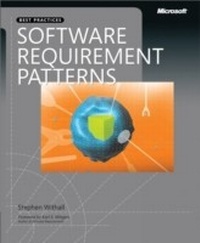
Software Requirement Patterns
Description
Alles über E-Books | Antworten auf Fragen rund um E-Books, Kopierschutz und Dateiformate finden Sie in unserem Info- & Hilfebereich.
Learn proven, real-world techniques for specifying software requirements with this practical reference. It details 30 requirement "patterns" offering realistic examples for situation-specific guidance for building effective software requirements. Each pattern explains what a requirement needs to convey, offers potential questions to ask, points out potential pitfalls, suggests extra requirements, and other advice. This book also provides guidance on how to write other kinds of information that belong in a requirements specification, such as assumptions, a glossary, and document history and references, and how to structure a requirements specification.
A disturbing proportion of computer systems are judged to be inadequate; many are not even delivered; more are late or over budget. Studies consistently show one of the single biggest causes is poorly defined requirements: not properly defining what a system is for and what it's supposed to do. Even a modest contribution to improving requirements offers the prospect of saving businesses part of a large sum of wasted investment. This guide emphasizes this important requirement need-determining what a software system needs to do before spending time on development. Expertly written, this book details solutions that have worked in the past, with guidance for modifying patterns to fit individual needs-giving developers the valuable advice they need for building effective software requirements
All prices
More details
Other editions
Additional editions
Person
Stephen J. Withall has been developing and specifying software systems for more than 26 years in a variety of roles: programmer, analyst/programmer, team leader, systems analyst, business analyst, project manager, systems architect, and chief technical officer. He has worked in diverse environments in companies big and small, in 17 countries across four continents. He has used object-oriented design approaches and technology for more than 16 years, and actively maintains his hands-on software development skills.

System requirements
File format: PDF
Copy-Protection: Adobe-DRM (Digital Rights Management)
System requirements:
- Computer (Windows; MacOS X; Linux): Install the free reader Adobe Digital Editions prior to download (see eBook Help).
- Tablet/smartphone (Android; iOS): Install the free app Adobe Digital Editions or the app PocketBook before downloading (see eBook Help).
- E-reader: Bookeen, Kobo, Pocketbook, Sony, Tolino and many more (only limited: Kindle).
The file format PDF always displays a book page identically on any hardware. This makes PDF suitable for complex layouts such as those used in textbooks and reference books (images, tables, columns, footnotes). Unfortunately, on the small screens of e-readers or smartphones, PDFs are rather annoying, requiring too much scrolling.
This eBook uses Adobe-DRM, a „hard” copy protection. If the necessary requirements are not met, unfortunately you will not be able to open the eBook. You will therefore need to prepare your reading hardware before downloading.
Please note: We strongly recommend that you authorise using your personal Adobe ID after installation of any reading software.
For more information, see our eBook Help page.
File format: PDF
Copy protection: Watermark-DRM (Digital Rights Management)
System requirements:
- Computer (Windows; MacOS X; Linux): Use the free software Adobe Reader, Adobe Digital Editions, or any other PDF viewer of your choice (see eBook Help).
- Tablet/Smartphone (Android; iOS): Install the free app Adobe Digital Editions or another reading app for eBooks, e.g., PocketBook (see eBook Help).
- E-reader: Bookeen, Kobo, Pocketbook, Sony, Tolino and many more (only limited: Kindle).
The file format PDF always displays a book page identically on any hardware. This makes PDF suitable for complex layouts such as those used in textbooks and reference books (images, tables, columns, footnotes). Unfortunately, on the small screens of e-readers or smartphones, PDFs are rather annoying, requiring too much scrolling.
This eBook uses Watermark-DRM, a „soft” copy protection. This means that there are no technical restrictions to prevent illegal distribution. However, there is a personalised watermark embedded in the eBook that can be used to identify the purchaser of the eBook in the event of misuse and to provide evidence for legal purposes.
For more information, see our eBook Help page.