

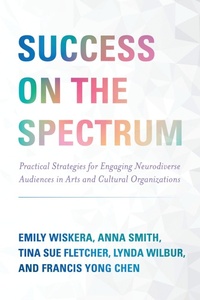
Success on the Spectrum
Practical Strategies for Engaging Neurodiverse Audiences in Arts and Cultural Organizations
1st Edition
Published on 4. January 2024
310 pages
978-1-5381-7103-5 (ISBN)
Description

The role of arts and cultural institutions is changing. Once viewed as stewards of objects, institutions are increasingly upheld as stewards of people-spaces where the diversity of human experience is asserted, explored, and celebrated. As such, they function as public resources and should be equally accessible to all members of diverse communities.Individuals with autism spectrum disorder account for a significant portion of the community. Advocates are working to shift attitudes and nomenclature, with terms such as neurodiversity and sensory-friendly becoming more commonplace. With this, cultural institutions are putting effort into creating tailored programs and resources to welcome neurodiverse visitors who have historically been excluded from these spaces. Despite their desire to connect, many cultural workers fear they lack the expertise or resources needed to effectively create inclusive spaces and experiences.This book's content is presented by museum educators, arts administrators, occupational therapists, and school psychologists-contributors with different expertise and perspectives on the stakes of cultural arts experiences for neurodiverse visitors.We offer advice based on what has worked for us and share the sometimes-difficult lessons learned along the way. However, this advice comes with the caution there is no one-size-fits-all solution. To be truly successful, arts and cultural institutions must respond to their unique community and work within the resources and limitations of their institution.Our practical goals for the reader are threefold:To understand the value of programming for neurodiverse visitors and effectively communicate this to others,To build a toolkit of strategies and resources for neurodiverse visitors to have successful visits to cultural institutions, no matter the staff size, budget, or current stages of accessibility,To develop evaluation strategies to gauge the impact of offerings for neurodiverse visitors with results that help the reader improve, grow, and refine for the future.
More details
Edition
1. Auflage
Language
English
Place of publication
New York
United States
Publishing group
Bloomsbury Publishing Plc
Target group
Professional and scholarly
Illustrations
23 BW Photos, 21 Tables, 11 Textboxes
ISBN-13
978-1-5381-7103-5 (9781538171035)
Copyright in bibliographic data and cover images is held by Nielsen Book Services Limited or by the publishers or by their respective licensors: all rights reserved.
Schweitzer Classification
Other editions
Additional editions
Emily Wiskera | Anna Smith | Tina Sue Fletcher
Success on the Spectrum
Practical Strategies for Engaging Neurodiverse Audiences in Arts and Cultural Organizations
Book
02/2024
Rowman & Littlefield Publishers
€143.90
Shipment within 3-4 weeks
Emily Wiskera | Anna Smith | Tina Sue Fletcher
Success on the Spectrum
Practical Strategies for Engaging Neurodiverse Audiences in Arts and Cultural Organizations
Book
02/2024
Rowman & Littlefield Publishers
€64.20
Shipment within 3-4 weeks
Persons
Emily Wiskera has worked in museum education since 2011, with a focus on accessibility. As Interpretation Specialist at the Dallas Museum of Art (DMA), Emily develops interpretive materials for collections and exhibitions. She was previously the DMA's Senior Manager of Access Programs and Resources, developing programs for visitors with dementia, Parkinson's disease, autism, cognitive disabilities, mobility disabilities, and those who are Deaf, hard of hearing, blind or low vision. She has written extensively on autism programming and trauma-aware practices in museums. She is passionate about creating dynamic, equitable arts experiences that encourage visitors to create, reflect, share, and connect.Anna Smith has nearly twenty years of experience in museum education and has been Curator of Education at Nasher Sculpture Center since 2011. She directs a team that strives to remove barriers to museum experiences for learners with a range of backgrounds and identities. Leading with an emphasis on collaboration, Smith participates directly in programming while upholding administrative aspects of the education department and serving on the museum's senior leadership team. Smith holds degrees in Art History and Museum Education and has published and presented on modern and contemporary artists, the role of art in healthcare, and reaching homeschool audiences. Tina Fletcher is a professor emeritus at Texas Woman's University and was a special education therapist in public schools. She has a research doctorate in curriculum design and master's degrees in figurative sculpture and allied health education. She has over 40 publications on autism, social participation, and creativity in occupational therapy, arts, and museum science journals, and book chapters on creativity, action research, and sensorimotor impairment in children, worked internationally as an autism program developer and was awarded Academic Educator of the Year by the Texas Occupational Therapy Association. She is an ad hoc reviewer for multiple museum journals.Lynda Wilbur is Manager of Access and Outreach Programs at Nasher Sculpture Center and has been creating meaningful museum experiences for over two decades. She initiated and expanded the museum's accessibility programs for neurodiverse, blind, and vision-impaired visitors, adults with cognitive disabilities, and children with life-threatening medical conditions. Wilbur seeks to foster a person's love of art and sense of belonging, whether at the museum or at a community event. She has published articles and presented at state and national conferences. Wilbur earned MA and MEd degrees and was honored with Southwest Airlines' Hospitality Champion Award for her museum work.Francis Yong Chen (he/him/his) has been a professional in the field of school psychology since 1999. He works with a neurodiverse population from preschool to adults over 18 in the school system, including students who are autistic. In this role, Chen works with the students directly and consults with parents and school faculty and staff. He offers parent training to give parents an understanding and working knowledge about neurodivergence. His passion is advocacy. He has co-authored articles in support of transgender and nonbinary youth and was awarded the Outstanding School Psychologist of 2020 Through the Texas Association of School Psychologists.
Content
- Intro
- Contents
- Acknowledgments
- Preface. Embracing Neurodiverse Audiences in Cultural Institutions
- Part 1. UNDERSTANDING AND CONNECTING WITH NEURODIVERSE PEOPLE
- 1. Know Your Audience: Characteristics of Autism and Neurodiversity
- 2. Responding to Culture Shifts: Identity and Terminology
- 3. Nothing About Us Without Us: Co-creating with Neurodiverse Communities
- Part 2. LAYING THE GROUNDWORK FOR INCLUSIVE PROGRAMMING
- 4. Opening the Doors: Planning from an Institutional Perspective
- 5. Something for Everyone: Program Models and Examples from Cultural Institutions
- 6. Know Where You're Going: Developing Participant and Institutional Goals
- Part 3. PREPARING RESOURCES FOR NEURODIVERSE AUDIENCES
- 7. Speaking Their Language: Communicating with Neurodivergent Visitors
- 8. Show and Tell: Creating and Using Visual Supports
- 9. Happily Ever After: Writing Effective Success Stories
- 10. First Things First: Schedules for Neurodiverse Visitors
- 11. Best Foot Forward: Training and Educating Staff and Volunteers
- Part 4. MAKING ADJUSTMENTS FOR DIFFERENCES IN SENSORY PROCESSING
- 12. Making Sense of It All: Sensory Processing and Sensory Processing Disorders
- 13. Know Your Space: Learning from Sensory Audits
- 14. Change Can Be Good: Accommodations and Modifications for Neurodiverse Visitors
- 15. There's a Place for Us: Sensory Spaces for Neurodiverse Visitors
- Part 5. DEVELOPING PROGRAMMING AND BUILDING COMMUNITY CONNECTIONS
- 16. Better Together: Forming Healthy Partnerships
- 17. Set Yourself Up for Success: Logistics for Sensory-Friendly Events
- 18. Spreading the Word: Reaching and Involving Audiences
- 19. Lessons Learned: Stories of Community Success
- Part 6. SECURING FUNDING AND CONDUCTING RESEARCH AND EVALUATION
- 20. Ask Away: Conducting Formal and Informal Program Evaluation
- 21. Beyond Evaluation: Research Practices and Ethics
- 22. Find the Money to Make It Work: Fundraising for Sensory-Friendly Programming
- 23. Funding Follow-Through: Reviewing and Reporting on Grants
- 24. Adding Your Voice to the Chorus: Publishing and Presenting
- A Closing Note. Start Your Own Band
- Appendix A. Glossary
- Appendix B. Build Your Library: What's on Our Bookshelves
- Index
- About the Authors
