


Getting Started with Doctoral Supervision
1st Edition
Will be published approx. on 18. June 2026
256 pages
978-1-040-46823-4 (ISBN)
Description

Getting Started with Doctoral Supervision is a uniquely inclusive book in its exploration of the diversity of doctoral candidates, research projects, disciplines, and modes of supervision. It is written for those who are beginning to supervise postgraduate students.
This book is based on the three dimensions of supervision - personal, learning, and institutional - and considers ways of working with individual candidates throughout their doctoral or master's learning journeys. It focuses on motivations, personal engagement, wellbeing, and strategies for addressing difficulties. Seeing supervision as a developmental learning dialogue, this book emphasises enabling candidates' experiences as learners who develop new knowledge through supervisory guidance. It also addresses the changing demands of the institution placed on doctoral study and supervision, broadly conceived, including the construction and presentation of doctoral work - whether as a thesis, creative work, or publications - within realistic timeframes and in approved appropriate forms.
Getting Started with Doctoral Supervision will take you on a research and experience based, reflection and action provoking journey and is a must-read guide for all those coming to supervision for the first time or looking to refresh their practice.
The 'Insider Guides to Success in Academia' offers support and practical advice to doctoral students and early-career researchers. Covering the topics that really matter, but which often get overlooked, this indispensable series provides practical and realistic guidance to address many of the needs and challenges of trying to operate, and remain, in academia.
These neat pocket guides fill specific and significant gaps in current literature. Each book offers insider perspectives on the often implicit rules of the game -- the things you need to know but usually aren't told by institutional postgraduate support, researcher development units, or supervisors -- and will address a practical topic that is key to career progression. They are essential reading for doctoral students, early-career researchers, supervisors, mentors, or anyone looking to launch or maintain their career in academia.
This book is based on the three dimensions of supervision - personal, learning, and institutional - and considers ways of working with individual candidates throughout their doctoral or master's learning journeys. It focuses on motivations, personal engagement, wellbeing, and strategies for addressing difficulties. Seeing supervision as a developmental learning dialogue, this book emphasises enabling candidates' experiences as learners who develop new knowledge through supervisory guidance. It also addresses the changing demands of the institution placed on doctoral study and supervision, broadly conceived, including the construction and presentation of doctoral work - whether as a thesis, creative work, or publications - within realistic timeframes and in approved appropriate forms.
Getting Started with Doctoral Supervision will take you on a research and experience based, reflection and action provoking journey and is a must-read guide for all those coming to supervision for the first time or looking to refresh their practice.
The 'Insider Guides to Success in Academia' offers support and practical advice to doctoral students and early-career researchers. Covering the topics that really matter, but which often get overlooked, this indispensable series provides practical and realistic guidance to address many of the needs and challenges of trying to operate, and remain, in academia.
These neat pocket guides fill specific and significant gaps in current literature. Each book offers insider perspectives on the often implicit rules of the game -- the things you need to know but usually aren't told by institutional postgraduate support, researcher development units, or supervisors -- and will address a practical topic that is key to career progression. They are essential reading for doctoral students, early-career researchers, supervisors, mentors, or anyone looking to launch or maintain their career in academia.
Reviews / Votes
There are very few people more qualified than Professor Gina Wisker to write a book such as this. Designed to help early career doctoral supervisors transition into their new role, it's comprehensive and well-written. It integrates theory and practice to produce a pedagogy of supervision that all supervisors (however experienced) will benefit from reading.Professor Alistair McCulloch, Adelaide University, Australia
Being asked to supervise your first research student can be a scary prospect, particularly if your own supervisors were less than ideal role models and/or you are being asked to supervise in an unfamiliar context in terms of the composition of candidates, the type of doctorate or the mode of supervision. This book, written by a distinguished researcher and practitioner in the field of doctoral supervision, offers a succinct yet comprehensive guide to undertaking that first supervisory role. It should be on the bookshelf of everyone new to supervision!
Professor Stan Taylor, Durham University, UK
Gina Wisker's Getting Started with Doctoral Supervision is the gold standard for research supervisors. Drawing on decades of international expertise, she transforms supervision from instinct into evidence-based practice, offering an essential toolkit that spans the entire research journey. Every research supervisor should have this indispensable book on their desk.
Professor Vijay Kumar Mallan, Quest International University, Malaysia & University of Otago, New Zealand
While this is a friendly, chatty and personal introduction to doctoral supervision it is also soundly embedded in the research. Enjoyable to read it covers the major stages of supervising a doctoral candidate and references numerous helpful resources, many of them online along with others based on the personal experience of the author. Certainly a helpful introduction of getting started with supervision.
Dr. Margaret Kiley, Australian National University, Canberra
More details
Series
Edition
1. Auflage
Language
English
Place of publication
London
United Kingdom
Publishing group
Taylor & Francis Ltd
Target group
College/higher education
Professional and scholarly
Illustrations
10 Tables, black and white; 1 Line drawings, black and white; 1 Illustrations, black and white
File size
2,63 MB
ISBN-13
978-1-040-46823-4 (9781040468234)
Copyright in bibliographic data and cover images is held by Nielsen Book Services Limited or by the publishers or by their respective licensors: all rights reserved.
Schweitzer Classification
Other editions
Additional editions

Gina Wisker
Getting Started with Doctoral Supervision
Book
approx. 06/2026
1st Edition
Routledge
€179.50
Not yet published
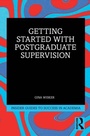
Gina Wisker
Getting Started with Doctoral Supervision
Book
approx. 06/2026
1st Edition
Routledge
€25.00
Not yet published
Person
Gina Wisker is Doctoral Supervisor and Associate Professor in the International Centre for Higher Education Management, University of Bath, UK.
Content
Chapter 1 Introduction: What do supervisors do? What does this book do?
Chapter 2 Starting as you mean to continue: planned, structured, flexible and responsive to difference.
Chapter 3 Supervising and shaping the research - getting off to a good start with research questions, research proposals and ethical approval, some thoughts on using AI.
Chapter 4 Working together well, relationship building and dealing with any breakdowns in the relationship.
Chapter 5 Supervision for personal dimensions of the doctoral learning journey, dealing with damaging learning-related behaviours, supporting wellbeing, developing academic identity.
Chapter 6 Supervising research writing in the thesis.
Chapter 7 Supervisor feedback to support research learning.
Chapter 8 Supervising for different formats and outcomes: professional practice, by publication, creative research.
Chapter 9 Different modes of supervision: supervising in teams, remote supervision, cohorts, developing communities and 'the hidden curriculum'.
Chapter 10 Nearing the end: examinations, vivas, corrections and jobs.
Chapter 2 Starting as you mean to continue: planned, structured, flexible and responsive to difference.
Chapter 3 Supervising and shaping the research - getting off to a good start with research questions, research proposals and ethical approval, some thoughts on using AI.
Chapter 4 Working together well, relationship building and dealing with any breakdowns in the relationship.
Chapter 5 Supervision for personal dimensions of the doctoral learning journey, dealing with damaging learning-related behaviours, supporting wellbeing, developing academic identity.
Chapter 6 Supervising research writing in the thesis.
Chapter 7 Supervisor feedback to support research learning.
Chapter 8 Supervising for different formats and outcomes: professional practice, by publication, creative research.
Chapter 9 Different modes of supervision: supervising in teams, remote supervision, cohorts, developing communities and 'the hidden curriculum'.
Chapter 10 Nearing the end: examinations, vivas, corrections and jobs.
