

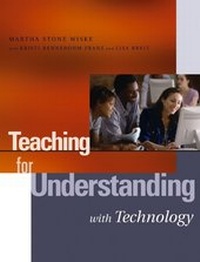
Teaching for Understanding with Technology
Description

Reviews / Votes
"Here's a fresh and insightful look at how technology can enhancelearning. Forget the computer rooms and all the fancy hardware. Ifyou don't make technology part of the learning process, you'remissing the critical link. A must-read for teachers, educators, andanyone else who wants to transmit ideas and help others think innew and bold ways." --Robert B. Reich, Hexter Professor of Social and Economic Policy,Brandeis University "Teaching for Understanding with Technology is animportant owner's manual for educators, as well aspolicymakers and the larger public, on the most effective uses fortechnology in the classroom. The authors combine their perspectivefrom the university and the school classroom to show how powerfulideas in learning can be realized in the work of teachers andstudents." --Milton Chen, executive director, The George Lucas EducationalFoundation "This book supports innovative pedagogical theory withclassroom-based examples of how to teach with Internet-based andother technology tools. The Teaching for Understanding frameworkprovides a roadmap for educators seeking to use and assess the fullpotential of technology in the classroom, whether they are poisedon the on-ramp or already cruising the information superhighway. Itis required reading for both teachers, education policymakers andglobal educators." --Dr. Edwin Gragert, executive director, iEARN-USA (InternationalEducation and Resource Network) "At last, a book written with the practitioner in mind.Teaching for Understanding with Technology will serveas an invaluable guide for educators everywhere. The authors speakin real terms, through the eyes of real students and teachers. Thevignettes show how technology can empower and motivate both studentand teacher. As a principal and instructional manager, I see thisbook as a must-have blueprint for all educators. I intend topurchase a copy for every staff member in my building." --Mary Skipper, headmaster, TechBoston Academy, Dorchester,Massachusetts "If you have any doubts about the way in which technology canenrich the learning of all students, you are holding the book youneed to read. Stone details the ways in which Kristi is reinventinglearning in the age of technology and explains why this approach isso essential. What is remarkable is that when you treat firstgraders like graduate students they end up acting like them." --Margaret Riel, senior researcher, Center for Technology inLearning SRI, and visiting professor, Pepperdine University "This book is about translation and transformation, using thenew technologies to improve teaching and learning. It demonstrateshow these new technologies, essential ingredients in education inthe twenty-first century, can support teachers as they refine theirpractice, and make learning a deeper and more lastingexperience---students learn to understand. The book makes anelegant case for the appropriate and informed use of technology inour schools." --Isa Kaftal Zimmerman, director, Technology in Education Program,Lesley University "This book is needed so that all educators will understand howto use the power of technology to propel teaching and studentlearning. Teachers need to understand how to create classroomprojects with technology that build on the students'interests and extend those interests by having studentscommunicating and collaborating with peers around the globe. Thisbook can help teachers break through the barriers of integratingtechnology into their curriculum. Classrooms can then become learning environments where students reach out to their world andfind their place in it." --Katherine Law, Seattle public school teacher and lead educationaltechnologistMore details
Other editions
Additional editions
Persons
Content
Preface
The need for good public education has never been greater than in today’s complex, interdependent, and rapidly changing world. At the same time, pressures on schoolteachers and administrators have rarely been as intense. Educators need ways to specify clear goals and to coordinate their efforts coherently to help all students succeed. New information and communication technologies can be valuable resources in developing effective strategies for promoting ambitious learning in public education. This book presents a detailed language and a practical structure—the Teaching for Understanding framework—for guiding educators through the maelstrom of competing pressures toward effective teaching and learning with new technologies.
Background of the Problem
Policymakers and politicians, business leaders and parents, educational researchers and developers—all have their own particular and often competing expectations for educators and schools. They expect schools to
- Provide access to opportunity for every student to develop his or her full potential
- Differentiate instruction to meet all students’ needs, with extra help for those who have fallen behind and special enrichment for students who are already advanced beyond their peers
- Transmit the legacies of multiple cultures
- Cover a required curriculum that encompasses vast amounts of information
- Prepare all students to pass standardized tests (whose items may not correlate with the endorsed curriculum standards)
- Develop students’ ability to think critically, apply their knowledge in the world, and be continuing learners
- Enable students to succeed in the modern workplace1
- Produce citizens who will sustain local and global communities
All these stakeholders ply the schools with often incoherent and incompatible combinations of requirements, resources, constraints, and complaints.
Addressing these multiple agendas has always challenged and frustrated educators. During periods of rapid change, like the present, both the imperatives and the difficulties for providing excellent public education become even more intense. Astonishing technological developments during the past century have transformed the nature of knowledge and work, the speed of travel and communication, modes of warfare, and humanity’s impact on the planet. All of these conditions make access to high-quality learning essential for all people. Economic development, international peace, democratic government, and preservation of the global environment all depend on universal education. Furthermore, traditional basic education in the three R’s of reading, writing, and ‘rithmetic is nowhere near adequate for modern conditions. Nor is traditional instruction, with teachers leading rows of students through standard curriculum materials, sufficient to prepare today’s students to succeed as stewards of tomorrow’s world. Teachers must be supported in their efforts to teach new curricula, using new methods and new technologies, to a newly diverse range of students.
In the face of competing agendas and mounting pressures, how can teachers make responsible choices as they design lessons and orchestrate learning with their students? How should school administrators establish priorities, design structures, and foster an organizational culture that galvanizes all members of a school community in a focused and sustained pursuit of coherent goals? How might policymakers, business leaders, and supporters of public education make contributions that truly help school people meet the challenges and serve the purposes of public education in these complex times? How can new technologies support these processes? Educators do not agree on the answers to these questions. They don’t even share a common language for articulating their own answers or forging them into a coherent plan.
What This Book Is About
This book outlines a coherent process to help educators address these questions. The Teaching for Understanding framework is distilled from years of analysis by researchers at the Harvard Graduate School of Education, in collaboration with reflective schoolteachers working in a range of subject matters and settings. The elements of the framework guide deliberate decisions about fundamental issues that all educators must resolve. These include framing curriculum topics, defining educational goals, designing learning activities, integrating coherent and effective assessments, developing supportive learning communities, and integrating new technologies to improve learning.
The framework does not supply particular answers, but it helps decision makers involved in all sorts of educational contexts develop effective strategies for their own particular circumstances; it is applicable for all subject matters, ages of learners, and types of settings. Classroom teachers, principals, curriculum planners, technology specialists, policymakers, teacher educators, university professors, corporate trainers, business leaders, researchers, parents, and philanthropists can apply it to their work. In so doing, they learn how to clarify, negotiate, and coordinate their efforts in ways that integrate new educational technologies to advance teaching and learning for understanding.
The book is organized to help a broad range of readers understand the underlying principles behind this model and learn to use it to help guide their work. Chapter One introduces the five elements of the Teaching for Understanding framework: (1) generative curriculum topics, (2) understanding goals, (3) performances of understanding, (4) ongoing assessment, and (5) collaborative, reflective learning communities. It also describes how these elements fit together as a coherent guide for educators.
Chapter Two explains how this framework and new educational technologies can be effectively coordinated to improve student performance around key learning goals.
Each of the next five chapters concentrates on one element of the framework, elaborating on the key features of the element and illustrating how teachers can use it to guide their integration of new technologies and promote students’ learning. The case studies are drawn from one author’s extensive experience as a classroom teacher and from all the authors’ consultation with a wide range of educators over many years. The examples reveal how teachers make choices as they plan curricula that integrate new technologies, assemble the materials and assistance they need, manage their classroom activities, and develop relationships with colleagues and collaborators within and beyond their school. Most of the examples deal with students in K–12 classrooms, but some vignettes illustrate how this approach works with other learners, including postsecondary students and teachers themselves. In all the examples, the central goal is to advance learners’ understanding and their ability to apply knowledge in their lives.
Chapter Eight describes how educators learn to apply the framework to their own practice. It illustrates how the framework itself can be explicitly applied and modeled in designing professional development to support teaching for understanding with new technologies. The examples in this chapter are based on the authors’ experience teaching graduate courses and leading professional development for educators, both in on-line courses and in on-site sessions.
The urgent rationale for taking action and some guidance for doing so are summarized in Chapter Nine. Thoughtfully integrating new technologies to help students develop flexible and creative understanding is a complex process that requires sustained inquiry and collaboration among professional communities of educators and between schools and their surrounding communities. This ongoing process depends on coordinated support from policymakers, educational administrators, professional developers, and teacher educators.
Why This Book Is Needed Now
People in schools, as well as those who hope to support them, must respond to the urgent need for improved public education. All young people must now be educated in ways that enable them to be responsible citizens of the planet and of their local communities—a new kind of citizenship. The times generate crushing pressures on educators, with broad mandates to serve increasingly diverse student populations, narrowly focused accountability measures, and often chaotic administrative contexts in which contradictory policies generate competition for resources. Yet these times also provide new opportunities, including an emerging consensus about the nature of effective learning and increasing access to new technologies that support such learning. Teachers must be helped to perform in ways that go far beyond traditional conceptions of delivering instruction. Educational technologies can be used to promote the kinds of learning and teaching that today’s world requires. These goals are challenging, but they must be accomplished.
The Authors’ Ongoing Collaborative Inquiry
For the past two decades, the authors have worked to improve public education with new technologies in numerous ways—as researchers, professional developers, teacher educators, technology-integration specialists, and classroom teachers. Firsthand experience has revealed both the challenges and the benefits of transforming educational practice from an emphasis on transmitting knowledge to constructing understanding, from isolation and competition to interaction and collaboration, and from trivial or distracting uses of technologies to applications that...
