

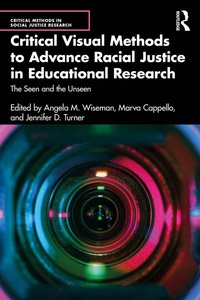
Critical Visual Methods to Advance Racial Justice in Educational Research
The Seen and the Unseen
Published on 23. September 2025
270 pages
978-1-040-43257-0 (ISBN)
Description

Critical Visual Methods to Advance Racial Justice in Educational Research advances critical research methodologies for analyzing visual and multimodal data, with particular attention to racial justice for minoritized communities. It presents innovative theoretical frameworks and analytical approaches for examining how visual representations impact, perpetuate, and potentially transform systemic inequities in educational research.
Organized into three sections, this book explores analytic frameworks, methods for critical visual analysis, and visual praxis in schools and communities. Contributors weave together transformative theories while demonstrating innovative approaches to visual analysis that center participant perspectives, including photovoice, collage, slow looking, and radical curation. The book showcases rigorous approaches to analyzing visual data while maintaining methodological depth. Key findings illustrate how visual methodologies can reveal hidden power structures, document lived experiences, and generate new knowledge about how minoritized communities engage with and create visual meaning. The work advances the understanding of perspectives across the lifespan-from children to youth to adults-through critical visual and multimodal research methods.
This book is designed for emerging and established educational scholars interested in critical visual and multimodal methodologies and serves as an ideal text for undergraduate and graduate research courses. It offers valuable insights for researchers studying representation, identity, and equity while advancing innovative approaches for analyzing visual and multimodal data in educational research.
Organized into three sections, this book explores analytic frameworks, methods for critical visual analysis, and visual praxis in schools and communities. Contributors weave together transformative theories while demonstrating innovative approaches to visual analysis that center participant perspectives, including photovoice, collage, slow looking, and radical curation. The book showcases rigorous approaches to analyzing visual data while maintaining methodological depth. Key findings illustrate how visual methodologies can reveal hidden power structures, document lived experiences, and generate new knowledge about how minoritized communities engage with and create visual meaning. The work advances the understanding of perspectives across the lifespan-from children to youth to adults-through critical visual and multimodal research methods.
This book is designed for emerging and established educational scholars interested in critical visual and multimodal methodologies and serves as an ideal text for undergraduate and graduate research courses. It offers valuable insights for researchers studying representation, identity, and equity while advancing innovative approaches for analyzing visual and multimodal data in educational research.
Reviews / Votes
"Critical Visual Methods to Advance Racial Justice in Educational Research gives me a wave of relief and faith in the crusading spirit of literacy researchers. What the editors have produced with this volume by leading voices in the field is a book that amplifies the tremendous sway that visuals have on viewers. It is a book that compels readers to sit up and take notice about the power and disquietude of images. This book contributes to a better future." -- Jennifer Rowsell, University of Sheffield, UK"Critical Visual Methods to Advance Racial Justice in Educational Research assembles cutting-edge scholarship to advance epistemic pluralism through multimodal approaches to literacy research and pedagogy. Taken together, the studies chart new directions for inquiry that honor students' and youth's creativity and varied ways of knowing and being, refusing to shy away from issues of race, power, and coloniality. This powerful compilation promises to make an influential contribution to the field in the service of education justice." -- H. Gerald Campano, University of Pennsylvania, USA
"This powerful collection on critical visual methodologies invites us to witness how images not only reflect but actively shape our social realities-especially when viewed through an intersectional lens. Readers are reminded that what we see and how we are seen are always entangled with histories of power, resistance, and possibility." -- Venus E. Evans-Winters, LCSW, Ph.D., Professor & Director of Ph.D. Programs, School of Leadership & Educational Sciences, University of San Diego, USA
More details
Series
Language
English
Place of publication
London
United Kingdom
Publishing group
Taylor & Francis Ltd
Target group
College/higher education
Professional and scholarly
Illustrations
9 Tables, black and white; 1 Line drawings, black and white; 57 Halftones, black and white; 58 Illustrations, black and white
File size
27,69 MB
ISBN-13
978-1-040-43257-0 (9781040432570)
Copyright in bibliographic data and cover images is held by Nielsen Book Services Limited or by the publishers or by their respective licensors: all rights reserved.
Schweitzer Classification
Other editions
Additional editions
Angela M. Wiseman | Marva Cappello | Jennifer D. Turner
Critical Visual Methods to Advance Racial Justice in Educational Research
The Seen and the Unseen
Book
09/2025
1st Edition
Routledge
€62.00
Shipment within 10-20 days
Angela M. Wiseman | Marva Cappello | Jennifer D. Turner
Critical Visual Methods to Advance Racial Justice in Educational Research
The Seen and the Unseen
Book
09/2025
1st Edition
Routledge
€193.50
Shipment within 10-20 days
Persons
Angela M. Wiseman is an associate professor of Literacy Education at North Carolina State University, USA, has an appointment as a scholar of multiliteracies research at the University of Tampere, Finland, and is affiliated faculty of the Center for Visual Literacies at San Diego State University.
Marva Cappello is a professor of Literacy Education at San Diego State University, USA, where she is the founder and director of the Center for Visual Literacies. She teaches master's courses in literacy as well as doctoral courses in qualitative research methods.
Jennifer D. Turner is a professor of Literacy Education and the College of Education ADVANCE Professor at the University of Maryland, USA, and is affiliated faculty of the Center for Visual Literacies at San Diego State University.
Marva Cappello is a professor of Literacy Education at San Diego State University, USA, where she is the founder and director of the Center for Visual Literacies. She teaches master's courses in literacy as well as doctoral courses in qualitative research methods.
Jennifer D. Turner is a professor of Literacy Education and the College of Education ADVANCE Professor at the University of Maryland, USA, and is affiliated faculty of the Center for Visual Literacies at San Diego State University.
Content
Section 1. Expanding Race-Based Analytic and Conceptual Frameworks 1. Exploring Intersectional Media Literacies to Interpret Racialized Texts 2. You Are the [Theory], Baby: The Interplay between Black Photographs and Theory-Making 3. Outsiders Within: Visual Representations of Black and Brown National Identities 4. Hope, Dystopia, and Imagination: Visualising the Semiotic Landscape in a School for Incarcerated Youth in Eswatini; Section 2. Understanding Methods and Techniques for Critical Visual Analysis 5. Braiding African Diasporic Autoethnography, Visual, and Multimodal Methodologies to Examine the Lived Experience of a Ghanaian/African Student-Athlete Concerning Sickle Cell Trait (SCT) Status and the 1-Year Scholarship in the U.S. and NCAA 6. Visualizing Asian American Identities: Connecting Cultural Roots to Otherwise Possibilities through Collaging 7. Borders Are Man-Made Just Like Racism: Using Photovoice to Reveal Transborder College Students' Experiences of Violence and Militarization at the US-Mexico Borderlands 8. "Using My Own Face as a Frame": Creating, Curating, and Analyzing Self-Portraits in Pursuit of Intersectional Educational Justice; Section 3. Advancing Critical Visual Praxis with Schools and Communities 9. "I Think They Both Have Power!": Critical "Slow Looking" of Picturebooks with Diverse Racial, Linguistic, and Cultural Representations 10. Elevating Black Girlhood through Visual Methodology: Arts-Based Research as a Lens for Seeing Black Girls 11. Finding Hope in the Disruption of Epistemologies of Ignorance through Students' Visual Representations 12. Embodied Solidarities: An Examination of Using Critical Digital Literacies to Dismantle White Supremacy and Racial Terror 13. Collaborative Radical Curatorial Praxis as Liberatory Research Methodology
