

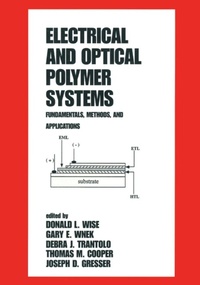
Electrical and Optical Polymer Systems
Fundamentals: Methods, and Applications
Published on 27. March 1998
1256 pages
978-1-4822-6988-8 (ISBN)
Description

"Offers background information, methods of characterization, and applications for electrical and optical polymers, including biopolymers, and tutorial sections that explain how to use the techniques."
Reviews / Votes
". . .gives a comprehensive view of characterization and applications of electrical and optical polymers, including fundamentals, methods and applications. Different chapters are focused on state-of-the-eart applications, with tutorial chapters on electrical and optical polymers, with emphasis on commercial polymers."---Polymer International
More details
Series
Language
English
Place of publication
London
United Kingdom
Publishing group
Taylor & Francis Ltd
Target group
Professional and scholarly
File size
52,98 MB
ISBN-13
978-1-4822-6988-8 (9781482269888)
Copyright in bibliographic data and cover images is held by Nielsen Book Services Limited or by the publishers or by their respective licensors: all rights reserved.
Schweitzer Classification
Other editions
Additional editions
Book
03/1998
1st Edition
CRC Press
€526.14
Shipment within 15-20 days
Content
Part 1 Conductive polymers: polyanaline as a corrosion barrier; optimization of electrical and redox properties of electrogenerated polypyroles; heterocycle-based electroconductive polymers; electrochemical characteristics of conducting polymers; anisotropy in electrically conducting polymers; basic methods of synthesis and characterization of electronically conducting polymers. Part 2 Nonlinear optical polymers: nonlinear optical characterization of polymers; conjugated polynitriles - a novel class of nonlinear optical and electric functional polymers; second harmonic generation in poled polymer waveguides using co-propagating geometries; design and fabrication of nonlinear polymer integrated optic devices; fabrication and characterization of electrooptic polymer waveguide modulator for photonic applications. Part 3 Advances in electrical and optical polymer systems: optical and spectroscopic investigations on the supramolecular assemblies of optoelectronic materials; towards organic functional devices using ionized cluster beam deposition method; electrochemical synthesis and characterization of conjugated polymers; optically active conjugated polymers with main chain chirality; coordination polymers - infinite 1-D, 2-D and 3-D frameworks based upon transition metals and polyfunctional ligands; interfacial aspects in the manufacture of soft contact. Part 4 Dielectric and field responsive materials: electrical responses of polymer gels; electric field alignment of polymer materials exhibiting long-range order; ferroelectric liquid crystalline polymers; electrical impedance properties of chemically responsive hydrogels; ferroelectricity and peizoelectric biopolymers. (Part contents).
