

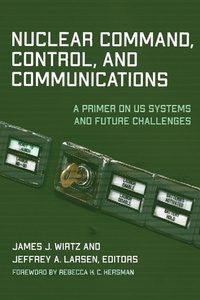
Nuclear Command, Control, and Communications
Description

he first overview of US NC3 since the 1980s, Nuclear Command, Control, and Communications explores the current NC3 system and its vital role in ensuring effective deterrence, contemporary challenges posed by cyber threats, new weapons technologies, and the need to modernize the United States' Cold War?era system of systems.
More details
Other editions
Additional editions
Persons
James J. Wirtz is a professor in the Department of National Security Affairs at the Naval Postgraduate School in Monterey, California. His publications address intelligence analysis, deterrence, and strategy. He received his PhD from Columbia University.
Jeffrey A. Larsen is a research professor at the Naval Postgraduate School in Monterey, California. He is also the president of Larsen Consulting Group. His publications focus on strategic issues, deterrence, arms control, NATO, and aerospace power. He received his PhD from Princeton University.
Content
Foreword by Rebecca K. C. Hersman
Acknowledgments
Introduction: Assuring Control of the Nuclear Force
James J. Wirtz
Part I
1. Nuclear Command, Control, and Communications and the Strategy of Deterrence
James J. Wirtz
2. NC3 during the Bomber Age: 1945?57
James Clay Moltz
3. NC3 during the Missile Age: 1957?91
James Clay Moltz
Part II
4. US Nuclear Command, Control, and Communications: The NC3 Weapons
Jeffrey A. Larsen
5. Space Architecture for NC3: Systems and Technologies
Mathew R. Crook
Part III
6. Cyber Operations and Nuclear Escalation: The Diversity of Danger
Jon R. Lindsay
7. Technology Threats to NC3: Past Lessons and Current Challenge
Wade L. Huntley
8. Technology Threats to NC3: A Future Scenario
Wade L. Huntley
Part IV
9. NC3 Modernization: Progress and Remaining Changes
Michael S. Malley
Conclusion: NC3 at a Critical Juncture
Jeffrey A. Larsen
List of Contributors
Index
