

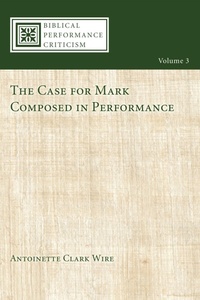
The Case for Mark Composed in Performance
Published on 1. January 2011
238 pages
978-1-62189-280-9 (ISBN)
Description

Is it possible to make a case that the Gospel of Mark was not composed by a single man from scattered accounts but in a process of people's telling Jesus' story over several decades? And what can we say about the tellers who were shaping this story for changing audiences?
After an introduction showing the groundwork already laid in oral tradition research, the case begins by tracing the Mark we know back to several quite different early manuscripts which continue the flexibility of their oral ancestors. The focus then turns to three aspects of Mark, its language, which is characterized as speech with special phrases and rhythms, its episodes characterized by traditional forms, and its overall story pattern that is common in oral reports of the time.
Finally several soundings are taken in Mark to test the thesis of performance composition, two scenarios are projected of possible early tellers of this tradition, and a conclusion summarizes major findings in the case. Mark's writer turns out to be the one who transcribes the tradition, probably adhering closely to it in order to legitimate the new medium of writing.
More details
Other editions
Additional editions
Antoinette Clark Wire
The Case for Mark Composed in Performance
Book
01/2011
Wipf & Stock Publishers
€27.50
Shipment within 3-4 weeks
Antoinette Wire
The Case for Mark Composed in Performance
Book
01/2011
Wipf & Stock Publishers
€43.60
Shipment within 15-20 days
Person
Antoinette Clark Wire is Professor of New Testament Emerita at San Francisco Theological Seminary and the Graduate Theological Union in Berkeley. Her writings include The Corinthian Women Prophets: A Reconstruction through Paul's Rhetoric and Holy Lives, Holy Deaths: A Close Hearing of Early Jewish Storytellers.
Content
- Intro
- (Start) The Case for Mark Composed in Performance
- Series Foreword
- Preface
- Abbreviations
- Introduction
- Part 1: The Written Text of Mark
- 1 Mark Found in the Christian Canon
- 2 Mark Found in Manuscript
- 3 Mark Found in Writing: The Setting
- 4 Mark Found in Writing: The Event
- 5 Mark Found in Greek
- Part 2: Language, Scenes, and Story Patterns
- 6 The Language of Mark as Performance Tradition
- 7 Language as Parataxis and the Continuing Kai
- 8 Language as Simple Diction and Spoken Discourse
- 9 The Scenes of Mark as Performance Tradition
- 10 Scenes of Action: Exorcism, Healing, and Controversy
- 11 Scenes of Vision: A Voice from Heaven and the Mortal Coming on the Clouds
- 12 The Story Pattern of Mark as Performance Tradition1
- 13 The Story Pattern as Conflict in Process
- 14 The Story Pattern as Report of a Prophet's Sign
- Part 3: Soundings in Mark
- 15 "Who Is This?"
- 16 "God's Kingdom Is Arriving"
- 17 "And They Said Nothing to Anyone"
- Part 4: Conclusion
- 18 Who Is Telling? Two Scenarios
- 19 Findings in the Case
- Bibliography
