

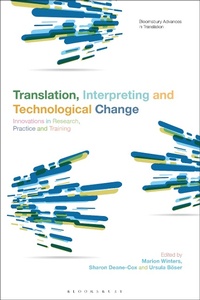
Translation, Interpreting and Technological Change
Innovations in Research, Practice and Training
1st Edition
Published on 16. May 2024
224 pages
978-1-350-21295-4 (ISBN)
Description

The digital era is characterised by technological advances that increase the speed and breadth of knowledge turnover within the economy and society. This book examines the impact of these technological advances on translation and interpreting and how new technologies are changing the very nature of language and communication.
Reflecting on the innovations in research, practice and training that are associated with this turbulent landscape, chapters consider what these shifts mean for translators and interpreters. Technological changes interact in increasingly complex and pivotal ways with demographic shifts, caused by war, economic globalisation, changing social structures and patterns of mobility, environmental crises, and other factors. As such, researchers face new and often cross-disciplinary fields of inquiry, practitioners face the need to acquire and adopt novel skills and approaches, and trainers face the need to train students for working in a rapidly changing landscape of communication technology. This book brings together advances and challenges from the different but intertwined perspectives of translation and interpreting to examine how the field is changing in this rapidly evolving environment.
Reflecting on the innovations in research, practice and training that are associated with this turbulent landscape, chapters consider what these shifts mean for translators and interpreters. Technological changes interact in increasingly complex and pivotal ways with demographic shifts, caused by war, economic globalisation, changing social structures and patterns of mobility, environmental crises, and other factors. As such, researchers face new and often cross-disciplinary fields of inquiry, practitioners face the need to acquire and adopt novel skills and approaches, and trainers face the need to train students for working in a rapidly changing landscape of communication technology. This book brings together advances and challenges from the different but intertwined perspectives of translation and interpreting to examine how the field is changing in this rapidly evolving environment.
More details
Series
Edition
1. Auflage
Language
English
Place of publication
London
United Kingdom
Publishing group
Bloomsbury Publishing PLC
Target group
College/higher education
Illustrations
7 bw illus
ISBN-13
978-1-350-21295-4 (9781350212954)
Copyright in bibliographic data and cover images is held by Nielsen Book Services Limited or by the publishers or by their respective licensors: all rights reserved.
Schweitzer Classification
Other editions
Additional editions
Marion Winters | Sharon Deane-Cox | Ursula Boeser
Translation, Interpreting and Technological Change
Innovations in Research, Practice and Training
Book
approx. 12/2025
Bloomsbury Academic
€44.10
Not yet published
Marion Winters | Sharon Deane-Cox | Ursula Boeser
Translation, Interpreting and Technological Change
Innovations in Research, Practice and Training
Book
06/2024
Bloomsbury Academic
€141.36
Shipment within 15-20 days
Persons
Marion Winters is Senior Lecturer in Translation Studies at Heriot-Watt University, UK.
Sharon Deane-Cox is Senior Lecturer in Translation Studies at the University of Strathclyde, UK.
Ursula Böser is Professor Emerita in Languages and Intercultural Studies at Heriot-Watt University, UK.
Sharon Deane-Cox is Senior Lecturer in Translation Studies at the University of Strathclyde, UK.
Ursula Böser is Professor Emerita in Languages and Intercultural Studies at Heriot-Watt University, UK.
Content
List of Figures
List of Tables
List of Contributors
Introduction: Technological Change in Translation and Interpreting: Current Directions and Future Challenges, Marion Winters (Heriot-Watt University, UK), Sharon Deane-Cox (University of Strathclyde, UK), and Ursula Böser (Heriot-Watt University, UK)
Part I: Shifting Boundaries of Human and Technology Interaction
1. Cognitive Artefacts and Boundary Objects: On the Changing Role of Tools in Translation Project Management, Regina Rogl and Hanna Risku (University of Vienna, Austria)
2. Interpreters' Performances and Cognitive Load in the Context Of a CAI Tool, Bart Defrancq (Ghent University, Belgium), Helena Snoeck (Ghent University, Belgium) and Claudio Fantinuoli (University of Mainz-Germersheim, Germany)
3. Customization, Personalization, and Style in Literary Machine Translation, Dorothy Kenny (Dublin City University, Ireland) and Marion Winters (Heriot-Watt University, UK)
4. The Figure of the Literary Translator amidst New Technologies, Damien Hansen (University of Liège, Belgium and Grenoble Alpes University, France)
Part II: Shifting Methods and Models
5. Risk Management for Content Delivery via Raw Machine Translation, Maarit Koponen (University of Eastern Finland) and Mary Nurminen (Tampere University, Finland)
6. Machine Translation in the Legal Context: A Spanish-to-English Comparative Study of Statistical vs. Neural Machine-Translation Output, Jeffrey Killman (University of North Carolina at Charlotte, USA)
Part III: Shifting Translation and Interpreting Pedagogies
7. Open-Source Statistical Machine Technology in Translator Training: From Machine Translation Users to Machine Translation Creators, Khetam Y. Al Sharou (Imperial College London, UK)
8. Teaching Machine Translation Literacy to Non-Translation Students: A Case Study at a Canadian University, Lynne Bowker (University of Ottawa, Canada)
Index
List of Tables
List of Contributors
Introduction: Technological Change in Translation and Interpreting: Current Directions and Future Challenges, Marion Winters (Heriot-Watt University, UK), Sharon Deane-Cox (University of Strathclyde, UK), and Ursula Böser (Heriot-Watt University, UK)
Part I: Shifting Boundaries of Human and Technology Interaction
1. Cognitive Artefacts and Boundary Objects: On the Changing Role of Tools in Translation Project Management, Regina Rogl and Hanna Risku (University of Vienna, Austria)
2. Interpreters' Performances and Cognitive Load in the Context Of a CAI Tool, Bart Defrancq (Ghent University, Belgium), Helena Snoeck (Ghent University, Belgium) and Claudio Fantinuoli (University of Mainz-Germersheim, Germany)
3. Customization, Personalization, and Style in Literary Machine Translation, Dorothy Kenny (Dublin City University, Ireland) and Marion Winters (Heriot-Watt University, UK)
4. The Figure of the Literary Translator amidst New Technologies, Damien Hansen (University of Liège, Belgium and Grenoble Alpes University, France)
Part II: Shifting Methods and Models
5. Risk Management for Content Delivery via Raw Machine Translation, Maarit Koponen (University of Eastern Finland) and Mary Nurminen (Tampere University, Finland)
6. Machine Translation in the Legal Context: A Spanish-to-English Comparative Study of Statistical vs. Neural Machine-Translation Output, Jeffrey Killman (University of North Carolina at Charlotte, USA)
Part III: Shifting Translation and Interpreting Pedagogies
7. Open-Source Statistical Machine Technology in Translator Training: From Machine Translation Users to Machine Translation Creators, Khetam Y. Al Sharou (Imperial College London, UK)
8. Teaching Machine Translation Literacy to Non-Translation Students: A Case Study at a Canadian University, Lynne Bowker (University of Ottawa, Canada)
Index
