

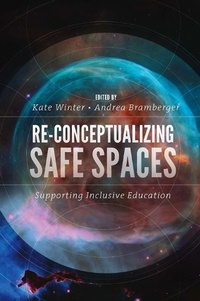
Re-Conceptualizing Safe Spaces
Supporting Inclusive Education
Published on 25. October 2021
232 pages
978-1-83982-250-6 (ISBN)
Description

A 'safe space' is both a precondition, and one of the effects, of efforts of inclusiveness and egalitarian access to education. By creating safe spaces for learning and unlearning, researchers and practitioners have been working to strengthen the purpose of schools and universities, where education and learning are intended for everyone, with the goal of increasing critical thinking and valuing difference.
Re-Conceptualizing Safe Spaces broadens the idea of a safe space that is traditionally discussed in feminist studies, to include gendered identities intersecting with class, race/ethnicity, sexual orientation, and ability within multiple aspects of education. This edited collection showcases work supporting access to education of persistently marginalized individuals, as well as efforts that help privileged groups understand their role in perpetuating the marginalization of others in educational spaces, by bringing into the popular discourse examples of the diverse and valuable work taking place.
Combining foundational concepts with practical cases of creating safe spaces in venues of education, this book is essential reading for educators across the USA, Europe, and beyond.
Re-Conceptualizing Safe Spaces broadens the idea of a safe space that is traditionally discussed in feminist studies, to include gendered identities intersecting with class, race/ethnicity, sexual orientation, and ability within multiple aspects of education. This edited collection showcases work supporting access to education of persistently marginalized individuals, as well as efforts that help privileged groups understand their role in perpetuating the marginalization of others in educational spaces, by bringing into the popular discourse examples of the diverse and valuable work taking place.
Combining foundational concepts with practical cases of creating safe spaces in venues of education, this book is essential reading for educators across the USA, Europe, and beyond.
More details
Language
English
Place of publication
Bingley
United Kingdom
Target group
Professional and scholarly
File size
4,64 MB
ISBN-13
978-1-83982-250-6 (9781839822506)
Copyright in bibliographic data and cover images is held by Nielsen Book Services Limited or by the publishers or by their respective licensors: all rights reserved.
Schweitzer Classification
Persons
Kate Winter, PhD, is an independent consultant on research design and evaluation in higher education. Her areas of expertise include diversity in Science, Technology, Engineering, and Mathematics (STEM), college student access and retention, professional development for faculty, and institutional cultural change.
?Andrea Bramberger, Dr.phil., is a Professor of Gender and Education at the University of Education Austria. Her areas of expertise include Educational Science, Gender and Education, and Aesthetics in Education.
?Andrea Bramberger, Dr.phil., is a Professor of Gender and Education at the University of Education Austria. Her areas of expertise include Educational Science, Gender and Education, and Aesthetics in Education.
Content
Section I. Aspects Addressing the Conceptualization of Safe Spaces in Education
Chapter 1. Learning In and Through Safe Spaces; Andrea Bramberger and Kate Winter
Chapter 2. Why Safe Spaces Are Needed; Andrea Bramberger and Kate Winter
Chapter 3. Ways of Framing Safe Spaces; Andrea Bramberger and Kate Winter
Chapter 4. Considering Various Performances of Safe Spaces; Andrea Bramberger and Kate Winter
Section II. Interventions Addressing the Performance of Safe Spaces in Education
Chapter 5. "Train Your Imagination": On The Program "Globalization And Education" at The University Of Fribourg (Switzerland); Edgar Forster
Chapter 6. Expand the Space, Expand the Bravery: A Practicum for Building Safe Brave Spaces Within STEM Faculty Professional Development Programs; Kelly Mack
Chapter 7. Safer Brave Spaces That Empower Queer and Trans Students; Erica Jayne Friedman
Chapter 8. Sexualized Violence: Safe or Brave Spaces in Educational Measures; Marita Kampshoff
Chapter 9. Gendered Patterns in Lifelong Learning in Spain in the European context: The Opening of New Cultural Spaces for Women; Montserrat Cabre i Pairet, Marta Garcia-Lastra, and Tomas Mantecon Movellan
Chapter 10. "Empathy Is Really Important": Improving Undergraduate STEM Education Through a Community of Care; Eva M. Fernandez, Michelle C. Fraboni, Jennifer Valad, Sabrina Avila, Allan Edmond, and Corinna Singleman
Chapter 11. Confronting the Ambiguities of Safe Space in Creative and Participatory Work; Elena Vacchelli
Chapter 12. Our Best Place; Kelly Mack, Claudia Rankins, Patrice McDermott, and Orlando Taylor
Chapter 13. A Dialog about Safer Spaces in Education: Why We Must Understand and Mediate the Energy in an Educational Space; Bettina Aptheker, Andrea Bramberger, and Kate Winter
Chapter 1. Learning In and Through Safe Spaces; Andrea Bramberger and Kate Winter
Chapter 2. Why Safe Spaces Are Needed; Andrea Bramberger and Kate Winter
Chapter 3. Ways of Framing Safe Spaces; Andrea Bramberger and Kate Winter
Chapter 4. Considering Various Performances of Safe Spaces; Andrea Bramberger and Kate Winter
Section II. Interventions Addressing the Performance of Safe Spaces in Education
Chapter 5. "Train Your Imagination": On The Program "Globalization And Education" at The University Of Fribourg (Switzerland); Edgar Forster
Chapter 6. Expand the Space, Expand the Bravery: A Practicum for Building Safe Brave Spaces Within STEM Faculty Professional Development Programs; Kelly Mack
Chapter 7. Safer Brave Spaces That Empower Queer and Trans Students; Erica Jayne Friedman
Chapter 8. Sexualized Violence: Safe or Brave Spaces in Educational Measures; Marita Kampshoff
Chapter 9. Gendered Patterns in Lifelong Learning in Spain in the European context: The Opening of New Cultural Spaces for Women; Montserrat Cabre i Pairet, Marta Garcia-Lastra, and Tomas Mantecon Movellan
Chapter 10. "Empathy Is Really Important": Improving Undergraduate STEM Education Through a Community of Care; Eva M. Fernandez, Michelle C. Fraboni, Jennifer Valad, Sabrina Avila, Allan Edmond, and Corinna Singleman
Chapter 11. Confronting the Ambiguities of Safe Space in Creative and Participatory Work; Elena Vacchelli
Chapter 12. Our Best Place; Kelly Mack, Claudia Rankins, Patrice McDermott, and Orlando Taylor
Chapter 13. A Dialog about Safer Spaces in Education: Why We Must Understand and Mediate the Energy in an Educational Space; Bettina Aptheker, Andrea Bramberger, and Kate Winter
