

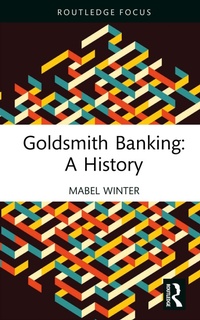
Goldsmith Banking: A History
Will be published approx. on 10. June 2026
106 pages
978-1-040-55956-7 (ISBN)
Description

In seventeenth-century England goldsmiths became what we would now recognise as bankers. Goldsmiths' shops sold not only gold and silver plate but also instruments of credit, such as bonds and bills of exchange, and offered 'safe' places to lodge capital at interest. As well as offering financial services to private individuals, goldsmith bankers also became trusted financial agents to the Crown.
Whilst some goldsmith banks still survive today, and the likes of Coutts are still associated with the Crown, the link between goldsmiths and banking is largely forgotten in modern Britain. This book explores the history of goldsmith banking from its early seventeenth-century origins, through its maturity in the Restoration, the collapse of significant goldsmith banks following the 1672 Stop on the Exchequer, and the continuation of goldsmith banking through the 'financial revolution', formation of the Bank of England, and beyond. It combines a general narrative with examples of specific goldsmith banks throughout the period to examine goldsmith bankers' practices, the instruments they dealt in and popularised, and the innovations in finance they instituted.
This concise introduction to goldsmith banking is ideal for students, academics, and those with a general interest in financial history or early modern London.
Whilst some goldsmith banks still survive today, and the likes of Coutts are still associated with the Crown, the link between goldsmiths and banking is largely forgotten in modern Britain. This book explores the history of goldsmith banking from its early seventeenth-century origins, through its maturity in the Restoration, the collapse of significant goldsmith banks following the 1672 Stop on the Exchequer, and the continuation of goldsmith banking through the 'financial revolution', formation of the Bank of England, and beyond. It combines a general narrative with examples of specific goldsmith banks throughout the period to examine goldsmith bankers' practices, the instruments they dealt in and popularised, and the innovations in finance they instituted.
This concise introduction to goldsmith banking is ideal for students, academics, and those with a general interest in financial history or early modern London.
More details
Series
Language
English
Place of publication
London
United Kingdom
Publishing group
Taylor & Francis Ltd
Target group
College/higher education
Professional and scholarly
Illustrations
5 Tables, black and white; 1 Line drawings, black and white; 1 Illustrations, black and white
File size
1,94 MB
ISBN-13
978-1-040-55956-7 (9781040559567)
Copyright in bibliographic data and cover images is held by Nielsen Book Services Limited or by the publishers or by their respective licensors: all rights reserved.
Schweitzer Classification
Other editions
Additional editions
Mabel Winter
Goldsmith Banking: A History
Book
approx. 06/2026
1st Edition
Routledge
€69.50
Not yet published
Person
Mabel Winter received her PhD from the University of Sheffield and has since held positions at the University of Kent and the University of Sheffield. She is currently a postdoctoral research associate on the AHRC-funded project 'The Politics of the English Grain Trade, 1315-1815' at Oxford University. Mabel is the author of Banking, Projecting and Politicking in Early Modern England.
Content
1 The Rise of Goldsmith Banking 2 The Practices of Goldsmith Bankers 3 Early Goldsmith Bankers 4 Goldsmith Banking and the 1672 Stop on the Exchequer 5 Later Goldsmith Bankers 6 The Legacy of Goldsmith Banking Index
