

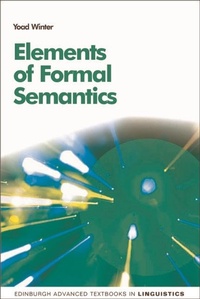
Elements of Formal Semantics
Description

Introduces the essential principles and techniques of formal semantics
In formal semantics, structure is treated as the essential ingredient in the creation of sentence meaning from individual word meaning. This book introduces some of the foundational concepts, principles and techniques in the formal semantics of natural language and outlines the mathematical principles that underlie linguistics meaning. Using English examples, Yoad Winter presents the most useful tools and concepts of formal semantics in an accessible style and includes a variety of practical exercises so that readers can learn to utilize these tools effectively. For readers with an elementary background in set theory and linguistics or with an interest in mathematical modelling, this fascinating study is an ideal introduction to natural language semantics. Designed as a quick yet thorough introduction to one of the most vibrant areas of research in modern linguistics today this volume reveals the beauty and elegance of the mathematical study of meaning.
- An ideal introduction to natural language semantics
- Includes a wide range of concrete English examples
- Accessible style is aimed at students developing knowledge of formal semantics
More details
Other editions
Additional editions

Content
- Cover
- Series List
- Title Page
- Copyright
- Contents
- Acknowledgements
- Notations
- Abbreviations
- 1 Introduction
- Aims and organization of this book
- On the exercises in this book
- Who is this book for?
- Presupposed background
- For the instructo
- Further reading, exercises, solutions
- 2 Meaning and Form
- Entailment
- Models and the Truth-Conditionality Criterion
- Arbitrary and constant denotations
- Analyzing an entailment
- Direct compositionality
- Structural ambiguity
- Further reading, exercises, solutions
- 3 Types and Meaning Composition
- Part 1: Types and Domains
- Part 2: Denotations atWork
- Part 3: Using Lambda Notation
- Part 4: Restricting Denotations
- Further reading, exercises, solutions
- 4 Quantified Noun Phrases
- Generalized quantifiers and the denotation of quantified NPs
- Looking at generalized quantifiers in models
- Quantifier monotonicity
- Quantified NPs and verb phrase coordination
- Determiner expressions
- A note on monotonicity and negative polarity items
- More entailments, and determiner conservativity
- Coordination of quantified NPs
- Proper names and generalized quantifiers
- Further reading, exercises, solutions
- 5 Long-Distance Meaning Relationships
- Clauses with multiple noun phrases
- Hypothetical reasoning and the Lambek-Van Benthem Calculus
- Linguistic signs and Abstract Categorial Grammar
- Using signs
- Further reading, exercises, solutions
- 6 Intensionality and PossibleWorlds
- Puzzles about intensional expressions
- Extensions, intensions and possible worlds
- Intensionality and grammar architecture
- De dicto/de re interpretations and scope ambiguity
- Further reading, exercises, solutions
- 7 Conclusion and Further Topics
- Recapitulation
- Where to go from here?
- More topics and readings in formal semantics
- Appendix to Chapter 3
- Bibliography
- Index
