

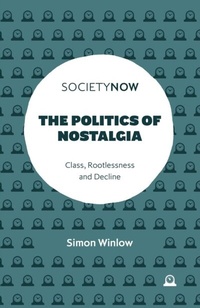
The Politics of Nostalgia
Class, Rootlessness and Decline
1st Edition
Published on 18. February 2025
208 pages
978-1-83753-548-4 (ISBN)
Description

For ordinary people today, the future seems dark and forbidding. In generations gone by, parents looked forward with optimism, confident their children would do better. Not anymore. Standards of living continue to fall. Our institutions seem redundant, our cities dilapidated and dysfunctional. Electoral systems seem incapable of driving positive change. What is there to be optimistic about?
A multiplicity of escalating pressures and a growing fear of the future encourage people to look to the past to identify something positive, and the bittersweet sting of nostalgia now plays a key role in working-class politics and community life. But how should we understand our increasingly common retreat into nostalgia?
In this sweeping ethnography, Simon Winlow explores our common desire to take refuge in the past, and what it means for our political future.
A multiplicity of escalating pressures and a growing fear of the future encourage people to look to the past to identify something positive, and the bittersweet sting of nostalgia now plays a key role in working-class politics and community life. But how should we understand our increasingly common retreat into nostalgia?
In this sweeping ethnography, Simon Winlow explores our common desire to take refuge in the past, and what it means for our political future.
Reviews / Votes
In The Politics of Nostalgia, Winlow takes us out onto the streets of our forgotten towns and cities to reveal lives destabilised by economic insecurity and high-paced cultural change. In these places, nostalgia is reshaping the political views of ordinary people, but not in the ways we tend to assume. This is a daring analysis of a nation tumbling downwards, a nation in which more and more people see only dark days ahead... The Politics of Nostalgia runs contrary to so much mainstream analysis of contemporary Britain, and it will be awkward reading for many who would prefer to look away from the reality of our nation today. Nonetheless, it offers an essential examination of where we are now, and where we appear to be going... It's also a reminder that a much better Britain existed in the near past, and, with sufficient public investment, a better future is possible. Having given away our resources and past to those with no interest in Britain, the state needs to get us our resources in order to give us back our future. -- Matthew Johnson, Professor of Public Policy and Chair of the Common Sense Policy Group This is an outstanding ethnographic study of a crucial social and political issue. For the first time in living memory, huge numbers of people believe the future will be qualitatively worse than the present. The data is sad but revelatory. Winlow's analysis is full of pathos and insight, with occasional bursts of anger at the refusal of our political elites to cast off the shackles of neoliberalism and reassert our commitment to the common good... Utterly compelling reading! -- James Treadwell, Professor of Criminology, Staffordshire University The Politics of Nostalgia is a boundary-redefining ethnographic analysis of the rootlessness and decline overwhelming Britain today. In focusing on the sentiments of those who feel increasingly lost in today's fast-paced society, and their nostalgic attachment to a world that once made sense, Simon Winlow offers a crucial understanding of our current political conjuncture. Essential reading. -- Anthony Lloyd, Professor of Sociology, Teesside University Simon Winlow has long been the outstanding criminologist working in Britain and The Politics of Nostalgia enhances his already stellar reputation. Beautifully written and sensitively researched, it returns to one of his enduring themes - how class remains the best means of illuminating what is hidden in contemporary British society and why looking back provides solace, reassurance and a powerful sense of self-narration. -- David Wilson, Emeritus Professor of Criminology, Birmingham City UniversityMore details
Series
Language
English
Place of publication
Bingley
United Kingdom
Target group
Professional and scholarly
ISBN-13
978-1-83753-548-4 (9781837535484)
Copyright in bibliographic data and cover images is held by Nielsen Book Services Limited or by the publishers or by their respective licensors: all rights reserved.
Schweitzer Classification
Person
Simon Winlow is Professor of Social Sciences at Northumbria University, UK. An internationally recognized criminologist and sociologist, he is one of the left's most original thinkers and a key commentator on British politics and culture.
Content
Introduction: Falling
Chapter 1. The New Politics of Nostalgia
Chapter 2. Fearing the Future
Chapter 3. Lost Roots
Chapter 4. Beyond Modernism
Chapter 5. Permanent Reform
Chapter 6. Intimations of Post-Sociality
Chapter 7. Towards a Better Future
Chapter 1. The New Politics of Nostalgia
Chapter 2. Fearing the Future
Chapter 3. Lost Roots
Chapter 4. Beyond Modernism
Chapter 5. Permanent Reform
Chapter 6. Intimations of Post-Sociality
Chapter 7. Towards a Better Future
