

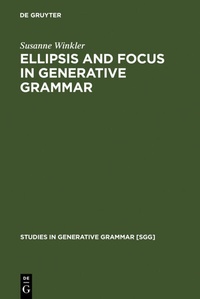
Ellipsis and Focus in Generative Grammar
Description

Covering linguistic research on empty categories over more than three decades, this monograph presents the result of an in-depth syntactic and focus-theoretical investigation of ellipsis in generative grammar. The phenomenon of ellipsis most generally refers to the omission of linguistic material, structure and sound. The central aim of this book is to explain on the basis of linguistic theorizing of how it is possible that we understand more than we actually hear. The answer developed throughout this book is that ellipsis is an interface phenomenon which can only be explained on the basis of the complex interaction between syntax, semantics and information structure. Scholars of grammar and cognitive scientists will profit from reading this book.
More details
Other editions
Additional editions
Person
Content
- Intro
- Prologue
- Chapter 1: Ellipsis and focus: An introduction
- 1. Introduction
- 2. The derivational model
- 3. The syntax-semantics interface
- 3.1. The cyclic derivation of surface semantic interpretation
- 3.2. The double-cycle information structure hypothesis
- 3.3. Information focus and contrastive focus: A derivational approach
- 4. The hybrid focus analysis of ellipsis
- 5. Conclusion
- 6. Distinguishing sentence-bound and discourse-bound ellipsis: A preview
- Chapter 2: Ellipsis at the interfaces: A proposal
- 1. Introduction
- 2. Deletion vs. deaccentuation
- 2.1. Previous accounts
- 2.2. The parallel computation account
- 3. The pragmatics-PF interface
- 3.1. Anaphoricity and the traditional notion of givenness
- 3.2. Schwarzschild's proposal: The notion of GIVENness
- 3.3. Objections
- 3.4. E-GIVENness and VP-/IP-ellipsis
- 3.5. Contrastivity and VP-ellipsis
- 4. The syntax-phonology interface
- 4.1. The derivation of intonation by phase
- 4.2. The derivation of ellipsis by phase
- 5. Conclusion
- Chapter 3: VP-anaphora and ellipsis of VP in English and German
- 1. Introduction
- 1.1. In search of VP -ellipsis in German
- 1.2. Roadmap
- 2. The representation of ellipsis
- 2.1. The proform hypothesis vs. the PF-deletion hypothesis
- 2.2. VP-ellipsis: Arguments for an empty proform account
- 2.3. German VPA patterns with English VPE
- 2.4. Evidence from English for the derivational account of VPE
- 3. German auch-ellipsis
- 3.1. Ellipsis of VP in German
- 3.2. Auch-ellipsis is a case of contrastive remnant ellipsis or stripping
- 3.3. A sideward movement account of contrastive remnant ellipsis
- 3.4. Contrastive remnant ellipsis and the syntax-phonology interface
- 4. Conclusion
- Chapter 4: Gapping: A sideward movement account
- 1. Introduction
- 2. The syntax of gapping
- 2.1. Deletion vs. ATB-movement accounts
- 2.2. The proposal: Gapping as sideward movement of vP
- 3. Evidence for the sideward movement account
- 3.1. The information structure of gapping: Paired contrastive remnants
- 3.2. Scope facts as evidence for vP coordination
- 3.3. Intonational evidence for vP coordination
- 3.4. Evidence for an A'-position in vP
- Chapter 5: Conclusion and final remarks
- 1. The informational structural proposal for ellipsis
- 2. Challenges for further research
- 3. Closing remark: Or a note on Wittgenstein's problem
- Notes
- References
- Subject Index
- Author Index
