

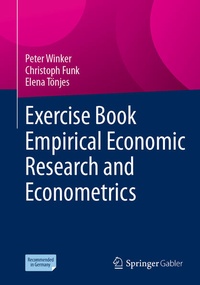
Exercise Book Empirical Economic Research and Econometrics
Description

This exercise book is aimed at students and teachers of economics and related subjects. It offers the opportunity to deepen skills in important methods of applied economic research and econometrics by solving different types of exercises. The book offers exercises in the areas of data, economic indicators, input-output analysis, econometric methods, trend and seasonal adjustment, simulation, and forecasting. The exercises cover both formal basics and the application of methods and interpretation of the results obtained. Other exercises draw on specific applications from the literature. The mix of rather elementary questions, illustrative applications, and examples on topics relevant to practice make the exercise book particularly clear and interesting.
More details
Other editions
Additional editions
Persons
Prof. Dr. Peter Winker has been teaching statistics and econometrics at Justus Liebig University Giessen since 2006. His research focuses on various areas of applied economic research as well as computationally intensive methods in econometrics and statistics.
Dr. Christoph Funk has been working at the Center for International Development and Environmental Research (ZEU) at Justus Liebig University Giessen since 2020. His areas of interest and research include monitoring the UN Sustainable Development Goals (SDGs), the micro- and macro-level consequences of climate change, energy economics, and econometric modeling in general.
Elena Tönjes has been a research assistant at the Chair of Statistics and Econometrics at Justus Liebig University Giessen since 2020. Her research focuses on text mining-based analyses in the field of economics.
Content
Part I: Exercises .- Chapter 1. Multiple choice questions.- Chapter 2. Exercises.- Chapter 3. Text-related exercises.- Part II. Solutions. Chapter 4. Solutions for multiple choice questions.- Chapter 5. Solutions for selected exercises.- Chapter 6. Learning from the Pandemic: Summary and Outlook.
