

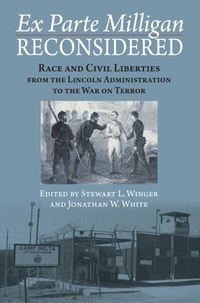
Ex Parte Milligan Reconsidered
Description

At the very end of the Civil War, a military court convicted Lambdin P. Milligan and his coconspirators in Indiana of fomenting a general insurrection and sentenced them to hang. On appeal, in Ex parte Milligan the US Supreme Court sided with the conspirators, ruling that it was unconstitutional to try American citizens in military tribunals when civilian courts were open and functioning-as they were in Indiana. Far from being a relic of the Civil War, the landmark 1866 decision has surprising relevance in our day, as this volume makes clear. Cited in four Supreme Court decisions arising from the wars in Afghanistan and Iraq, Ex parte Milligan speaks to constitutional questions raised by the war on terror; but more than that, the authors of Ex parte Milligan Reconsidered contend, the case affords an opportunity to reevaluate the history of wartime civil liberties from the Civil War era to our own.
After the Civil War, critics of Reconstruction pointed to Milligan as an example of the Republican Party's abuse of federal power; even historians sympathetic to Lincoln have found it necessary to apologize for his administration's record on civil liberties during the Civil War. However, the authors of this volume argue that this distorts the nineteenth-century understanding of the Bill of Rights, neglects international law entirely, and, equally striking, ignores the experience of African Americans. In reviving Milligan, the Supreme Court has implicitly cast Reconstruction as a ?war on terror? in which terrorist insurgencies threatened and eventually halted the assertion of black freedom by the Republican Party, the Union Army, and African Americans themselves. Returning African Americans to the center of the story, and recognizing that Lincoln and Republicans were often forced to restrict white civil liberties in order to establish black civil rights and liberties, Ex parte Milligan Reconsidered suggests an entirely different account of wartime civil liberties, one with profound implications for US racial history and constitutional law in today's war on terror.
All prices
More details
Other editions
Additional editions
Content
List of Illustrations
Foreword, Laura F. Edwards
Acknowledgments
Introduction: Ex Parte Milligan at 150?The Constitution and Military Commissions in American Wars on Terror, Stewart L. Winger
Part 1. The Meaning of Martial Law
1. Benjamin F. Butler, Ex Parte Milligan, and the Unending Civil War, Brian Matthew Jordan
2. Martial Law and the Expansion of Civil Liberties during the Civil War, Jonathan W. White
3. The Janus-Faced Character of Martial Law in the American Civil War, or the Strange Case of Lieutenant Alanson L. Sanborn and Dr. David M. Wright, Mark S. Schantz
Part 2. The Copperheads of the Middle West
4. Race, Class, and Copperheadism: The Localist Foundations of Dissent in the Civil War's Middle Border, Christopher Phillips
5. ?The State Was Honeycombed with Secret Societies?: Governor Oliver P. Morton and the Copperheads in Indiana, A. James Fuller
6. ?These Scoundrels Stand in No Fear of the Civil Courts: They Do, of the Military?: The Decision to Use Military Commissions to Try the Indiana Conspirators in 1864, Stephen E. Towne
Part 3. The Milligan Decision
7. Ex Parte Milligan in Context and History: David Davis and the Constitutional Politics and Law of Civil Liberty, Michael Les Benedict
8. To Leave Behind the Law of Force: Salmon Chase and the Civil War Era, Michael Haggerty
9. The Least Naive Position: The Lincoln Administration and International Law in American Wars on Terror, Stewart L. Winger
Part 4. The Precedential Power of Milligan
10. Ex Parte Milligan in the State Courts: Madison Y. Johnson's Vindication in Illinois, John A. Lupton
11. Ex Parte Milligan in Context and History: From Reconstruction to the War on Terror, Michael Les Benedict
12. Ex Parte Milligan and the War on Terrorism: Testing the Constitutional Bedrock of a Civilian Criminal Trial, Jonathan Hafetz
List of Contributors
Index

