

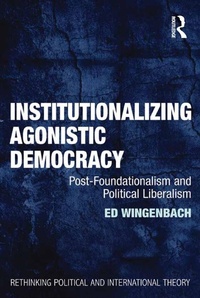
Institutionalizing Agonistic Democracy
Post-Foundationalism and Political Liberalism
Published on 23. May 2016
238 pages
978-1-317-11572-4 (ISBN)
Description

The first book length study of agonism as a mature account of democratic politics, Institutionalizing Agonistic Democracy provides a lucid overview of agonistic democratic theories and demonstrates the viability of this approach for institutional politics. Situating agonistic democracy within and against debates about radical democracy, foundationalism, liberal democracy, and pluralism, Institutionalizing Agonistic Democracy engages the texts of Mouffe, Connolly, Ranciere, Tully, Honig, Owen, and others to fully map the contours of agonistic democratic theories. Organizing this diverse literature into a coherent typology enables sophisticated analysis of the assumptions, distinctions, and aspirations of the often conflicting theoretical positions gathered within the constellation of agonistic democratic theory. Using this framework to explore the concrete institutional possibilities appropriate to agonistic democracy, Wingenbach argues that a modified version of Rawlsian political liberalism describes the institutional conditions most likely to sustain agonistic political practices. Once shorn of metaphysical commitments and detached from aspirations to consensus, political liberalism offers a contingent and historically viable framework within which agonistic contestation can occur. Such a reinterpretation of Rawls produces not the sublimation of agonism but a transformation of liberalism, so that it more adequately accommodates the deep pluralism of the post-foundational condition.
Reviews / Votes
'Overall, Wingenbach's work is a passionate and thoughtful defense of agonistic democracy and its need to be institutionalized. Against those who claim that agonistic thought provides little foundation for positive political formulations, Wingenbach carefully and with great skill develops an agonistic liberalism that is faithful to agonistic philosophy and political liberalism. The first half of the work provides an accessible and rich analysis of the various strands of agonistic thought. Then, Wingenbach develops an innovative and compelling version of agonistic liberalism that will appeal to those seeking to develop a post-foundational political thought on the principles of agonistic philosophy or its close relatives, postmodernism and postcolonialism. In so doing, Wingenbach offers a clear and convincing response to those critics of agonism who claim that its Achilles heel is that it provides little or no guidance for creating political institutions.' William Paul Simmons, Arizona State University, USA 'Wingenbach reads agonistic democracy soberly and pragmatically; he reads Rawls radically. This leads him to the counterintuitive yet pathbreaking conclusion that only political liberalism can provide safe harbor for the principles and ethos of agonistic democracy. This book may please neither Rawlsians nor radical democrats, yet it will show both that the future of democracy lies in the formation of democratic institutions that foster agonism.' Samuel A. Chambers, Johns Hopkins University, USA 'Wingenbach artfully develops the institutional framework of agonistic pluralism.? Given the agonistic commitment to exposing and contesting the inevitable violence, exclusions and remainders of forms of political order, this is no easy task. Closely engaged with a broad range of contemporary democratic theory, this book brings agonistic and post-structuralist theory "into the fold" of liberal theory and political science research on institutions, offering a timeMore details
Series
Language
English
Place of publication
London
United Kingdom
Publishing group
Taylor & Francis Ltd
Target group
College/higher education
File size
3,35 MB
ISBN-13
978-1-317-11572-4 (9781317115724)
Copyright in bibliographic data and cover images is held by Nielsen Book Services Limited or by the publishers or by their respective licensors: all rights reserved.
Schweitzer Classification
Other editions
Additional editions
Book
09/2011
1st Edition
Routledge
€206.40
Shipment within 10-20 days
Person
Ed Wingenbach is Interim Associate Vice-President of Academic Affairs at the University of Redlands, USA. His research interests include contemporary political theory, democratic theory, Heidegger, and the scholarship of teaching and learning. He has published articles and chapters on a range of topics in some of the top journals in his fields, including the American Journal of Political Science, the Journal of Politics, and International Philosophical Quarterly. He has received repeated recognition for excellence in his teaching, including awards at Notre Dame and the University of South Carolina, and a nomination for Professor of the Year at the University of Redlands. In 2006 he received the University of Redlands Award for Outstanding Service.
Content
Preface; Introduction; Part I Post-Foundationalism and Agonistic Democratic Theory; Chapter 1 Post-Foundational Politics and Democracy; Chapter 2 Agonism and Democracy; Chapter 3 A Typology of Agonistic Democracy; Chapter 4 Agonistic Democracy and the Question of Institutions; Part II Evaluating the Institutional Possibilities for Agonistic Democracy; Chapter 5 Agonistic Democracy and the Limits of Popular Part icipation; Chapter 6 Populism, Representation, and the Popular Will; Chapter 7 Political Liberalism, Contingency, and Agonistic Pluralism; Chapter 8 Liberalism, Agonism, and Democracy;
