

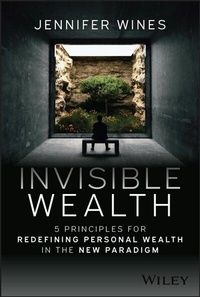
Invisible Wealth
Description

In Invisible Wealth: 5 Principles for Redefining Personal Wealth in the New Paradigm, certified wealth management advisor and entrepreneur, Jennifer Wines, delivers an insightful exploration into reimagining and redefining wealth. This book explores the technological advancements and societal shifts that have us considering everything from digital assets to digital community, all of which are organized around values. This new paradigm places a premium on intangible, or invisible, assets represented by 5 principles--money, health, knowledge, time, and relationships--each of which is attainable through your own personal, renewable resources. This paradigm shift takes on a more holistic and personalized approach to defining wealth.
In this book, you'll discover:
* How to use the personal wealth algorithm to identify your values, and wealth goals.
* How to optimize your most valuable asset, your time.
* How technology can support your wealth and well-being.
Offering pragmatic and philosophical considerations for redefining what's truly important to you, Invisible Wealth belongs in the hands of anyone seeking a rich life.
It's time to reimagine and redefine what wealth means to you.
More details
Other editions
Additional editions
Person
Content
Preface
Chapter 1: Defining and Redefining Wealth
Chapter 2: A Rich Opportunity for the Unluckiest Generation
Chapter 3: We Can't Put the Genie Back in the Bottle
PART II
Chapter 4: The 5 Principles of Invisible Wealth
Chapter 5: The Wealth of Money and Investment
Chapter 6: The Wealth of Health and Quality of Life
Chapter 7: The Wealth of Knowledge, Status, and Influence
Chapter 8: The Wealth of Time, Energy, and Experiences
Chapter 9: The Wealth of Relationships with Self and Others
PART III
Chapter 10: Personal Wealth Algorithm
Chapter 11: Personal, Renewable Resources
About the Author
Index
Chapter 1
Defining and Redefining Wealth
We are shifting into a new wealth paradigm that's inviting us to reimagine and redefine our definition and concept of wealth. The antiquated wealth narrative typically equates wealth to an abundance of money; we're wealthy when we have lots of money. We see this messaging everywhere, watercolor frog paintings included. And while there is an interconnected relationship between wealth and money, now is the time to revisit the premise that they are merely one and the same. But before we can redefine wealth, we must first define it. Additionally, by exploring the concept of wealth, we'll explore the relationship between wealth, money, and the economy. First, we'll take a look at how these three concepts are braided together; thereafter, we'll untie the braid and focus on each thread independently: What is wealth? What is money? and What is an economy?
The Relationship Between Wealth, Money, and the Economy
We're familiar with the idea that wealth equates to an abundance of money. The intertwined relationship between wealth and money has a lot to do with the advancements in our economies; the more efficient economies became, the more synonymous wealth and money became. An economy is a system where goods and services are produced, sold, and bought, within a country or region.1 The introduction and use of money within economies allowed economies to scale, thereby increasing the potential for (financial) wealth creation. Throughout this chapter, we'll unpack how and why economies became more advanced and efficient over time, thereby influencing the intertwined relationship between wealth and money.
What Is Wealth?
Let's start with a simple question: What is wealth?
Take a moment to answer this for yourself.
What came to mind?
Odds are, your mind went to one of two places: either that wealth is having lots of money, or a forced pause and ponder. Regardless of which fork in the (mental) road you went down, each response invites a deeper look into what wealth is.
First Principles Thinking
The best way to approach the question What is wealth? is through a critical thinking model called first principles thinking. This turn of phrase has gotten a lot of attention lately thanks to the likes of Elon Musk. Despite the recent attention of this phrase, first principles thinking has been around since the days of Aristotle, around 350 BC. Therefore, it is a tried-and-true methodology. This critical thinking model requires the breaking down of a concept, idea, or problem into its most fundamental parts. Per Aristotle, first principles thinking is "the first basis from which a thing is known."2 Per Elon Musk, "First principles is a physics way of looking at the world. You boil things down to the most fundamental truths and then reason up from there."3
From that, we can extrapolate that if we want to understand what wealth is, by definition, then a great place to start is with where the word came from-its etymology. Etymology is the study of the origin of a word, and how the meaning of a word changes over time. In other words, we are looking at the genesis of the word wealth. We can more fully appreciate the word wealth by understanding where the first basis (or instance) of the word was used (first principles). From there, we can explore how the meaning has changed over time, and the reasons for this evolutionary change. First principles thinking allows us to break down wealth into basic, etymological building blocks, to then reassemble it's meaning from the bottom up, within the context of today's world.
The Etymology of Wealth
Using the Online Etymology Dictionary, let's take a look at the origins of "wealth" as a noun:
Mid 13-c., "happiness," also "prosperity in abundance of possessions or riches," from Middle English wele "well-being" (see weal (n.1)) on analogy of health.4
Given the definition suggests we look at "weal," let's go ahead and do so here:
"well-being," Old English wela "wealth," in late Old English also "welfare, well-being," from West Germanic *welon-, from PIE root *wel- (2) "to wish, will" (see will (v)). Related to well (adv.)5
Next, here's what the etymology dictionary provides for the adjective "wealthy."
Late 14-c., "happy, prosperous," from wealth + -y (2). Meaning "rich, opulent" is from early 15-c. Noun meaning "wealthy persons collectively" is from late 14-c.6
Finally, here's a look at the etymology of "commonweal," given that we just saw a nod to collective wealth:
Mid 14-c., comen wele, "a commonwealth or its people;" mid-15c., comune wele, "the public good, the general welfare of a nation or community;" see common (adj.) + weal (n.1).7
Now let's string these etymological pearls of insight together. First things first, the word wealth came into our lexicon in the mid-thirteenth century, compliments of England; wealthy came next, followed by commonwealth. It's fascinating that wealth started out as a noun relating to the individual and then wealthy came into our lexicon as an adjective to describe an individual. Finally, the term expanded conceptual reach to that of the community in the mid-fifteenth century. Following this logic, we can deduce that wealth related to the individual first, and then to society as a whole second. This logic supports the premise that wealth originally started as an individualistic construct: personal wealth, thereby supporting community wealth.
Furthermore, the word wealth initially took on a more expansive definition in the mid-thirteenth century. Originally, wealth expanded into the realms of possessions, happiness, health, and well-being. It embodied a wider array of concepts, covering both the tangible and intangible aspects of wealth-a multidimensional definition; a totality of being. What's interesting is that the fundamental roots of the word related to health and well-being, more so than anything else. Over time, the definition and concept of wealth narrowed to our current wealth narrative, which suggests that wealth relates to money and material wealth, generally speaking.8 This is the antiquated wealth paradigm. This reflects the fact that over time-from the thirteenth century up through today-the relationship between wealth and money evolved, ultimately becoming tightly intertwined, nearly collapsing into one and the same.
This then begs the question: What is money?
"What can be added to the happiness of a man who is in health, out of debt, and has a clear conscience?"
-Adam Smith
What Is Money?
Money used to be a crisp (or not) green piece of paper we'd line our wallets with. Maybe you'd fold a $10 bill into a secret compartment within your wallet as a kid-for a rainy day. I remember having a multicolored, neon wallet with Velcro compartments, which I loved. I also remember the sound and feel of peeling the Velcro panels apart, granting access to my hard-earned money-money I earned from my after-school, 3.5-hour shift at Filene's department store in New Hampshire. My then-boyfriend would drive me 30 minutes to and from work, where I made less than $10 an hour, all to line my favorite neon wallet with.
Money is a tool used to transfer value within an economy, because it is an expression of value. Money has specific attributes that enable it to work within an economy. The functional attributes of money unlock the potential for an increasingly efficient economy. So long as these attributes (listed later) are satisfied, the monetary tool of popular choice can be used to transfer value across society. Consider this historical example: there was a time when cowry shells were considered money. Some of you may be scratching your head thinking, shells, really? And yes, it turns out cowry shells do embody the attributes necessary to function as money. Here are the three primary functions of money, plus the use case for cowry shells, in parallel:
- Store of Value: Money can be saved and used later because it retains its value over time-in perpetuity. Money retains its value over time because of its durable nature-meaning it doesn't rot, rust, or decay (which would otherwise diminish its value). Money also exists in finite supply (scarcity), preserving the integrity of its value.
Cowry shells retain their value over time because they are durable. In other words, cowry shells don't rot, rust, or decay. There is also a finite supply of cowry shells in the world.
- Unit of Account: Money must exist in small, standardized units for less valuable exchanges and aggregated together for more valuable exchanges. The units of account must be divisible, fungible, and measurable.
Cowry shells are standardized units that are divisible, fungible, and measurable, because of their consistently small size and shape. Each cowry shell can easily represent one unit of value, and can be...
