

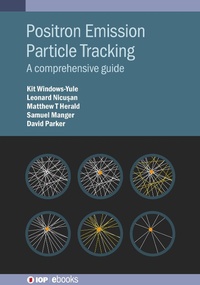
Positron Emission Particle Tracking
Description

Positron Emission Particle Tracking (PEPT) is a technique which allows the three-dimensional, internal dynamics of opaque systems - from industrial process equipment to the human body - to be imaged with high temporal and spatial resolution. In the three decades since its inception, the technique has helped us gain invaluable insight into the flow dynamics of particles and fluids in a variety of scientific and industrial systems and processes, from the blenders, mills and granulators used in the pharmaceutical, food and chemical industries, to waste plastic recycling systems, and even biological systems.
This book provides both an accessible introduction to, and a comprehensive reference guide for, the PEPT technique. The work provides detailed information regarding the technique, its underpinning principles and underlying physics, the detectors, tracers and algorithms which allow it to operate, and the extensive, discipline-spanning work which has been performed using it. The text is accompanied by detailed interactive examples and working pre- and post-processing codes which the reader can use not only to gain still deeper insight into how PEPT works, but to directly perform PEPT analysis using real data provided. It is aimed at masters students, PhD students and researchers for whom PEPT may be a valuable research tool.
More details
Other editions
Additional editions

Persons
Kit Windows-Yule is a Turing Fellow and two-time Royal Academy of Engineering Industrial Fellow, currently working as a Lecturer based in Positron Imaging Centre. He has used PEPT in diverse projects addressing various issues of contemporary importance, including waste plastic recycling, biofuels production, pharmaceutical secondary manufacture and the study of cardiovascular disease, in projects funded by EPSRC, the Royal Academy of Engineering, the Royal Society, InnovateUK and the British Heart Foundation.
Leonard Nicusan published the PEPT-ML algorithm; the paper was selected as a featured article and scientific highlight by IOP Publishing. He is the lead developer of the open-source PEPT Python library, unifying computational PEPT research, including tracking, simulation, post-processing and visualisation tools. He implemented all major PEPT algorithms to date as interactive Jupyter Notebooks in the present book.
Matthew T Herald is a PhD student at the University of Birmingham whose work focuses on applications of simulating PEPT using Monte Carlo radiation transport. His research includes validating the performance of detector models, optimising experimental parameters, benchmarking PEPT algorithms, and contributing to the development of new PEPT algorithms.
Samuel Manger is a Contributor to the construction of superPEPT and the Pept library at the University of Birmingham. He created a software implementation of the Pept-EM algorithm. Currently, Samuel is working at University of Manchester studying the interplay of patient motion and spot-scanned proton therapy treatment.
David Parker is the original co-inventor of the PEPT technique, winning the 2008 Institute of Physics Joule Medal 'for the creation of positron emission particle tracking as a practical tool in a wide variety of engineering applications'. He has over 30 years of experience developing the PEPT technique and applying it across an expansive range of disciplines and applications. David is the a leading expert on the PEPT technique.
Content
0 - Using the Book
Part I - Introduction and Background Knowledge
1 - Imaging Particulate and Multiphase Systems
2 - The Fundamentals of PEPT
3 - A History of PEPT
4 - Comparison with Other Techniques
Part II - The PEPT Technique in Detail
5 - Tracers and Detectors
6 - Pre-processing: PEPT data and algorithms
7 - Post-processing: extracting physical information from PEPT data
Part III - Applying the PEPT Technique
8 - Applications
9 - Future Outlook
10 - Accessing a PEPT Facility
11 - Appendices
12 - Glossary
