

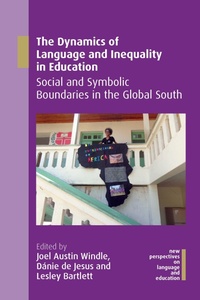
The Dynamics of Language and Inequality in Education
Social and Symbolic Boundaries in the Global South
Published on 13. February 2020
184 pages
978-1-78892-696-6 (ISBN)
Description

This book contributes new perspectives from the Global South on the ways in which linguistic and discursive boundaries shape inequalities in educational contexts, ranging from Amazonian missions to Mongolian universities. Through critical ethnographic and sociolinguistic analysis, the chapters explore how such boundaries contribute to the geopolitics of colonialism, capitalism and myriad, interwoven, forms of social life that structure both oppression and resistance. Boundaries are examined across time and space as relational constructs that mark the terms upon which admission to groups, institutions, territories, or practices are granted. The studies further present alternative educational approaches that demonstrate the potential for agency and transgression, highlighting moments of boundary crossing that disrupt existing linguistic ideologies, language policies and curriculum structures.
Reviews / Votes
The dividing practices of coloniality continue to affect our language ideologies, linguistic pedagogies, and the relative status of languages. Bound up with issues of access, power and identity, language is a complex terrain that learners and teachers in the political South navigate constantly. This volume provides insight into this complexity while presenting possibilities for thinking otherwise that embrace multiplicity, maintain diversity and hint at the transgressive. * Hilary Janks, University of the Witwatersrand, South Africa * Boundaries real and metaphoric unify this unique collection on the dynamics of language and inequality in settings less often voiced in mainstream publications. As these inspiring chapters show, boundaries can be imposed and/or concealed but also transgressed by informed and courageous language educators. * Brian Morgan, Glendon College, York University, Canada * Kipling's famous assertion "Oh, East is East, and West is West, and never the twain shall meet" has morphed under the influence of today's geopolitical climate into an all-out clash between the North and the South, but the fundamental premises of the divide remain intact. It is fuelled by the fear of the Other. Or rather, the need to reassure one of the integrity of one's own group by othering those that don't fit in. This collection of insightful papers delves into the genealogy of the tense standoff, its multifarious manifestations, and its abiding-almost visceral-persistence in the scheme of things. While pointing out the North's constant need to justify itself by hammering home its opposition to this Other, it also underscores how the South also plays a constitutive role in the very identity of the North. Finally, some of the contributors also look at how transgressive moves emanating from the South can muddy the waters and thereby thwart the North's ingeniously laid out plans to maintain the status quo. * Kanavilil Rajagopolan, University of Campinas, Brazil * This book abounds in in-depth and original reflections and ideas centered on the relationship between language and educational inequalities [...] it is a valuable and down-to-earth introduction for both novices and experts who want to explore sociolinguistic and sociocultural perspectives of language inequalities through education. -- Ying Wang and Fan Fang, Shantou University, China * System 107 (2022) * Through a strong theoretical and applied lens, the diverse array of experiences that this book draws upon makes it a valuable resource for advanced undergraduate or graduate courses in education, language teaching, and applied linguistics. -- Juan Jose Bueno Holle, Independent Researcher * LINGUIST List 32.898 *More details
Series
Language
English
Place of publication
Bristol
United Kingdom
Target group
College/higher education
Product notice
Reflowable
ISBN-13
978-1-78892-696-6 (9781788926966)
Copyright in bibliographic data and cover images is held by Nielsen Book Services Limited or by the publishers or by their respective licensors: all rights reserved.
Schweitzer Classification
Other editions
Additional editions
Joel Austin Windle | Danie de Jesus | Lesley Bartlett
The Dynamics of Language and Inequality in Education
Social and Symbolic Boundaries in the Global South
Book
02/2020
Multilingual Matters
€42.20
Shipment within 3-4 weeks
Persons
Joel Austin Windle is Professor of Modern Languages, Fluminense Federal University, Brazil and Adjunct Senior Research Fellow at Monash University, Australia. He is the author of Making Sense of School Choice (Palgrave, 2015, Winner of the Raewyn Connell and Stephen Crook prizes).
Danie de Jesus is Professor of English, Federal University of Mato Grosso, Brazil. He has edited volumes in Portuguese entitled Critical Perspectives on Language Teaching (Pontes, 2017) and Studies on Gender: Identities, Discourse and Education (Pontes, 2017).
Lesley Bartlett is Professor of Educational Policy Studies at the University of Wisconsin-Madison, USA. She is co-author (with Frances Vavrus) of Rethinking Case Study Research (Routledge, 2015) and co-editor (with Ameena Ghaffar-Kucher) of Refugees, Immigrants, and Education in the Global South: Lives in Motion (Routledge, 2012).
Danie de Jesus is Professor of English, Federal University of Mato Grosso, Brazil. He has edited volumes in Portuguese entitled Critical Perspectives on Language Teaching (Pontes, 2017) and Studies on Gender: Identities, Discourse and Education (Pontes, 2017).
Lesley Bartlett is Professor of Educational Policy Studies at the University of Wisconsin-Madison, USA. She is co-author (with Frances Vavrus) of Rethinking Case Study Research (Routledge, 2015) and co-editor (with Ameena Ghaffar-Kucher) of Refugees, Immigrants, and Education in the Global South: Lives in Motion (Routledge, 2012).
Content
Joel Windle, Danie de Jesus and Lesley Bartlett: Introduction: The Dynamics of Language and Inequality in Global Schooling
Section 1: The Shifting Boundaries of Linguistic Inequality
Chapter 1. Dennys Silva-Reis and Marcos Bagno: Across Linguistic Boundaries: Language as a Dimension of Power in the Colonization of the Brazilian Amazon
Chapter 2. Joel Windle and Kassandra Muniz: Navigating Soft and Hard Boundaries: Race and Educational Inequality at the Borderlands
Chapter 3. Daariimaa Marav: Rural-Urban Divides and Digital Literacy in Mongolian Higher Education
Section 2: Language, Ideology and Inequality
Chapter 4. Teresa Speciale: A Cycle of Shame: How Shaming Perpetuates Language Inequalities in Dakar, Senegal
Chapter 5. Indika Liyanage and Suresh Canagarajah: The Role of Shame in Drawing Social Boundaries for Empowerment: ELT in Kiribati
Chapter 6. Junia C. S. Mattos Zaidan: "Authenticity" and Symbolic Violence in Constructions of Teacher Competence
Chapter 7. Maria do Socorro Alencar Nunes Macedo, Daniele Alves Ribeiro, Euclides de Freitas Couto, and Andre Luan Nunes Macedo: Knowledge Politics, Language, and Inequality in Educational Publishing
Section 3: Transgression and Agency
Chapter 8. Carolyn McKinney: Decoloniality and language in education: Transgressing Language Boundaries in South Africa
Chapter 9. Danie de Jesus: Queering Literacy in Brazilian Higher Education: Questioning the Boundaries of the Normalized Body
Chapter 10. Osman Z. Barnawi and Phan Le-Ha: "Saudi Women Are Finally Allowed to Sit behind the Wheel": Initial Responses from TESOL Classrooms
Section 1: The Shifting Boundaries of Linguistic Inequality
Chapter 1. Dennys Silva-Reis and Marcos Bagno: Across Linguistic Boundaries: Language as a Dimension of Power in the Colonization of the Brazilian Amazon
Chapter 2. Joel Windle and Kassandra Muniz: Navigating Soft and Hard Boundaries: Race and Educational Inequality at the Borderlands
Chapter 3. Daariimaa Marav: Rural-Urban Divides and Digital Literacy in Mongolian Higher Education
Section 2: Language, Ideology and Inequality
Chapter 4. Teresa Speciale: A Cycle of Shame: How Shaming Perpetuates Language Inequalities in Dakar, Senegal
Chapter 5. Indika Liyanage and Suresh Canagarajah: The Role of Shame in Drawing Social Boundaries for Empowerment: ELT in Kiribati
Chapter 6. Junia C. S. Mattos Zaidan: "Authenticity" and Symbolic Violence in Constructions of Teacher Competence
Chapter 7. Maria do Socorro Alencar Nunes Macedo, Daniele Alves Ribeiro, Euclides de Freitas Couto, and Andre Luan Nunes Macedo: Knowledge Politics, Language, and Inequality in Educational Publishing
Section 3: Transgression and Agency
Chapter 8. Carolyn McKinney: Decoloniality and language in education: Transgressing Language Boundaries in South Africa
Chapter 9. Danie de Jesus: Queering Literacy in Brazilian Higher Education: Questioning the Boundaries of the Normalized Body
Chapter 10. Osman Z. Barnawi and Phan Le-Ha: "Saudi Women Are Finally Allowed to Sit behind the Wheel": Initial Responses from TESOL Classrooms
