

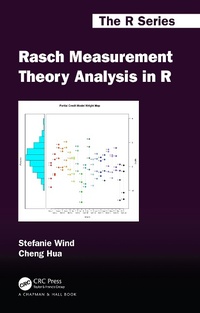
Rasch Measurement Theory Analysis in R
1st Edition
Published on 7. June 2022
322 pages
978-1-000-58776-0 (ISBN)
Description

Rasch Measurement Theory Analysis in R provides researchers and practitioners with a step-by-step guide for conducting Rasch measurement theory analyses using R. It includes theoretical introductions to major Rasch measurement principles and techniques, demonstrations of analyses using several R packages that contain Rasch measurement functions, and sample interpretations of results.
Features:
Accessible to users with relatively little experience with R programming
Reproducible data analysis examples that can be modified to accommodate users' own data
Accompanying e-book website with links to additional resources and R code updates as needed
Features dichotomous and polytomous (rating scale) Rasch models that can be applied to data from a wide range of disciplines
This book is designed for graduate students, researchers, and practitioners across the social, health, and behavioral sciences who have a basic familiarity with Rasch measurement theory and with R. Readers will learn how to use existing R packages to conduct a variety of analyses related to Rasch measurement theory, including evaluating data for adherence to measurement requirements, applying the dichotomous, Rating Scale, Partial Credit, and Many-Facet Rasch models, examining data for evidence of differential item functioning, and considering potential interpretations of results from such analyses.
Features:
Accessible to users with relatively little experience with R programming
Reproducible data analysis examples that can be modified to accommodate users' own data
Accompanying e-book website with links to additional resources and R code updates as needed
Features dichotomous and polytomous (rating scale) Rasch models that can be applied to data from a wide range of disciplines
This book is designed for graduate students, researchers, and practitioners across the social, health, and behavioral sciences who have a basic familiarity with Rasch measurement theory and with R. Readers will learn how to use existing R packages to conduct a variety of analyses related to Rasch measurement theory, including evaluating data for adherence to measurement requirements, applying the dichotomous, Rating Scale, Partial Credit, and Many-Facet Rasch models, examining data for evidence of differential item functioning, and considering potential interpretations of results from such analyses.
Reviews / Votes
Over 60 years ago, Georg Rasch introduced a fundamentally new way of viewing measurement theory into the social sciences. His approach to invariant measurement provides the opportunity to achieve sample-free calibration of items and item-free measurement of persons. His research remains the gold standard for developing psychometrically sound assessments. Stefanie A. Wind and Cheng Hua introduce Rasch's fundamental ideas to students, researchers, and practitioners using readily available software in R that facilitates the quest for invariant measurement. --George Engelhard, University of Georgia
More details
Series
Edition
1. Auflage
Language
English
Place of publication
London
United Kingdom
Publishing group
Taylor & Francis Ltd
Target group
College/higher education
Product notice
Reflowable
Illustrations
15 Tables, black and white; 87 Line drawings, black and white; 87 Illustrations, black and white
ISBN-13
978-1-000-58776-0 (9781000587760)
Copyright in bibliographic data and cover images is held by Nielsen Book Services Limited or by the publishers or by their respective licensors: all rights reserved.
Schweitzer Classification
Other editions
Additional editions
Stefanie Wind | Cheng Hua
Rasch Measurement Theory Analysis in R
Book
06/2022
1st Edition
Chapman & Hall/CRC
€96.20
Shipment within 15-20 days
Stefanie Wind | Cheng Hua
Rasch Measurement Theory Analysis in R
Book
06/2022
1st Edition
Chapman & Hall/CRC
€231.40
Shipment within 10-20 days
Persons
Stefanie A. Wind is an Associate Professor of Educational Measurement at the University of Alabama. Her primary research interests include the exploration of methodological issues in the field of educational measurement, with emphases on methods related to rater-mediated assessments, rating scales, Rasch models, item response theory models, and nonparametric item response theory, as well as applications of these methods to substantive areas related to education.
Cheng Hua is a Ph.D. candidate in Educational Measurement program at the University of Alabama. His primary research interests include Rasch Measurement theory, advanced regression models, Bayesian statistics, and visual learning tools (such as Mind Maps and Concept Maps). He enjoys applying his psychometric and statistical skills to address real-world research questions through interdisciplinary collaborations.
Cheng Hua is a Ph.D. candidate in Educational Measurement program at the University of Alabama. His primary research interests include Rasch Measurement theory, advanced regression models, Bayesian statistics, and visual learning tools (such as Mind Maps and Concept Maps). He enjoys applying his psychometric and statistical skills to address real-world research questions through interdisciplinary collaborations.
Content
1 Introduction 2 Dichotomous Rasch Model 3 Evaluating the Quality of Measures 4 Rating Scale Model 5 Partial Credit Model 6 Many Facet Rasch Model 7 Basics of Differential Item Functioning
