

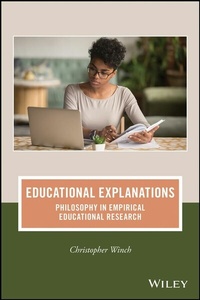
Educational Explanations
Description

Educational Explanations is a comprehensive study of the main philosophical questions that confront empirical educational researchers. The book outlines the sense in which empirical educational research pursues truth and sets out and defends an account of its task as the offering of explanations for the many educational problems that claim our attention. The book goes on to look at the criteria for high quality research, the relationship between different methodological approaches and the scope and limits of intervention studies. At all stages detailed examples are presented to make the argument clearer. A distinctive feature of the book is the presentation of four detailed case studies, over four chapters, of influential educational research programmes that not only examine what they have achieved, but emphasise the conceptual issues that researchers are confronted with as they seek to provide explanations. The book goes on to examine the impact of empirical educational research on educational practice and on the practice of teachers in particular.
CHRISTOPHER WINCH has taught in the primary, further and higher education sectors. Trained in Philosophy, he is also a qualified and experienced empirical researcher in Education. As well as writing on numerous topics in the Philosophy of Education, he has taken part in many research projects in Britain and Europe including the ongoing ESRC project 'Opportunity, Equality and Agency in England's new VET Landscape: a Longitudinal Study of Post-16 Transitions'.
More details
Other editions
Additional editions
Person
CHRISTOPHER WINCH has taught in the primary, further and higher education sectors. Trained in Philosophy, he is also a qualified and experienced empirical researcher in Education. As well as writing on numerous topics in the Philosophy of Education, he has taken part in many research projects in Britain and Europe including the ongoing ESRC project "Opportunity, Equality and Agency in England's new VET Landscape: a Longitudinal Study of Post-16 Transitions".
Content
Foreword vii
Preface xi
1 Introduction: What Is the Question? 1
2 A Criterial Conception of Truth and Objectivity: Its Relevance to Educational Research 21
3 Why Empirical Educational Research Needs to Be Taken Seriously 41
4 The Concept of an Educational Explanation and an Account of What Explanatory Adequacy Should Look Like 61
5 How Good Is Empirical Research - Disaster or Success? 81
6 Could Empirical Research-Based Knowledge Be Cumulative? 103
7 Converging Explanations: Quantitative and Qualitative Methods and How They Are Related 123
8 Intervention Studies, Experimental Methods and Evidence-Based Policy 141
9 Case Study 1: Bernsteinian Sociolinguistics 161
10 Case Study 2: The Comparative Study of Vocational Education 181
11 Case Study 3: School Effectiveness and Improvement Research 201
12 Case Study 4: Research on the Teaching of Reading Debate and on Dyslexia 219
13 Educational Faddism and How to (Possibly) Avoid It 239
14 How Philosophical and Empirical Research Can Work Together 259
15 Prospects for Empirical Educational Research and Its Future Relevance to Policy and Practice 275
References 293
Index 307
2
A Criterial Conception of Truth and Objectivity: Its Relevance to Educational Research
INTRODUCTION
Empirical educational research (EER) lies in the region of social science. As such, many of the problems and disputes concerning its aims, presuppositions and methods are held in common with the other social sciences. It is, however, distinctive in three ways. First, although there is a field of study, namely educational practices in all their variety, there is no distinctive educational methodology for investigating them. Typically EER uses a selection of sociological, economic, historical or psychological methods whenever they are thought to be appropriate. Second, philosophy has always been one of the central educational disciplines and, even if empirical researchers try to ignore the philosophical issues that arise in the interpretation of central educational concepts, those which structure our understanding of education (see Ch. 1), that does not mean that they go away. Finally, EER usually has a practical objective based loosely around the idea of improving an educational practice or educational performance. These three features make it distinctive among the social sciences. In what follows, some issues will be peculiar to education while others apply more generally to the social sciences.
One of the greatest challenges in outlining a systematic enquiry into human practices is to commit oneself to pursuit of the truth, not just in a quixotic sense, but in a way that is responsive to a set of demands that arise outside the opinions and desires of researchers; in other words, a set of demands that are objective rather than subjective. Failure to do this can lead one either into the pursuit of an impossible ideal of truth that can never be attained and thus lead to disillusionment and scepticism, or it can lead to an abandonment of the search for objectivity and a lapse into a validation of a more or less subjective view of what constitutes truth. In the following section, such an objective but non-absolutist view of the conception of truth proper to empirical educational enquiry will be set out. This is particularly important as the reality of different and often contesting perspectives on educational phenomena is such an important element in educational research and it needs to be acknowledged without surrendering to subjectivism, even in a disguised form. Subsequent to that, a suggestion for how to deal with the reality of multiple perspectives can be attained without a commitment to multiple realities.
OBJECTIVITY AND TRUTH CRITERIA
I maintain that EER should, and very often does, strive for objectivity, the claim that there are true or false propositions to be learned about educational practices whether or not anyone happens to believe them at any given time.1 This is a stronger claim than the claim that truth is constituted by intersubjective agreement about educational states of affairs. There can be false intersubjective agreement about such things. Rather, it is the claim that there are ways of determining truth and falsehood about educational matters which have deeper roots than what any body of researchers happen to think is the right way to do so at any given time. These roots lie in social practices of determining the truth or falsity of claims about educational practices and they in turn rest on criteria for truth and falsity. Truth conditions for such claims get their significance from the existence of such criteria. These criteria are embedded in practices of training, habituation, education, evaluation and judgement, which are more than intersubjective agreements: they have institutional foundations with their own set of practices embodying formal and informal rules for making distinctions between true and false propositions. They cannot be changed arbitrarily by any particular group of researchers, although they may change gradually over time. In this respect, educational research is no different from the other social sciences or indeed other truth-seeking practices. But we need to look at possible objections to this way of seeing things in order to appreciate its importance.
A criterial conception of truth is to be distinguished from correspondence accounts whereby a proposition is true if it corresponds in some way to a state of affairs (Ellenbogen 2003; Vision 2005). We might ask whether or not a proposition does correspond to a state of affairs and we would need some criterion for saying whether or not it did. A coherence account of truth would broadly claim that a proposition is true if it coheres with or perhaps is consistent with other propositions taken to be true, or better, if it belongs to a set which provides mutual explanatory support (Young 2018). While coherence accounts attempt to provide a sufficient account of what it is for a proposition to be true, this can only be the case if it is possible to advance satisfactory criteria for coherence and there is often substantial disagreement about what these are.
Pragmatism in its simplest form holds that truth (with some qualifications) is determined by utility (James 1907).2 , 3 This claim has obvious drawbacks and it is much more common for pragmatists to think of ascriptions of truth in relation to whole systems of belief and in particular to those fundamental propositions on which the truth conditions of less fundamental ones depend, but which are themselves subject to revision when our practical concerns appear to require it. Quine is sometimes thought to be a pragmatist in this sense (Quine 1951, see p. 43; Godfrey-Smith 2014). These are difficult to themselves justify empirically, as few or no propositions could count against them (Locke 1689), but which can in principle be overturned. Such propositions are, in principle, defeasible; however unlikely it may be, they can be trumped by experience (Quine 1951; Hacker 1996). Such propositions, however, differ from Wittgenstein's hinge or axis propositions which have a normative or quasi-normative status (Hacker 1996) in that they are, even if only in a somewhat extended sense, provisional in any given conceptual scheme. At the margins they may be discarded and the conceptual scheme modified, they have no special status except one of degree of defeasibility. Ultimately their status as truths rests upon the value that they have in upholding our more mundane truth-preserving practices.
The difference between this way of looking at truth and the criterial conception defended here is that truth criteria cannot be defeasible. It is a characteristic of criteria that they are decisive in determining whether a proposition or statement is true or false. If they were not, then we would need some other way of determining truth (Ellenbogen 2003). Criteria are objective in the sense that they hold independently of whether any group, authoritative or not, make judgements that are not in accord with them. But they do need to have general acceptance within a practice for that practice to be viable. The criteria for determining the truth of propositions may well vary from practice to practice. The criterion for determining the truth of whether or not a school building is of a certain age will differ from the criterion for determining whether or not a particular assessment practice is worth retaining, for example. So in practice both educational practices and research into those practices will depend on different criteria, a reflection of a broader diversity in criteria within assertoric practices more generally. In particular, it is the responsibility of educational researchers to adopt criteria which can deal with the largest possible range of possible defeaters of judgements. They also have a responsibility to take seriously and to try to understand the criteria for truth adopted by those whom they are researching.
Although truth criteria are objective because they are independent of the judgement of individuals and groups and are indefeasible, it is also the case that they are in principle and practice revisable. New criteria can be adopted and old ones abandoned as science and systematic enquiry progresses. The history of science is testament enough to the adoption of new and the abandonment of old truth criteria, as different techniques of measurement and their underlying rationale establish themselves. As Ellenbogen puts it, investigation can reveal that our criteria for what is true and for what is real may come apart at times. 'We should revise our picture of the meaning of "is true" as being independent of our current knowledge; this is a use which we should reserve for "is real"' (p. 116). Our picture of the meaning of 'is true' is a philosophical picture in which 'is true' and 'is real' tend to get conflated. Acknowledging this does not damage the objectivity of judgements made according to established criteria. All it does is to withdraw the implicit claim made by some philosophers that 'is true' is a contraction of 'is true for all time and in all circumstances' or the claim that 'is true' is equivalent to 'corresponds with reality'. If this expansion of 'is true' is accepted then little that we hold to be true would in fact count as such and the concept would have little use for us. What we rightly count as true now may not be counted as true later when judged according to different criteria. But we don't make the commitment that it should be, when we make an assertion. We make the assertion against the background of criteria that we take to be valid at the time.
One line of argument from a pragmatist...
