

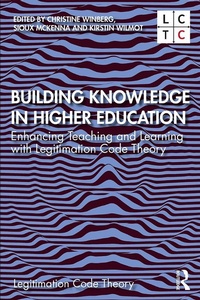
Building Knowledge in Higher Education
Enhancing Teaching and Learning with Legitimation Code Theory
1st Edition
Published on 27. May 2020
312 pages
978-1-000-07547-2 (ISBN)
Description

From pressures to become economically efficient to calls to act as an agent of progressive social change, higher education is facing a series of challenges. There is an urgent need for a rigorous and sophisticated research base to support the informed development of practices. Yet studies of educational practices in higher education remain theoretically underdeveloped and segmented by discipline and country. Building Knowledge in Higher Education illustrates how Legitimation Code Theory is bringing research together from across the disciplinary map and enabling practical change in a rigorously theorized way.
The volume addresses both students and educators. Part I explores ways of supporting student achievement from STEM to the arts, from introductory courses to doctoral training, and from using new digital media to reflective writing. Part II focuses on academic staff development in higher education, reaching from curriculum design to pedagogic practices. All chapters focus on issues of contemporary relevance to higher education, showing how Legitimation Code Theory enables these issues to be understood and practices improved.
Building Knowledge in Higher Education brings together internationally renowned scholars in higher education studies, academic development, academic literacies, and sociology, with some of the brightest new researchers. The volume significantly extends understandings of teaching and learning in changing higher education contexts and so contributes to educational research and practice. It will be essential reading not only to scholars and students in these fields but also to scholars and educators in higher education more generally.
The volume addresses both students and educators. Part I explores ways of supporting student achievement from STEM to the arts, from introductory courses to doctoral training, and from using new digital media to reflective writing. Part II focuses on academic staff development in higher education, reaching from curriculum design to pedagogic practices. All chapters focus on issues of contemporary relevance to higher education, showing how Legitimation Code Theory enables these issues to be understood and practices improved.
Building Knowledge in Higher Education brings together internationally renowned scholars in higher education studies, academic development, academic literacies, and sociology, with some of the brightest new researchers. The volume significantly extends understandings of teaching and learning in changing higher education contexts and so contributes to educational research and practice. It will be essential reading not only to scholars and students in these fields but also to scholars and educators in higher education more generally.
More details
Series
Edition
1. Auflage
Language
English
Place of publication
London
United Kingdom
Publishing group
Taylor & Francis Ltd
Target group
College/higher education
Illustrations
25 Tables, black and white; 65 Line drawings, black and white; 15 Halftones, black and white; 80 Illustrations, black and white
ISBN-13
978-1-000-07547-2 (9781000075472)
Copyright in bibliographic data and cover images is held by Nielsen Book Services Limited or by the publishers or by their respective licensors: all rights reserved.
Schweitzer Classification
Other editions
Additional editions
Christine Winberg | Sioux McKenna | Kirstin Wilmot
Building Knowledge in Higher Education
Enhancing Teaching and Learning with Legitimation Code Theory
Book
07/2020
1st Edition
Routledge
€60.70
Shipment within 15-20 days
Christine Winberg | Sioux McKenna | Kirstin Wilmot
Building Knowledge in Higher Education
Enhancing Teaching and Learning with Legitimation Code Theory
Book
07/2020
1st Edition
Routledge
€206.90
Shipment within 15-20 days
Building Knowledge in Higher Education
Enhancing Teaching and Learning with Legitimation Code Theory
Book
06/2020
Routledge
Unfortunately, price unknown
Available (delivery time upon request)
Persons
Christine Winberg is a leading scholar in work-integrated learning, in which she holds a South African Research Chair.
Sioux McKenna is a renowned scholar in higher education studies.
Kirstin Wilmot is an emerging scholar in the field of doctoral education.
All three are associate members of the LCT Centre for Knowledge-Building.
Sioux McKenna is a renowned scholar in higher education studies.
Kirstin Wilmot is an emerging scholar in the field of doctoral education.
All three are associate members of the LCT Centre for Knowledge-Building.
Content
List of Figures and Tables; Notes on Contributors; Chapter 1. 'Nothing So Practical as Good Theory': Legitimation Code Theory in Higher Education; Part I: Student Learning Across the Disciplinary Map Chapter 2. Demystifying Reflective Writing in Teacher Education with Semantic Gravity Chapter 3. Making Waves in Teacher Education: Scaffolding Students' Disciplinary Understandings by 'Doing' Analysis Chapter 4. New Assessment Forms in Higher Education: A Study of Student Generated Digital Media Products in The Health Sciences Chapter 5. Misalignments in Assessments: Using Semantics to Reveal Weaknesses Chapter 6. Supporting the Academic Success of Students Through Making Knowledge-Building Visible Chapter 7. (Un)Critical Reflection: Uncovering Disciplinary Values in Social Work and Business Reflective Writing Assignments Chapter 8. Learning How to Theorize in Doctoral Writing: A Tool for Teaching and Learning; Part II: Professional Learning in Higher Education Chapter 9. Changing Curriculum and Teaching Practice: A Practical Theory for Academic Staff Development Chapter 10. A Semantics Analysis of First Year Physics Teaching: Developing Students' Use of Representations in Problem-Solving Chapter 11. From Principle to Practice: Enabling Theory-Practice Bridging in Engineering Education Chapter 12. Building the Knowledge Base of Blended Learning: Implications for Educational Technology and Academic Development Chapter 13. Legitimate Participation in Program Renewal: The Role of Academic Development Units Chapter 14. Decolonizing the Science Curriculum: When Good Intentions are Not Enough Chapter 15. The Role of Assessment in Preparing Academic Developers for Professional Practice Chapter 16. Academic Development: Autonomy Pathways Towards Gaining Legitimacy
