

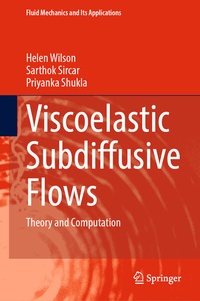
Viscoelastic Subdiffusive Flows
Description

This book discusses the dynamical and rheological properties of high molecular weight entangled polymer melts, commonly known as viscoelastic subdiffusive fluids. Unlike dilute liquids, these materials exhibit molecular transport within a sublinear regime, meaning the timescale of diffusive transport is sublinear. The text emphasizes the potential of fractional calculus in modeling these fluids and introduces a novel fractional model to investigate regions of spatiotemporal instability in channel flows. At the microscale, the entanglement of polymer chains leads to localized, non-homogeneous regions with increased viscosity, which manifest as spatiotemporal macrostructures at the macroscale. To capture these macrostructures within the flow, direct numerical simulations are employed using a newly developed, physically realizable structure tensor, contributing to a deeper understanding of this complex class of fluids.
More details
Other editions
Additional editions
Persons
Helen Wilson is Full Professor of Applied Mathematics at the University College London, UK. Earlier, she worked as Lecturer at the University of Leeds, UK, in 2000; the President of the British Rheological Society (in 2015-2017); Vice-President of the Institute of Mathematics and its Applications (in 2019-2020); and Chair of the Scientific Steering Committee at the Issac Newton Institute at Cambridge. A Ph.D from the University of Cambridge, in 1998, her research spans mathematical aspects of complex fluid flows, from viscoelastic fluids to multi-phase materials, and from instabilities to constitutive modelling.
Sarthok Sircar is Associate Professor in the Division of Applied Mathematics at the Indraprastha Institute of Information Technology Delhi, New Delhi, India. Earlier, he was Research Scientist at the Center for Nanophase Material Science, Oak Ridge National Laboratory (2007); Research Fellow in the Division of Biomathematics, University of Utah (2009-2012); Research Associate at the Division of Applied Mathematics, University of Colorado, Boulder (2012-2014); and Lecturer at Adelaide University (2014-2016). His main research interests are in developing and analysing nonlinear hyperbolic and elliptic partial differential equations, with applications in the interface of applied mathematics and biology. He is particularly interested in solving problems involving soft matter and fluid flow using asymptotic and perturbation methods, numerical approximation and statistical mechanics.
Priyanka Shukla is Associate Professor in the Department of Mathematics at the Indian Institute of Technology Madras, Chennai, Tamil Nadu, India. She completed her Ph.D from JNCASR, Bengaluru (2011). Earlier, she worked as Assistant Professor in the Department of Mathematics at Indian Institute of Science Education and Research Kolkata (2011-2014), and BELSPO Research Fellow at Nonlinear Physical Chemistry Unit, Universite Libre de Bruxelles (2014-2015). Her research interests are in mathematical modeling of diverse physical phenomena, including hydrodynamic instabilities, granular patterns, geophysical wave interactions, chemo-hydrodynamics, vortex crystals and non-Newtonian flows.
Content
Introduction.- Preliminaries of Fractional Derivatives.- Spatiotemporal Linear Stability Analyses.- Macrostructure quantification via a Riemannian metric.- Rheodynamics of sub-diffusive channel flows.- Limitations and Future Directions.
