

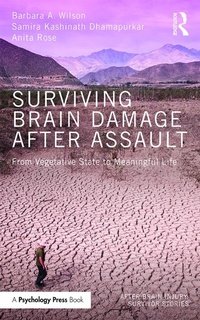
Surviving Brain Damage After Assault
From Vegetative State to Meaningful Life
Published on 2. February 2016
172 pages
978-1-317-58064-5 (ISBN)
Description

At the age of twenty eight Gary was assaulted by a gang with baseball bats and a hammer, resulting in several skull fractures and severe brain damage. For nineteen months he had little awareness of his surroundings before he started to show some recovery. This inspirational book documents his exceptional journey.
The book presents a series of interviews with Gary, his mother Wendie, who never gave up, the medical team who initially treated him, and the therapists who worked with him over a period of three years. Through their testimony we learn about the devastating effects which can follow a serious assault to the head, and the long process of recovery over several years. With specialist rehabilitation and continuing family support Gary has exceeded expectations and, apart from some minor physical problems, he is now a normal young man.
Surviving Brain Damage after Assault shows that, contrary to popular belief, considerable gains can be made by people who have experienced a long period of reduced consciousness. The book will be of great value to all professionals working in rehabilitation - psychologists, speech and language therapists, occupational therapists, social workers and rehabilitation doctors, and to people who have sustained a brain injury and their families.
The book presents a series of interviews with Gary, his mother Wendie, who never gave up, the medical team who initially treated him, and the therapists who worked with him over a period of three years. Through their testimony we learn about the devastating effects which can follow a serious assault to the head, and the long process of recovery over several years. With specialist rehabilitation and continuing family support Gary has exceeded expectations and, apart from some minor physical problems, he is now a normal young man.
Surviving Brain Damage after Assault shows that, contrary to popular belief, considerable gains can be made by people who have experienced a long period of reduced consciousness. The book will be of great value to all professionals working in rehabilitation - psychologists, speech and language therapists, occupational therapists, social workers and rehabilitation doctors, and to people who have sustained a brain injury and their families.
Reviews / Votes
This is a most valuable and detailed account of delayed, gradual and continuing recovery after a very severe traumatic brain injury. The authors' thoughtful and detailed discussion of the reasons for such unexpected and prolonged improvement will be crucially important in the planning of rehabilitation research and in developing health service provision. - Lindsay McLellan, Formerly Europe Professor of Rehabilitation, University of Southampton, UK and Medical Adviser to the Brain Injury GroupWilson, Dhamapurkar and Rose present a fascinating, thought provoking yet scientific account of late recovery from the Minimally Conscious State. This challenges the concept of 'cut-off' after which recovery is unlikely. Family and client perspectives enhance the account. This informative book will be of interest to all working with people with long term Disorders of Consciousness. - Agnes Shiel, Professor of Occupational Therapy, National University of Ireland, Galway, Ireland Wilson, Dhamapurkar and Rose present a fascinating, thought provoking yet scientific account of late recovery from the Minimally Conscious State. This challenges the concept of 'cut-off' after which recovery is unlikely. Family and client perspectives enhance the account. This informative book will be of interest to all working with people with long term Disorders of Consciousness. - Agnes Shiel, Professor of Occupational Therapy, National University of Ireland, Galway, Ireland
This is a most valuable and detailed account of delayed, gradual and continuing recovery after a very severe traumatic brain injury. The subject is a young man who has received excellent medical and surgical care and exemplary rehabilitation input from his family and the rehabilitation team involved over several years. The authors' thoughtful and detailed discussion of the reasons for such unexpected and prolonged improvement raise many questions.
This case is a further example of the fact that people's brains are potentially able to acquire new patterns of activity and responsiveness when they undergo intensive training and acquire new skills - not only in those who are healthy, but also (to a proportional degree) after severe damage to the brain has occurred. The time course of these changes in such patients after brain injury mirrors that of active skill acquisition in normal adults, rather than passive 'spontaneous' recovery from injury. It is crucially important that this principle is recognised, both in the planning of rehabilitation research and in health service provision, if the mechanisms involved are to be fully understood and optimal recovery from brain injury is to be achieved for all. - Lindsay McLellan, Formerly Europe Professor of Rehabilitation, University of Southampton, UK and Medical Adviser to the Brain Injury Group
More details
Series
Language
English
Place of publication
London
United Kingdom
Publishing group
Taylor & Francis Ltd
Target group
Professional and scholarly
Illustrations
11 s/w Abbildungen, 6 s/w Tabellen, 7 s/w Photographien bzw. Rasterbilder, 4 s/w Zeichnungen
6 Tables, black and white; 4 Line drawings, black and white; 7 Halftones, black and white; 11 Illustrations, black and white
File size
1,16 MB
ISBN-13
978-1-317-58064-5 (9781317580645)
Copyright in bibliographic data and cover images is held by Nielsen Book Services Limited or by the publishers or by their respective licensors: all rights reserved.
Schweitzer Classification
Other editions
Additional editions
Barbara A. Wilson | Samira Kashinath Dhamapurkar | Anita Rose
Surviving Brain Damage After Assault
From Vegetative State to Meaningful Life
Book
02/2016
1st Edition
Routledge
€241.10
Shipment within 10-20 days
Barbara A. Wilson | Samira Kashinath Dhamapurkar | Anita Rose
Surviving Brain Damage After Assault
From Vegetative State to Meaningful Life
Book
02/2016
1st Edition
Routledge
€52.40
Shipment within 10-20 days
Persons
Barbara A Wilson is a clinical neuropsychologist who has worked in brain injury rehabilitation for nearly 40 years. She has won many awards for her work including an OBE for services to rehabilitation and three lifetime achievement awards, one from the British Psychological Society, one from the International Neuropsychological Society and one from the National Academy of Neuropsychology. The Division of Neuropsychology has named a prize after her, "The Barbara A Wilson prize for distinguished contributions to neuropsychology." She is honorary professor at the University of Hong Kong, the University of Sydney and the University of East Anglia.
Samira Kashinath Dhamapurkar is an Occupational Therapist. Her special interest is in working with people in low awareness states. She worked in India at the Masina Hospital on a psychiatric/drug addiction unit and in a special school for autistic children before coming to the United Kingdom. For the past four years she has worked in the area of neurorehabilitation In addition to her clinical work, she is also involved in research involving people with disorders of consciousness.
Anita Rose is a Consultant Neuropsychologist. She works at the Raphael Medical Centre in Tonbridge and also works as an independent Consultant Neuropsychologist across the globe. She provides significant input in the field of multiple sclerosis via her clinical work, research publications, booklets and consultancy to the MS groups in the UK. She is Vice Chair for the European Neuropsychology Special Interest Group in MS, and acts as a clinical advisor to the MS Society in South Africa.
Samira Kashinath Dhamapurkar is an Occupational Therapist. Her special interest is in working with people in low awareness states. She worked in India at the Masina Hospital on a psychiatric/drug addiction unit and in a special school for autistic children before coming to the United Kingdom. For the past four years she has worked in the area of neurorehabilitation In addition to her clinical work, she is also involved in research involving people with disorders of consciousness.
Anita Rose is a Consultant Neuropsychologist. She works at the Raphael Medical Centre in Tonbridge and also works as an independent Consultant Neuropsychologist across the globe. She provides significant input in the field of multiple sclerosis via her clinical work, research publications, booklets and consultancy to the MS groups in the UK. She is Vice Chair for the European Neuropsychology Special Interest Group in MS, and acts as a clinical advisor to the MS Society in South Africa.
Content
1. Introduction to Brain Damage Part One 2. Introduction to Brain Damage Part Two 3. Imaging procedures in understanding brain injury 4. The assault: as described by Wendie, Gary's mum, and other members of the family 5. Early days in Hospital 6. Admission to the Raphael Medical Centre 7. Assessments While Gary was Vegetative and Minimally Conscious 8. Cranioplasty 9. Waking up 10. Rehabilitation Through Music Therapy (With a contribution from Melanie Cornell, Music Therapist) 11. Ongoing Rehabilitation 12. Home Evaluation 13. Gary today 14. Why did Gary do so well?
