

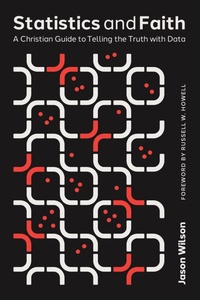
Statistics and Faith
Description

Bringing Integrity to the Stories Numbers Tell
When we tell stories with numbers, we depend on the field of statistics-but how do we know that those stories are true? Almost everything in life is connected to data, and thatdata can help us make sense of truth in a world that feels increasingly challenging to navigate as Christians.
But in a world where we are told to "do our own research," it can be nearly impossible to know whether we're just gravitating toward stories that confirm our own untested biases, or whether we're analyzing the data in a way that is illuminating truth.
Exploring a range of contemporary topics, professor of statistics Jason Wilson shows both non-experts and experts alike that statistics has something to say when it relates to the polarizing issues that we face today. Exploring topics such as gambling, Covid, and media bias, Wilson shows that the ways we collect, organize, analyze, and interpret data have something to say in conversation with the Christian faith.
In Statistics and Faith, you'll find
- examinations of contemporary issues using statistical concepts, tools, and theories;
- case studies from history that show how statistics can be used in ways that are helpful or harmful;
- application chapters based on over fifteen years of research; and
- reflection questions to help you explore how to do statistics with integrity.
This book is ideal for professors seeking to help students explore the history and application of statistics from a Christian worldview as well as for Christians who are curious about how we understand truth through numbers. It serves as an idealsupplementary text for statistics courses and other disciplines that incorporate statistical methods, and it offers an insightful perspective on how statistics in conversation with Christian faith can speak to today's polarizing issues, empowering readers to discern truth through data in a noisy world.
More details
Other editions
Additional editions
Person
Jason Wilson (PhD statistics, UC Riverside) is professor of statistics at Biola University where he oversees the statistics program and directs the Quantitative Consulting Center. He is the author of over twenty peer-reviewed journal articles andis a member of the American Statistical Association. He is the codeveloper of the Faith, Work and Money church integration survey and coinventor of the patented Quality of Pitch® MLB statistic. He loves spending time with family, mentoringstudents, reading, and practicing taekwondo. He and his wife, Natalie, have two daughters and live in the Los Angeles area.
Content
List of Figures and Tables Foreword by Russell W. Howell Preface Part 1-Foundations 1. On the History of Statistics 2. How to Assess Statistical Arguments Part 2-Applications 3. On Gambling 4. Probabilities of the Origin of Life, Prayer, and Fulfilled Prophecy 5. How to Lie (to Someone) with Statistics 6. Assessing Covid-19 Statistics 7. How to Lie (to Society) with Statistics 8. Statistics of the Bible Code 9. Conclusion Acknowledgments Glossary Figures and Tables Credits General Index Scripture Index
