
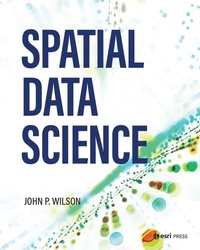
Spatial Data Science
Description
Alles über E-Books | Antworten auf Fragen rund um E-Books, Kopierschutz und Dateiformate finden Sie in unserem Info- & Hilfebereich.
Spatial Data Science will show GIS scientists and practitioners how to add and use new analytical methods from data science in their existing GIS platforms. By explaining how the spatial domain can provide many of the building blocks, it's critical for transforming data into information, knowledge, and solutions.
This book is for those using or studying GIS and the computer scientists, engineers, statisticians, and information and library scientists leading the development and deployment of data science.
All prices
More details
Other editions
Additional editions
Person
Dr. John P. Wilson
USC Professor and Founding Director
Spatial Sciences Institute
USC Dana and David Dornsife
College of Letters, Arts and Sciences
Professor, Departments of Civil & Environmental Engineering and Computer Science, Viterbi School of Engineering
Professor, Department of Population and Public Health Sciences, Keck School of Medicine of USC
Professor, Department of Sociology, Dornsife College of Letters, Arts and Sciences
Professor, USC School of Architecture
Editor, Transactions in GIS, Wiley-Blackwell
Editor, Geographic Information Science & Technology Body of Knowledge, University Consortium for Geographic Information Science
Fellow, University Consortium for Geographic Information Science (2014)
Fellow, American Association of Geographers (2021)
Content
Table of Contents
Introduction
Our Changing Planet
Role and Character of Geographic Information Science, Systems, and Services Today
Special Characteristics of Spatial Information
The Digital Era
The Opportunities Afforded by Spatial Data Science
Conclusions and Future Prospects

System requirements
File format: ePUB
Copy protection: Adobe-DRM (Digital Rights Management)
System requirements:
- Computer (Windows; MacOS X; Linux): Install the free reader Adobe Digital Editions prior to download (see eBook Help).
- Tablet/smartphone (Android; iOS): Install the free app Adobe Digital Editions or the app PocketBook before downloading (see eBook Help).
- E-reader: Bookeen, Kobo, Pocketbook, Sony, Tolino and many more (not Kindle).
The file format ePub works well for novels and non-fiction books – i.e., „flowing” text without complex layout. On an e-reader or smartphone, line and page breaks automatically adjust to fit the small displays.
This eBook uses Adobe-DRM, a „hard” copy protection. If the necessary requirements are not met, unfortunately you will not be able to open the eBook. You will therefore need to prepare your reading hardware before downloading.
Please note: We strongly recommend that you authorise using your personal Adobe ID after installation of any reading software.
For more information, see our ebook Help page.
File format: ePUB
Copy protection: Watermark-DRM (Digital Rights Management)
System requirements:
- Computer (Windows; MacOS X; Linux): Use a reading software that can process the file format ePUB: e.g., Adobe Digital Editions or FBReader – both free (see eBook Help).
- Tablet/Smartphone (Android; iOS): Before downloading, install the free app Adobe Digital Editions (see eBook Help).
- E-reader: Bookeen, Kobo, Pocketbook, Sony, Tolino and many more (not Kindle).
The file format ePUB works well for novels and non-fiction books – i.e., „flowing” text without complex layout. On an e-reader or smartphone, line and page breaks automatically adjust to fit the small displays.
This eBook uses Watermark-DRM, a „soft” copy protection. This means that there are no technical restrictions to prevent illegal distribution. However, there is a personalised watermark embedded in the eBook that can be used to identify the purchaser of the eBook in the event of misuse and to provide evidence for legal purposes.
For more information, see our eBook Help page.