

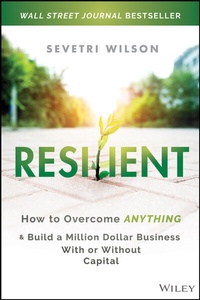
Resilient
Description

Discover how to overcome anything, bootstrap, and go from initial concept to Series A funding with this firsthand look at entrepreneurship
Resilient delivers an invaluable collection of private journal entries mapping out a path from bootstrapping a multi-million dollar business to raising millions in Series A funding for another. Entrepreneur and Resilia CEO Sevetri Wilson describes her journey from self-funding to venture capital success. Written for ambitious and aspiring entrepreneurs like herself, Wilson covers a wide variety of topics about the entrepreneurial journey:
* How to go from idea to product
* The correct way to dive into the hiring process
* Preparing to raise money
* Building a tech company as a non-technical founder
* How to select the right accelerators, programs, and pitch competitions
* Creating wealth while building a business
The author also shares her "Simple Agreement for Future Equity" (SAFE) agreement and first pitch deck. Perfect for entrepreneurs, startup enthusiasts, and founders, Resilient belongs on the bookshelves of anyone interested in the process of bootstrapping and/or raising capital to grow a business in any sector.
More details
Other editions
Additional editions
Person
Content
1 Coming From Where I'm From 3
Triple Threat 6
2 The Difference 16
Focus 25
3 Bootstrapping versus Raising Capital 28
Professional Services to Startup 28
On the Bootstrapping Process 31
Repeatable and Predictable Revenue, Regardless 38
Money Can't Be the Only Motivation 39
4 Idea to Product: Building a Startup 42
Starting With Funding 42
Starting Without Funding 43
What Not to Do When Starting a Company 44
You'll Never Get Going Unless 45
5 Building a Team 49
Hiring and Finding Freelancers and Others 49
Out of the Gate 57
Contingency versus Retained Recruiters 59
Get Out of the Way 62
6 I Hear You, But I Need Capital 67
Financing Terminology 68
Preparing to Raise 70
What Legal Documents Should I Use? 71
7 Raising a Pre-Seed $400,000 79
Pre-Seed, Better Known as a Friends-and-Family Round 79
The Pitch 85
8 Accelerators and Pitch Competitions? Bang or Bust 89
9 Raising My Seed Round 98
10 Product Market Fit 103
Sales: Remember Predictable, Repeatable Revenue? 103
11 Raising a Series A 107
12 Holy Crap--A Pandemic! 113
Prioritizing Mental Well-Being 116
13 The Murder of George Floyd, Breonna Taylor, and BLM 119
The Talk I Had With My Team 123
The Role of Philanthropy in Creating Equity 125
Systemic Issues Facing Black-Led Technology Companies 126
14 My Hopes, and Losing an Icon 129
The Role Technology Plays 129
On Building Generational Wealth 132
Appendix 137
Glossary 139
Rate Sheet 145
Online Resources 149
About the Author 151
Index 153
1
Coming From Where I'm From
To be a woman you have to look like a girl, act like a lady, think like a man, and work like a dog.
-Leah Chase
Attending Louisiana State University (LSU) for undergrad opened up an entirely new world for me. I come from a small town about 45 minutes outside of New Orleans, the city where my mama and her family are from.
The first time I became really aware of technology was when I was in middle school, when my mother brought home our first computer, a Dell desktop. We didn't have the Internet, but my Mama would get these AOL dial-up cards for free. Now, obviously, I would be exposed more to technology in college, but I had no idea that my journey would lead me into tech.
At LSU, I met a professor who truly pushed me and many others to go beyond the thinking of the small towns we came from. Dr. Leonard Moore would likely have the single most impactful role in my life while I was in college-so much so that I added history as a second major. Yet, more than anything, he showed how someone could manage multiple opportunities. He had written books naturally as a college professor, but he and his wife Thais had also started a program for youth, and a youth church. He was living a life that I had never imagined was a possibility. There was nothing luxurious about it, either; outwardly at least he lived very modestly but I had never seen this coming from where I was from. Over the course of my life, exposure has helped me more than anything to actually realize the possibilities of not only my work, but what my life could be like as well.
Doc would say that if you do something you are passionate about, you don't watch the clock. These thoughts of how I could use what I was good at to build something I loved wouldn't die, so entrepreneurship for me started at a young age.
I went to a large university-a Southeastern Conference (SEC) school with over 30,000 students and a national title-winning football team, so we were one of the first colleges to have Facebook. The coolest thing about Facebook then besides another place to post with your friends was that you were able to upload albums and sell and buy furniture on their marketplace.
Yet, for the most part, people were still on Facebook without a face. Instagram wasn't really a thing. Twitter was just taking off, with celebrities posting about their projects or other tidbits about their day.
I created B-NOW, a college online newspaper, when I was in school, and my first company would come when I was 22.
I've never been afraid to start something on my own. I think this goes to having confidence in your ability to figure it out even if your capabilities aren't there yet. Yes, in a way you can fake it until you make it, but eventually you're going to really have to make it. But more so, this is about starting somewhere so that over time you can become an expert at what you do and command the type of payment you used to only wish for.
Even with that, I had a lot of hiccups along the way because I had to really grasp and understand not only how to run a business but how to start a business from nothing. I didn't inherit a business and I didn't have anyone to turn to show me the ropes.
There are a lot of challenges that you are faced with when starting, and then running, a business. It's still challenging, you know, even as a second-time business owner now building a company to scale.
As a business owner, you have key responsibilities to your team, to your clients, to your investors if you have them, to the IRS-you name it.
You have to ensure that your business is legally sound. You have to ensure that you are paying people correctly, whether they are a W-9 or W-2 employee. You have to decide when and if you want to go from W-9 employees to W-2 employees and know the differences between them. There is so much foundational work that goes into play in building a business, particularly one you plan to grow, that if you don't do certain things correctly they will come back to haunt you.
Then there is the actual work: going after contract opportunities, and building and selling whatever product or service you are offering to bring revenue into your company.
Most importantly, you have to make your business make sense. When you're trying to get people in the door or contracts closed you will feel the pressure to take what sticks or whatever someone is offering you. It will on first sight look like an opportunity, but could be anything but. I talk later about upside-down contracts. When you are venture-backed you might take on a customer where the financial gain might not be as rewarding but the benefits you receive from the deal, because of a prominent logo or other reason, might be worth it, whereas if you are bootstrapped this might be a luxury you can't afford.
As a bootstrapped company one thing you have to learn quickly is how to monetize what you are seeking to do. People know that one of my favorite things to remind entrepreneurs of is that you are in business to make money; otherwise, what you're doing is solely a passion project. What I've found is that the real magic happens when you can be both. If you prioritize one over the other you'll likely start to question yourself and whether it's worth it. Passionate about a business that doesn't make you money? You'll certainly suffer from fatigue and burnout, and eventually your business will most likely fold because you can't sustain a business that's not profitable. Only in it for the money? The initial rush of having money will satisfy a part of you, but the longing for something more will without doubt catch up with you and that's a different type of fatigue and burnout in itself.
Triple Threat
As a business owner I was a "triple threat"-and not in a good way. I was Black, a woman, and young. And so, in many ways, when I was hitting roadblocks early on I felt the world was working against me. I had individuals across the table who weren't that much older than me, but they didn't look like me and so some of the struggles that come along with that were questioning myself, like oh man, what am I doing here again? Should I even be doing this or that?-the questions I was asking myself was a challenge within itself, and because there was no one else at the table who looked like me who was I suppose to ask were my feelings valid?
But I was here and I felt like I had nothing to lose, and I mean that very literally. My mother had just passed away when I graduated college and I started my company six months after that, and for me it was like, you know, I had spent so much time wanting to create this life so that I could help my mother, I felt like she'd missed out on so much and she had given so much to her children. When she passed away, I really had to rebuild in many ways.
I had to reframe what it was that I was living for. I'd launch my first business, Solid Ground Innovations (SGI), in July 2009, but wouldn't make it publicly known outside of my clients until 2011, which is also when I started to see real growth within the business.
I experienced so many lessons down the road, and it's important to know that you will face a lot of challenges. I made money. I lost money. I had contract deals that, starting out, I would have never dreamed of. I had an employee steal from the business by creating fake vendor invoices. I was furious. I had to fire my own clients because I no longer wanted to work within a situation that was not designed for anyone to succeed.
Yet, if it weren't for these hard lessons that I learned within SGI, I don't think I would have been as prepared to start a second company. Without the success of SGI, Resilia wouldn't exist today.
When you're first starting off in a business you feel like you can't turn down work, at least not paid work. I look back to some of those situations and today I wouldn't touch some of the work we took then because it wouldn't make sense. Time is one of my most valuable assets, and you don't want to waste it on deals that aren't worth it.
Choosing to turn down some work was one of the most refreshing moments in business for me. I was coming into my own as a business owner and leader; I could take opportunities that were meant for me and pass on the ones that I thought were not. But it wasn't always like this. Early on I had to build my capabilities, and create a name in the industry, and prove that we could compete, so I was happy to do work to build my portfolio and resume. This didn't mean working for free, but it did mean that the rate I charged in 2010 was a fraction of what I charge today.
I also made a conscious decision to stay in Louisiana and build my business where I was from. Not once but twice. People are always floored that I've made this decision, but I'd been committed to creating an ecosystem for minority business owners, and those who I never saw get a chance to sit at the table.
Building a business in the Deep South as a Black woman is challenging-and that is putting it lightly. At times, I thought maybe it wasn't meant for me to be here. Maybe I needed to go somewhere else because I could grow faster, I could hire from a larger talent pool. Eventually I would open up offices in other cities to create this dynamic, but I stick with my initial thoughts on if you leave at the moment you taste success, then you never...
