

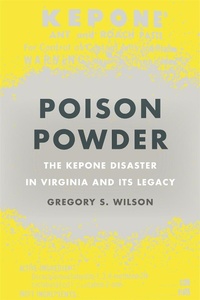
Poison Powder
The Kepone Disaster in Virginia and its Legacy
Published on 1. April 2023
252 pages
978-0-8203-6349-3 (ISBN)
Description

In 1975 workers at Life Science Products, a small makeshift pesticide factory in Hopewell, Virginia, became ill after exposure to Kepone, the brand name for the pesticide chlordecone. They made the poison under contract for a much larger Hopewell company, Allied Chemical. Life Science workers had been breathing in the dust for more than a year. Ingestion of the chemical made their bodies seize and shake. News of ill workers eventually led to the
discovery of widespread environmental contamination of the nearby James River and the landscape of the small, working-class city. Not only had Life Science dumped the chemical, but so had Allied when the company manufactured it in the 1960s and early 1970s. The resulting toxic impact was not only on the city of Hopewell but also on the faraway fields where Kepone was used as an insecticide.
Aspects of this environmental tragedy are all too common: corporate avarice, ignorance, and regulatory failure combined with race and geography to determine toxicity and shape the response. But the Kepone story also contains some surprising medical, legal, and political moments amid the disaster. With Poison Powder, Gregory S. Wilson explores the conditions that put the Kepone factory and the workers there in the first place and the effects of the poison on the people and natural world long after 1975. Although the manufacture and use of Kepone is now banned by the Environmental Protection Agency, organochlorines have long half-lives, and these toxic compounds and their residues still remain in the environment.
discovery of widespread environmental contamination of the nearby James River and the landscape of the small, working-class city. Not only had Life Science dumped the chemical, but so had Allied when the company manufactured it in the 1960s and early 1970s. The resulting toxic impact was not only on the city of Hopewell but also on the faraway fields where Kepone was used as an insecticide.
Aspects of this environmental tragedy are all too common: corporate avarice, ignorance, and regulatory failure combined with race and geography to determine toxicity and shape the response. But the Kepone story also contains some surprising medical, legal, and political moments amid the disaster. With Poison Powder, Gregory S. Wilson explores the conditions that put the Kepone factory and the workers there in the first place and the effects of the poison on the people and natural world long after 1975. Although the manufacture and use of Kepone is now banned by the Environmental Protection Agency, organochlorines have long half-lives, and these toxic compounds and their residues still remain in the environment.
More details
Other editions
Additional editions
Book
04/2023
University of Georgia Press
€33.00
Shipment within 10-20 days
Book
04/2023
University of Georgia Press
€144.04
Shipment within 10-20 days
Person
Gregory S. Wilson is professor of history at the University of Akron. He is the author of Communities Left Behind: The Area Redevelopment Adminstration, 1945-1965, coauthor, with Craig S. Simpson, of Above the Shots: An Oral History of the Kent State Shootings, and coauthor, with Kevin F. Kern, of Ohio: A History of the Buckeye State.
Content
- Cover
- Half-title
- Title
- Copyright
- Contents
- Foreword
- Acknowledgments
- Introduction
- Chapter 1. The James River before Kepone
- Chapter 2. Hopewell, Allied, and the Beetle Battles
- Chapter 3. The Kepone Shakes and a Poisoned River
- Chapter 4. Biocitizenship and Accountability
- Chapter 5. A Crime against Every Citizen
- Chapter 6. Kepone and the Environmental Management State
- Chapter 7. The Present and Future of Kepone
- Epilogue
- Notes
- Index
