

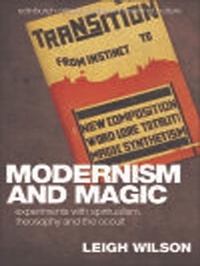
Modernism and Magic
Description

Explores the interplay between modernist experiment and occult discourses in the early twentieth century
While modernism's engagement with the occult has been approached by critics as the result of a loss of faith in representation, an attempt to draw on science as the primary discourse of modernity, or as an attempt to draw on a hidden history of ideas, Modernism and Magic argues that occult discourses have at their heart a magical practice which attempts to remake the relationship between world and representation. As Leigh Wilson demonstrates, the discourses of the occult are based on a magical mimesis which transforms the nature of the copy, from inert to vital, from dead to alive, from static to animated, from powerless to powerful. It is this magical mimesis that proved so attractive and productive for those early twentieth-century artists committed to remaking writing, the visual arts and film.
Wilson explores the aesthetic and political implications of the relationship between magic and mimesis in the work of those writers, artists and filmmakers who were most self-consciously experimental, including James Joyce, Ezra Pound, Dziga Vertov and Sergei M. Eisenstein.
More details
Other editions
Additional editions
Content
- Cover
- Copyright
- CONTENTS
- SERIES EDITORS' PREFACE
- ACKNOWLEDGEMENTS
- INTRODUCTION
- 1. 'BUT THE FACTS OF LIFE PERSIST': MAGIC, EXPERIMENT AND THE PROBLEM OF REPRESENTING THE WORLD OTHERWISE
- 2. 'AND WHAT HAS ALL THIS TO DO WITH EXPERIMENTAL WRITING?': WORDS AND GHOSTS
- 3. A 'SUBTLE METAMORPHOSIS': SOUND, MIMESIS AND TRANSFORMATION
- 4. 'HERE IS WHERE THE MAGIC IS': TELEPATHY AND EXPERIMENT IN FILM
- 5. 'DISNEY AGAINST THE METAPHYSICALS': EISENSTEIN, POUND, ECTOPLASM AND THE POLITICS OF ANIMATION
- BIBLIOGRAPHY
- INDEX
