

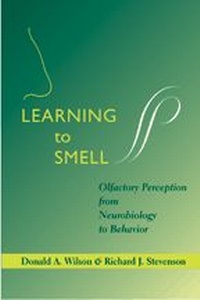
Learning to Smell
Olfactory Perception from Neurobiology to Behavior
Published on 1. August 2006
328 pages
978-0-8018-8894-6 (ISBN)
Description

Written by a neurobiologist and a psychologist, this volume presents a new theory of olfactory perception. Drawing on research in neuroscience, physiology, and ethology, Donald A. Wilson and Richard J. Stevenson address the fundamental question of how we navigate through a world of chemical encounters and provide a compelling alternative to the "reception-centric" view of olfaction.
The major research challenge in olfaction is determining how the brain discriminates one smell from another. Here, the authors hold that olfaction is generally not a simple physiochemical process, but rather a plastic process that is strongly tied to memory. They find the traditional approach-which involves identifying how particular features of a chemical stimulus are represented in the olfactory system-to be at odds with historical data and with a growing body of neurobiological and psychological evidence that places primary emphasis on synthetic processing and experiential factors.
Wilson and Stevenson propose that experience and cortical plasticity not only are important for traditional associative olfactory memory but also play a critical, defining role in odor perception and that current views are insufficient to account for current and past data.
The book includes a broad comparative overview of the structure and function of olfactory systems, an exploration into the mechanisms of odor detection and olfactory perception, and a discussion of the implications of the authors' theory. Learning to Smell will serve as an important reference for workers within the field of chemical senses and those interested in sensory processing and perception.
The major research challenge in olfaction is determining how the brain discriminates one smell from another. Here, the authors hold that olfaction is generally not a simple physiochemical process, but rather a plastic process that is strongly tied to memory. They find the traditional approach-which involves identifying how particular features of a chemical stimulus are represented in the olfactory system-to be at odds with historical data and with a growing body of neurobiological and psychological evidence that places primary emphasis on synthetic processing and experiential factors.
Wilson and Stevenson propose that experience and cortical plasticity not only are important for traditional associative olfactory memory but also play a critical, defining role in odor perception and that current views are insufficient to account for current and past data.
The book includes a broad comparative overview of the structure and function of olfactory systems, an exploration into the mechanisms of odor detection and olfactory perception, and a discussion of the implications of the authors' theory. Learning to Smell will serve as an important reference for workers within the field of chemical senses and those interested in sensory processing and perception.
More details
Language
English
Place of publication
Baltimore
United States
Target group
Professional and scholarly
Illustrations
6 s/w Photographien bzw. Rasterbilder, 26 s/w Zeichnungen
26 Line drawings, black and white; 6 Halftones, black and white
File size
3,10 MB
ISBN-13
978-0-8018-8894-6 (9780801888946)
DOI
10.1353/book.3242
Copyright in bibliographic data and cover images is held by Nielsen Book Services Limited or by the publishers or by their respective licensors: all rights reserved.
Schweitzer Classification
Other editions
Additional editions
Donald A. Wilson | Richard J. Stevenson
Learning to Smell
Olfactory Perception from Neurobiology to Behavior
Book
08/2006
Johns Hopkins University Press
€86.50
Article not available for order
Persons
Donald A. Wilson is a professor of zoology at the University of Oklahoma. Richard J. Stevenson is a professor of psychology at Macquarie University in Sydney, Australia.
Content
Preface
1. The Function of the Olfactory System in Animals and Humans
2. A Historical and Comparative Perspective on Theoretical Approaches to Olfaction
3. Receptive Mechanisms
4. The Relationship between Stimulus Intensity and Perceptual Quality
5. Odor Quality Discrimination in Nonhuman Animals
6. Odor Quality Discrimination in Humans
7. Odor Memory
8. Implications
Bibliography
Index
1. The Function of the Olfactory System in Animals and Humans
2. A Historical and Comparative Perspective on Theoretical Approaches to Olfaction
3. Receptive Mechanisms
4. The Relationship between Stimulus Intensity and Perceptual Quality
5. Odor Quality Discrimination in Nonhuman Animals
6. Odor Quality Discrimination in Humans
7. Odor Memory
8. Implications
Bibliography
Index
