

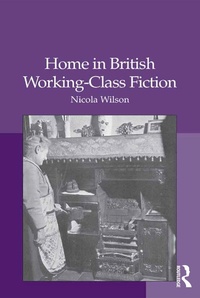
Home in British Working-Class Fiction
Published on 9. March 2016
252 pages
978-1-317-12136-7 (ISBN)
Description

Home in British Working-Class Fiction offers a fresh take on British working-class writing that turns away from a masculinist, work-based understanding of class in favour of home, gender, domestic labour and the family kitchen. As Nicola Wilson shows, the history of the British working classes has often been written from the outside, with observers looking into the world of the inhabitants. Here Wilson engages with the long cultural history of this gaze and asks how 'home' is represented in the writing of authors who come from a working-class background. Her book explores the depiction of home as a key emotional and material site in working-class writing from the Edwardian period through to the early 1990s. Wilson presents new readings of classic texts, including The Ragged Trousered Philanthropists, Love on the Dole and Saturday Night and Sunday Morning, analyzing them alongside works by authors including James Hanley, Walter Brierley, Lewis Grassic Gibbon, Buchi Emecheta, Pat Barker, James Kelman and the rediscovered 'ex-mill girl novelist' Ethel Carnie Holdsworth. Wilson's broad understanding of working-class writing allows her to incorporate figures typically ignored in this context, as she demonstrates the importance of home's role in the making and expression of class feeling and identity.
Reviews / Votes
'Striking the right balance between social context, history and close reading, Wilson brings to life the work of authors who are still not read as much as they should be. Her book provides a fine account of "home" and the many ways in which it was observed and criticised from the early years of the twentieth century through to its close.' Andrzej Gasiorek, University of Birmingham, UK "an ambitious and welcome addition to the few studies about the working class by the working class, which changes it from subject to experience""draws on an impressive range of sources to argue that there has been a tendency to ignore the importance of ideas and meanings of home as a key part of working-class writing"
- Belinda Webb-Blofeld, The TLS
"Home in British Working-Class Fiction fills an important niche; Wilson notes at the outset that due to gender biases and the attention to paid work outside the home, most prior studies of working-class texts do not attend at any length to domestic space itself. Recognising the importance of analyses of domestic space pioneered by such scholars as Nancy Armstrong, whom she discusses, Wilson connects the novels she explores to such readings of gender and material culture, engaging as well and at length with scholars of working-class novels. The mentions of lived experiences and structures of feeling anchor the book in the tradition of Raymond Williams, as does her broad contextualisation of texts and techniques in the larger span of literary history. Wilson also engages with seminal studies by such commentators as Ian Haywood, Pamela Fox and John Kirk. Home in British Working-Class Fiction does vital work in establishing an alternative narrative about working-class fiction that builds upon these scholars, but it also broadens their scope to include additional texts and more comprehensive readings of domestic space and gender in the texts they do analyse. In doing so, Wilson makes the case for the ongoing relevance of class as a conceptual category in the analysis of British fiction."
- Mary McGlynn, Literature & History
More details
Language
English
Place of publication
London
United Kingdom
Publishing group
Taylor & Francis Ltd
Target group
College/higher education
File size
1,52 MB
ISBN-13
978-1-317-12136-7 (9781317121367)
Copyright in bibliographic data and cover images is held by Nielsen Book Services Limited or by the publishers or by their respective licensors: all rights reserved.
Schweitzer Classification
Other editions
Additional editions
Nicola Wilson
Home in British Working-Class Fiction
Book
05/2019
1st Edition
Routledge
€57.03
Shipment within 15-20 days
Nicola Wilson
Home in British Working-Class Fiction
Book
04/2015
1st Edition
Routledge
€230.65
Shipment within 10-20 days
Person
Nicola Wilson is a British Academy Postdoctoral Research Fellow at the University of Reading, UK.
Content
Introduction; Chapter 1 Writing Home and Class; Chapter 2 The Forefathers of the Working-Class Novel; Chapter 3 Working Women and the Little House; Chapter 4 Home on the Dole in the Hungry Thirties; Chapter 5 Anger, Affluence and Domesticity; Chapter 6 The Uprooted and the Anxious; Chapter 7 Estates and the New Slum Life; Chapter 101 Afterword;
