

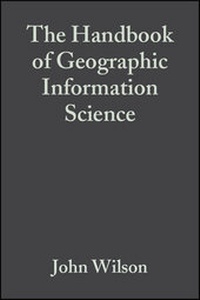
The Handbook of Geographic Information Science
Description

Reviews / Votes
"Eachchapter contains a valuable list of literature, and the book endswith an exten-sive, 15-page index. This makes this textbook avaluable and useful companion for students of geoinformation,geoinformatics, geocompu-tation, and geoprocessing(GIScience), as well as for experienced scientists andprofessionals applying GIS."(Geologos,2010) "This book is quite extraordinary value providing a timelyand extensive review of much of the discipline. Serious researchersand students alike should see it as an essential addition to theirGIScience library." (Journal of Regional Science, May2009) "The topics covered are wide ranging, covering many aspects ofGI science ... .A good spread of authors from Europe, NorthAmerica and Australia." (Reference Reviews, Issue 62008)More details
Other editions
Additional editions
Persons
Content
List of Contributors.
Preface.
Geographic Information Science: An Introduction: A. Stewart Fotheringham (National University of Ireland) and John P. Wilson (University of Southern California).
Part I: Data Issues:.
1. The Availability of Geographic Data: The Current Technical and Institutional Environment: David J. Cowen (University of South Carolina).
2. Social Data: David J. Martin (University of Southampton).
3. Remote Sensing: Brian G. Lees (University of New South Wales).
4. Spatialization: Andre Skupin (San Diego State University) and Sara I. Fabrikant (University of Zurich).
5. Uncertainty in Spatial Databases: Ashley Morris (DePaul University).
6. On the Identification of Uncertainties in Spatial Data and Their Quantification with Probability Distribution Functions: James D. Brown (Universiteit van Amsterdam) and Gerald B. M. Heuvelink (Wageningen University and Research Centre).
Part II: Database Trends and Challenges:.
7. Object-Oriented Database Management Systems: Shashi Shekhar and Ranga Raju Vatsavai (University of Minnesota).
8. Adding the Z Dimension: Michael F. Hutchinson (Australian National University).
9. Adding Time into Geographic Information Science Databases: May Yuan (University of Oklahoma).
10. Geospatial Data Integration: Craig A. Knoblock and Cyrus Shahabi (University of Southern California).
Part III: Visualization:.
11. Mapping in a Digital Age: William E. Cartwright (RHIT University).
12. Generalization of Spatial Databases: William A. Mackaness (University of Edinburgh).
13. Geographic Information Science and Surfaces: Nicholas J. Tate (University of Leicester), Peter F. Fisher (City University), and David J. Martin (University of Southampton).
14. Fuzzy Classification and Mapping: Vincent B. Robinson (University of Toronto).
15. Rule-Based Mapping: A-Xing Zhu (University of Wisconsin).
16. Multivariate Geovisualization: Mark Gahegan (Pennsylvania State University).
17. Virtual Reality in Geographic Information Science: Michael Batty (University College London).
Part IV: Knowledge Elicitation:.
18. Inference and Spatial Data: Chris Brunsdon (University of Leicester).
19. Geographic Data Mining and Knowledge Discovery: Harvey J. Miller (University of Utah).
20. The Geospatial Semantic Web: Frederico Fonseca (Pennsylvania State University).
Part V: Spatial Analysis:.
21. Quantitative Methods and Geographic Information Systems: Martin Charlton (National University of Ireland).
22. Spatial Cluster Analysis: Geoffrey M. Jacquez (BioMedware, Inc., Ann Arbor).
23. Terrain Analysis: Yongxin Deng (Western Illinois University), John P. Wilson (University of Southern California), and John C. Gallant (CSIRO Land and Water, Canberra).
24. Dynamic Modeling: Jochen Albrecht (City University of New York).
Part VI GIS and Society:.
25. Institutional Geographic Information Science and GI Partnering: David Tulloch (State University of New Jersey).
26. Participatory Geographic Information Science: Daniel Weiner and Trevor M. Harris (West Virginia University).
27. Geographic Information Science and Participatory Decision Making: Piotr Jankowski (San Diego State University) and Timothy L. Nyerges (University of Washington).
28. Surveys of People and Place: Peter H. Dana (Georgetown).
29. Geographic Information, Personal Privacy, and the Law: George C. H. Cho (University of Canberra).
30. Geographic Information in Education: Joseph J. Kerski (Denver Federal Center).
Part VII: Future Trends and Challenges:.
31. Web-based Geographic Information Science: Christopher B. Jones (Cardiff University) and Ross S. Purves (University of Zurich).
32. Location-based Services and Geographic Information Science: Allan J. Brimicombe (University of East London).
33. Geographic Information Science: The Grand Challenges: Michael F. Goodchild (University of California).
34. Geographic Information Science: Where Next?: Andreas Reuter (European Media Laboratory, Heidelberg) and Alexander Zipf (University of Applied Sciences FH Mainz).
Index
