

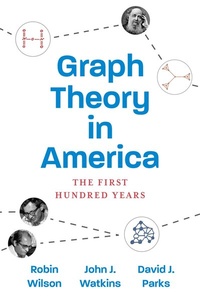
Graph Theory in America
The First Hundred Years
1st Edition
Published on 10. October 2022
320 pages
978-0-691-24065-7 (ISBN)
Description

How a new mathematical field grew and matured in America
Graph Theory in America focuses on the development of graph theory in North America from 1876 to 1976. At the beginning of this period, James Joseph Sylvester, perhaps the finest mathematician in the English-speaking world, took up his appointment as the first professor of mathematics at the Johns Hopkins University, where his inaugural lecture outlined connections between graph theory, algebra, and chemistry-shortly after, he introduced the word graph in our modern sense. A hundred years later, in 1976, graph theory witnessed the solution of the long-standing four color problem by Kenneth Appel and Wolfgang Haken of the University of Illinois.
Tracing graph theory's trajectory across its first century, this book looks at influential figures in the field, both familiar and less known. Whereas many of the featured mathematicians spent their entire careers working on problems in graph theory, a few such as Hassler Whitney started there and then moved to work in other areas. Others, such as C. S. Peirce, Oswald Veblen, and George Birkhoff, made excursions into graph theory while continuing their focus elsewhere. Between the main chapters, the book provides short contextual interludes, describing how the American university system developed and how graph theory was progressing in Europe. Brief summaries of specific publications that influenced the subject's development are also included.
Graph Theory in America tells how a remarkable area of mathematics landed on American soil, took root, and flourished.
Graph Theory in America focuses on the development of graph theory in North America from 1876 to 1976. At the beginning of this period, James Joseph Sylvester, perhaps the finest mathematician in the English-speaking world, took up his appointment as the first professor of mathematics at the Johns Hopkins University, where his inaugural lecture outlined connections between graph theory, algebra, and chemistry-shortly after, he introduced the word graph in our modern sense. A hundred years later, in 1976, graph theory witnessed the solution of the long-standing four color problem by Kenneth Appel and Wolfgang Haken of the University of Illinois.
Tracing graph theory's trajectory across its first century, this book looks at influential figures in the field, both familiar and less known. Whereas many of the featured mathematicians spent their entire careers working on problems in graph theory, a few such as Hassler Whitney started there and then moved to work in other areas. Others, such as C. S. Peirce, Oswald Veblen, and George Birkhoff, made excursions into graph theory while continuing their focus elsewhere. Between the main chapters, the book provides short contextual interludes, describing how the American university system developed and how graph theory was progressing in Europe. Brief summaries of specific publications that influenced the subject's development are also included.
Graph Theory in America tells how a remarkable area of mathematics landed on American soil, took root, and flourished.
More details
Other editions
Additional editions
Book
01/2023
Princeton University Press
€37.14
Shipment within 10-20 days
Persons
Robin Wilson is emeritus professor of mathematics at the Open University. His many books include Four Colors Suffice (Princeton). John J. Watkins is professor emeritus of mathematics at Colorado College. His books include Topics in Commutative Graph Theory, Number Theory, and Across the Board (all Princeton). David J. Parks received a PhD in mathematics at the Open University. His doctoral thesis forms the basis of this book.
Content
- Cover
- Contents
- Foreword by Gary Chartrand
- Preface
- Featured Papers
- Chronology of Events
- Setting the Scene: Early American Mathematics
- Some Early Colleges
- Mathematics Education
- 1. The 1800s
- James Joseph Sylvester
- Alfred Kempe
- William Story
- C. S. Peirce
- Interlude A: Graph Theory in Europe 1
- P. G. Tait (Scotland)
- Percy Heawood (England)
- Julius Petersen (Denmark)
- Lothar Heffter (Germany)
- Heinrich Tietze (Austria)
- Hermann Minkowski (Germany)
- 2. The 1900s and 1910s
- Paul Wernicke
- Oswald Veblen
- George D. Birkhoff
- World War I
- 3. The 1920s
- Philip Franklin
- H. Roy Brahana
- J. Howard Redfield
- A Trio of Map Colorers
- Interlude B: Graph Theory in Europe 2
- Dénes König (Hungary)
- Alfred Errera (Belgium)
- André Sainte-Laguë (France)
- Karl Menger (Austria)
- Kazimierz Kuratowski (Poland)
- 4. The 1930s
- Hassler Whitney
- Saunders Mac Lane
- Academic Life in the 1930s
- 5. The 1940s and 1950s
- World War II
- Graph Theorists of the 1940s
- W. T. Tutte
- Algorithms
- Frank Harary
- 6. The 1960s and 1970s
- Oystein Ore
- The Heawood Conjecture
- Ron Graham
- Complexity
- The Four Color Theorem
- Aftermath
- Glossary
- Notes, References, and Further Reading
- Acknowledgments and Picture Credits
- Index
