

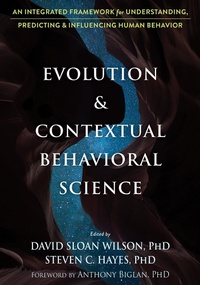
Evolution and Contextual Behavioral Science
Description

What do evolutionary science and contextual behavioral science have in common? Edited by David Sloan Wilson and Steven C. Hayes, this groundbreaking book offers a glimpse into the histories of these two schools of thought, and provides a sound rationale for their reintegration.
Evolutionary science (ES) provides a unifying theoretical framework for the biological sciences, and is increasingly being applied to the human-related sciences. Meanwhile, contextual behavioral science (CBS) seeks to understand the history and function of human behavior in the context of everyday life where behaviors occur, and to influence behavior in a practical sense. This volume seeks to integrate these two bodies of knowledge that have developed largely independently.
In Evolution and Contextual Behavioral Science, two renowned experts in their fields argue why ES and CBS are intrinsically linked, as well as why their reintegration¿or, reunification¿is...
More details
Other editions
Additional editions
Content
- Intro
- Foreword
- Chapter 1: Evolution and Contextual Behavioral Science
- Chapter 2: The Contextual Science of Learning: Integrating Behavioral and Evolution Science Within a Functional Approach
- Chapter 3: Classical and Operant Conditioning: Evolutionarily Distinct Strategies?
- Dialogue on Learning
- Participants: Michael J. Dougher, Derek A. Hamilton, Steven C. Hayes, and Eva Jablonka
- Chapter 4: Symbolic Thought and Communication from a Contextual Behavioral Science Perspective
- Chapter 5: Beneath Symbols: Convention as a Semiotic Phenomenon
- Dialogue on Symbolic Thought and Communication
- Participants: Dermot Barnes-Holmes, Yvonne Barnes-Holmes, Terrence W. Deacon, and Steven C. Hayes
- Chapter 6: The Evolutionary Basis of Risky Adolescent Behavior
- Bruce J. Ellis
- University of Utah
- Chapter 7: Shaping DNA (Discoverer, Noticer, and Advisor): A Contextual Behavioral Science Approach to Youth Intervention
- Dialogue on Development and Adolescence
- Participants: Joseph Ciarrochi, Bruce J. Ellis, Louise L. Hayes, and David Sloan Wilson
- Chapter 8: Situated Empathy: Applying Contextualism to the Science of Recognizing Other People's Emotions
- Chapter 9: The Social and Contextual Nature of Emotion: An Evolutionary Perspective
- Dialogue on Emotions and Empathy
- Participants: Jack W. Berry, Steven C. Hayes, Kibby McMahon, Lynn E. O'Connor, and M. Zachary Rosenthal
- Chapter 10: Relational Models, Leadership, and Organization Design: An Evolutionary View of Organizational Development
- Chapter 11: Organizational Flexibility: Creating a Mindful and Purpose-Driven Organization
- Dialogue on Organizational Development
- Participants: Frank W. Bond, J. W. Stoelhorst, Mark van Vugt, and David Sloan Wilson
- Chapter 12: Evolutionary Mismatch: A Framework for Understanding Health and Disease in the Modern World-"Better Living Through Evolution"
- Chapter 13: Living Well as the First Medicine: Health and Wellness in the Modern World
- Dialogue on Behavioral and Physical Health
- Participants: Aaron P. Blaisdell, David Sloan Wilson, Kelly G. Wilson
- Chapter 14: Small Groups as Fundamental Units of Social Organization
- Chapter 15: PROSOCIAL: Using CBS to Build Flexible, Healthy Relationships
- Dialogue on Small Groups
- Participants: Paul W. B. Atkins, Steven C. Hayes, David Sloan Wilson
- Chapter 16: Variation and Selection in Psychopathology and Psychotherapy: The Example of Psychological Inflexibility
- Chapter 17: Reconciling the Tension Between Behavioral Change and Stability
- Dialogue on Psychopathology and Behavior Change
- Participants: Renée Duckworth, Steven C. Hayes, Jean-Louis Monestès, David Sloan Wilson
- Chapter 18: Evolution and Contextual Behavioral Science: Where Are We and Where Are We Going? A Concluding Dialogue Between the Editors
- Index
