

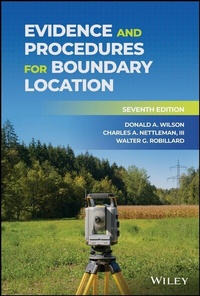
Evidence and Procedures for Boundary Location
Description

THE UPDATED CLASSIC GUIDE TO LAND BOUNDARY LAW AND EVIDENCE DISCOVERY
The revised Seventh Edition of Evidence and Procedures for Boundary Location serves as the seminal guide to the principles and concepts of land boundary law and evidence for accurately determining boundaries. Written by a team of noted authorities on the subject, the book presents the proven methods for the rediscovery of real property boundaries. Grounded in historical documentation, field investigation, and recreation of the original surveying methodology, the book contains the appropriate and legally defensible tools needed for the re-establishment of land boundaries.
Thoroughly revised and updated, the classic text contains fresh examples of case law, the most recent developments in forensic investigation in the discovery of obscured evidence, as well as a new chapter on emerging technology used in boundary surveying. Designed for use by both working surveyors and aspiring professionals studying for the Fundamentals of Land Surveying licensure exam, this important book:
- Has been the leading guide to land boundary law and evidence for nearly 60 years
- Contains new case law examples and exhibits
- Offers expanded coverage on the use of forensic investigative techniques
- Presents a new chapter on the most recent surveying technology
Written for practicing surveyors and students, the updated Seventh Edition of Evidence and Procedures for Boundary Location continues to offer an authoritative guide to the principles, laws, and latest developments in the field.
Donald A. Wilson is president of Land & Boundary Consultants, Inc.
Charles A. Nettleman, III, Ph.D., is president and CEO of Nettleman Land Consultants, Inc. and Director of the Nettleman Institute of Land Surveying Engineering Technology, Inc.
Walter G. Robillard is a principal at World Boundaries, Inc.
More details
Other editions
Additional editions
Persons
Donald A. Wilson is president of Land & Boundary Consultants, Inc.
Charles A. Nettleman, III, Ph.D., is president and CEO of Nettleman Land Consultants, Inc. and Director of the Nettleman Institute of Land Surveying Engineering Technology, Inc.
Walter G. Robillard is a principal at World Boundaries, Inc.
Content
Preface
1 Introduction
2 Definition, Scope, and Nature of Evidence
3 Words as Evidence
4 Evidence and Technology
5 Other Types or Species of Evidence
6 Calculations and Measurements as Evidence
7 Plats as Evidence
8 Evidence of Water Boundaries
9 Using Historical Knowledge as Evidence
10 Recording and Preserving Evidence
11 Procedures for Locating Boundaries Described by Words
12 Original Surveys and Related Platting Laws
13 Unwritten Transfers of Land Ownership
14 Guarantees of Title and Location
15 Using and Understanding Words in Boundary Descriptions
16 Professional Liability
17 Professional Stature
18 The Surveyor in Court
19 The Surveyor, the Law, and Evidence: A Professional Relationship
Appendix A The Surveyor's Report
Appendix B Wooden Evidence
Appendix C The [Quasi-]Judicial Function of Surveyors
Appendix D Geodaesia
Appendix E Land Acts that Created the Public Lands
Index
1
INTRODUCTION
1.1 Scope of the Book
In writing any book, authors should have a goal or philosophy as to what it is they wish to accomplish. We have such a philosophy: It is our desire to help the student and the practicing surveyor, as well as those aspiring young people who wish to enter the surveying profession, appreciate some of what we feel are the finer aspects of surveying, that is, the legal aspects as well as that area of the law that relates to and encompasses evidence in all of its aspects.
This is a book about survey evidence and, as such, it is not a book on "how to survey" but what to do with your survey when it is completed and what your clients can expect from your survey. Many consider the surveyor as the individual standing behind a transit or theodolite turning angles or collecting data for a new road or measuring for a new subdivision. This book will have a double focus: First, it is aimed at those students who wish to enter the surveying profession and at those surveyors who locate boundary lines and land parcels or utilize evidence in searching for and locating the footsteps of the earlier surveyors who originally created the parcels or property.
Second, we wish to provide a reference textbook that future professional land surveyors may use as a study guide to prepare for their Fundamentals, Principles & Practice, and state-specific examinations. In writing this book, the authors have attempted to modernize the format to be more in keeping with the legal texts of today. The authors have attempted to make the references and the terminology consistent with legal courses to be in keeping with the modern approach. In this we have tried to modernize the land surveyor's responsibilities and liabilities.
The functions of land surveyors should be considered as varied and different in each state. For simplicity, boundary surveying can be divided into two general areas or disciplines: (1) locating or relocating originally described parcels of land; and (2) creating new parcels. In keeping with recent legal decisions, we have somewhat modified some of the terminology. For instance, seldom is the term property line or property boundary used. It is our belief that property rights, including property boundaries, are legal questions and as such are not addressed by land surveyors. Surveyors locate boundaries, or land boundaries or deed lines. They do not and cannot locate property rights.
Corners and the lines connecting those corners define the extent of property rights that are described in the land description. These lines may coincide with property rights or they may be separate and independent. These originally created lines remain fixed and unalterable except as provided by law, such as the loss or gaining of property rights or the addition or elimination of contiguous parcels of land in the same ownership.
This concept is what gives rise to the phrase "following the footsteps" because a parcel, once established, should remain fixed through any series of conveyances. This phrase is historical in that many earlier decisions coined the phrase, which now has been adopted and adapted by modern-day courts in rendering decisions. A grantee who acquires a parcel owned by a grantor determines the boundaries of his/her purchase at the time that the particular parcel was carved out of some larger tract. He or she takes to the bounds of the estate of his or her grantor, who, in turn, took to the limits of that grantor's estate, to the time of the creation of the boundaries [1].
The first portion of the book (Chapters 1-11) covers resurveys or retracements of former surveys based on the record; the latter part (Chapters 12-19) covers the creation of new parcels or the division of land in which the surveyor may create the record. The importance of evidence in both phases will be stressed in the following pages.
The first problem one encounters is in the definition of surveying. No two states or the federal government or the international community describe surveying in the same terms; nor do they have the same requirements for one to become qualified to create, identify, retrace, and then testify in judicial tribunals as to boundaries or to survey real property.
How original surveys are made is subject to control by the legislative branch of the government, and since there are 50 states and the federal government, land subdivision laws and regulations of original surveys are extremely variable and usually are regulated by standards, statutes, rules, and regulations. However, after parcels have been created and the land has been divided and described, it is left to the courts to interpret the position of the original boundaries. Today, practically all original surveys must begin from a survey of an existing parcel. For this reason, the first portion of the book pertains to the location of previously described parcels. It deals with the evidence and methods for locating these corners, lines, and parcels.
In attempting to survey and locate a described parcel of land, the only permanent and correct location of its boundaries is where a court of competent jurisdiction would locate them. To know where a court would locate property boundaries, the surveyor must have expert knowledge and understanding of the laws of boundaries and evidence. Yet regardless of where the surveyor would locate the boundaries of the parcel, the final location of any boundary is nothing more than an opinion of the evidence recovered, evaluated, and then interpreted, and this is always subject to review by the courts and by other subsequent surveyors.
Once a boundary is questioned or litigated and the parties seek determination by a jury, the trial is usually divided into two parts: It is left to the jury to decide what the facts are and it is left to the judge to apply the law to the facts. This has led many courts to hold to the old saying: "What boundaries are is a matter of law; where boundaries are is a matter of fact."
Thus, in a trial, the jury decides where an original monument position was located based on evidence the surveyor used to formulate an opinion. The judge decides whether the monument or measurement is controlling as a matter of evidence presented at the trial and not necessarily as a matter of law. In a survey based on the record, the surveyor may be asked to determine both of these questions, either knowingly or unknowingly. Chapter 2 examines the laws of evidence necessary to prove facts and the order of importance of discovered evidence.
According to the Statute of Frauds first enacted in England in 1677 and later adopted both in statute law and common law in the United States, land ownership must be proven by some form of written evidence. To prove the right of legal possession, a written document must be produced witnessing such right. In early decisions, courts found that the requirement for written deeds sometimes caused an individual to commit fraud; thus, the concept of title passing without a writing was created, yet English courts recognized a concept from Roman law, adverse possession, by calling it an unwritten title. Since a legally created unwritten title is legally superior to a written title, one may say that the written title is either extinguished or reduced in status to a junior interest.
In recent years, a marked change has occurred in the courts' thinking on the subject of professional responsibility and liability. The concepts of privity of contract and the time of commencement of the running of any statute of limitations are vastly different from what they were 50 years ago. Chapter 16 and a portion of Chapter 17 discuss these subjects with the hope that student will be able to limit or possibly escape professional exposure for liability when entering the profession.
According to decisions reported in court cases, surveyors, in retracing old boundary lines, are directed and obligated to follow the "footsteps of the original or creating surveyor"; therefore, it is essential that any surveyor who practices in the area of property or boundary identification has knowledge of the historical background of land surveys in general and the geographic area specifically and that he or she know under which laws they were originally performed. The authors believe that the term footsteps equates to a question of evidence: evidence created and then evidence recovered. Evidence will be discussed to include many facets. The purpose of discussing surveying history in Chapter 9 is to aid present-day surveyors in understanding why we must follow certain procedures when locating property boundaries. Even this history must be used as a tool for the present and not as a device to present the romance of the past. Exploration of historical background and the study of the development of various survey systems and equipment will provide the needed background of laws and customs governing property owners' rights and privileges.
Although surveying history will be shown to be quite ancient, it does not overlook the fact that the United States is rich in many phases of the history of surveying and law that have widespread application within the individual states, territories, and the United States proper:
- the English system that gave rise to English common law, which was used in the colonies and now forms many of the fundamental rules, as well as civil law, which evolved from Roman law and was subsequently referred to as the Napoleonic Code and is still found in vestiges in most of the...
