

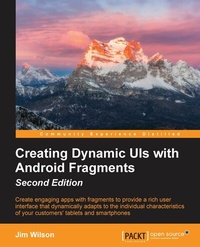
Creating Dynamic UIs with Android Fragments
Creating Dynamic UIs with Android Fragments Second Edition
2nd Edition
Published on 8. July 2025
154 pages
978-1-78588-276-0 (ISBN)
Description

Create engaging apps with fragments to provide a rich user interface that dynamically adapts to the individual characteristics of your customers' tablets and smartphones
Key Features
[*]From an eminent author comes a book that will help you create engaging apps that dynamically adapt to individual device characteristics
[*]The only book that includes the latest fragment-oriented features and their role in Material design
[*]This book provides code-intensive discussions and detailed examples that help you understand better and learn faster.
Book DescriptionToday's users expect mobile apps to be dynamic and highly interactive, with rich navigation features. These same apps must look fantastic whether running on a medium-resolution smartphone or high-resolution tablet. Fragments provide the toolset we need to meet these user expectations by enabling us to build our applications out of adaptable components that take advantage of the rich capabilities of each individual device and automatically adapt to their differences. This book looks at the impact fragments have on Android UI design and their role in both simplifying many common UI challenges and in providing best practices for incorporating rich UI behaviors. We look closely at the roll of fragment transactions and how to work with the Android back stack. Leveraging this understanding, we explore several specialized fragment-related classes such as ListFragment and DialogFragment. We then go on to discuss how to implement rich navigation features such as swipe-based screen browsing, and the role of fragments when developing applications that take advantage of the latest aspects of Material Design. You will learn everything you need to provide dynamic, multi-screen UIs within a single activity, and the rich UI features demanded by today's mobile users. What you will learn
[*]Learn the role and capabilities of fragments
[*]Use Android Studio s fragment-oriented features
[*]Create an app UI that works effectively on smartphones and tablets
[*]Manage the creation and life cycle of fragments
[*]Dynamically manage fragments using the FragmentTransaction class
[*] Learn the application design for communicating between fragments
[*]Leverage fragments when implementing applications that take advantage of the latest features of Material Design
Who this book is forThis book is for developers with a basic understanding of Android programming who would like to improve the appearance and usability of their applications by creating a more interactive user experience and dynamically adaptive UIs; providing better support for tablets and smartphones in a single app; and reducing the complexity of managing app UIs.
Key Features
[*]From an eminent author comes a book that will help you create engaging apps that dynamically adapt to individual device characteristics
[*]The only book that includes the latest fragment-oriented features and their role in Material design
[*]This book provides code-intensive discussions and detailed examples that help you understand better and learn faster.
Book DescriptionToday's users expect mobile apps to be dynamic and highly interactive, with rich navigation features. These same apps must look fantastic whether running on a medium-resolution smartphone or high-resolution tablet. Fragments provide the toolset we need to meet these user expectations by enabling us to build our applications out of adaptable components that take advantage of the rich capabilities of each individual device and automatically adapt to their differences. This book looks at the impact fragments have on Android UI design and their role in both simplifying many common UI challenges and in providing best practices for incorporating rich UI behaviors. We look closely at the roll of fragment transactions and how to work with the Android back stack. Leveraging this understanding, we explore several specialized fragment-related classes such as ListFragment and DialogFragment. We then go on to discuss how to implement rich navigation features such as swipe-based screen browsing, and the role of fragments when developing applications that take advantage of the latest aspects of Material Design. You will learn everything you need to provide dynamic, multi-screen UIs within a single activity, and the rich UI features demanded by today's mobile users. What you will learn
[*]Learn the role and capabilities of fragments
[*]Use Android Studio s fragment-oriented features
[*]Create an app UI that works effectively on smartphones and tablets
[*]Manage the creation and life cycle of fragments
[*]Dynamically manage fragments using the FragmentTransaction class
[*] Learn the application design for communicating between fragments
[*]Leverage fragments when implementing applications that take advantage of the latest features of Material Design
Who this book is forThis book is for developers with a basic understanding of Android programming who would like to improve the appearance and usability of their applications by creating a more interactive user experience and dynamically adaptive UIs; providing better support for tablets and smartphones in a single app; and reducing the complexity of managing app UIs.
All prices
More details
Edition
2nd Revised edition
Language
English
Place of publication
Birmingham
United Kingdom
Target group
US School Grade: College Graduate Student
Edition type
Revised edition
File size
3,83 MB
ISBN-13
978-1-78588-276-0 (9781785882760)
Copyright in bibliographic data and cover images is held by Nielsen Book Services Limited or by the publishers or by their respective licensors: all rights reserved.
Schweitzer Classification
Other editions
Additional editions
Jim Wilson
Creating Dynamic UIs with Android Fragments
Book
03/2016
Packt Publishing
€39.00
Shipment within 3-4 weeks
Person
Wilson Jim :
Jim Wilson is the President of JW Hedgehog, Inc., a consulting firm specializing in solutions for the Android, iOS, and Microsoft platforms. He has over 30 years of software engineering experience, with the past 15 years heavily focused on creating mobile device and location-based solutions. Jim cofounded multiple software-related startups and has served in a consulting role at several more. After nearly a decade as a Microsoft Device Application Development MVP, he now focuses on developing Android and iOS device applications. Jim's passion is mentoring software developers. He is a regular contributor of Android, iOS, and Xamarin training material at Pluralsight (http://training.jwhh.com), a leading provider of online developer training. Jim has authored more than 30 articles on device application development and has served as a contributing expert on mobile software development issues for a variety of media outlets. Jim and his wife, along with several cats, split their time between Celebration, Florida (just three miles from Walt Disney World) and Weirs Beach, New Hampshire. You can take a look at his blog (http://blog.jwhh.com) where he talks about a variety of mobile software development issues as well as the adventures of a life split between the busy region of the "House of Mouse" and the quietness of NH's lakes and mountains. You can reach Jim at androidtraining@jwhh.com.
Jim Wilson is the President of JW Hedgehog, Inc., a consulting firm specializing in solutions for the Android, iOS, and Microsoft platforms. He has over 30 years of software engineering experience, with the past 15 years heavily focused on creating mobile device and location-based solutions. Jim cofounded multiple software-related startups and has served in a consulting role at several more. After nearly a decade as a Microsoft Device Application Development MVP, he now focuses on developing Android and iOS device applications. Jim's passion is mentoring software developers. He is a regular contributor of Android, iOS, and Xamarin training material at Pluralsight (http://training.jwhh.com), a leading provider of online developer training. Jim has authored more than 30 articles on device application development and has served as a contributing expert on mobile software development issues for a variety of media outlets. Jim and his wife, along with several cats, split their time between Celebration, Florida (just three miles from Walt Disney World) and Weirs Beach, New Hampshire. You can take a look at his blog (http://blog.jwhh.com) where he talks about a variety of mobile software development issues as well as the adventures of a life split between the busy region of the "House of Mouse" and the quietness of NH's lakes and mountains. You can reach Jim at androidtraining@jwhh.com.
Content
Table of Contents
Fragments and UI Modularization
Fragments and UI Flexibility
Fragment Lifecycle and Specialization
Working with Fragment Transactions
Creating Rich Navigation with Fragments
Fragments and Material Design
Fragments and UI Modularization
Fragments and UI Flexibility
Fragment Lifecycle and Specialization
Working with Fragment Transactions
Creating Rich Navigation with Fragments
Fragments and Material Design

