

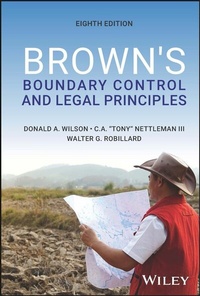
Brown's Boundary Control and Legal Principles
Description

The latest edition of the industry-leading reference to boundary law for property surveying
In the newly revised eighth edition of Brown's Boundary Control and Legal Principles, a team of distinguished surveying professionals delivers an updated and expanded treatment of the latest in surveying technology and surveying caselaw. This classic reference to boundary law principles for property surveying continues to evolve, covering all relevant and necessary information related to the complex area of boundary law.
The book offers a wealth of case studies on federal and state rectangular and non-sectionalized land surveys demonstrating real-world examples. It provides numerous illustrations highlighting the concepts discussed within, and is an essential reference tool for professionals and students in the area, providing:
* A thorough introduction to the foundational principles of boundary surveying and property rights
* Comprehensive explorations of decision-making in professional boundary surveying
* Practical discussions of the legal principles governing land surveying, land boundaries, and land rights
* A holistic combination of law and surveying that's ideal as a reference tool and as a learning tool
Perfect for practicing surveyors and those studying for the Fundamentals of Surveying (FS) licensing exam, Brown's Boundary Control and Legal Principles will also benefit undergraduate and graduate students of surveying programs, as well as lawyers who practice in the areas of real estate, land, and property law.
More details
Other editions
Additional editions
Persons
Donald A. Wilson is President of Donald Wilson Consulting, LLC.
C.A. "Tony" Nettleman III is President and CEO of Nettleman Land Consultants, Inc. and Director of the Nettleman Institute of Land Surveying Engineering Technology, Inc.
Walter G. Robillard is a Retired Surveyor.
Content
Preface xvii
Chapter 1 History and Concept of Boundaries 1
1.1 Introduction 1
1.2 Significance of Boundaries 3
1.3 Boundary References 4
1.4 Terminus: The God (or Goddess) of Boundaries 6
1.5 Disputes and Boundaries 7
1.6 Role of the Surveyor in Boundaries 9
1.7 What is Being Created? What is Being Located? 13
1.8 Original Written Title 15
1.9 Rights and Interests in Land are Composed of a Bundle of Rights 16
1.10 Role of the Court 20
1.11 Real and Personal Property 21
1.12 What Constitutes Real Property 22
1.13 Nature of Modern Estates 25
1.14 Taxes on Land and Tax Maps 25
1.15 Easements and Licenses 26
1.16 Servitudes, Restrictions, Covenants, and Conditions 30
1.17 Actions on Boundaries and Easements 31
1.18 One Unique Parcel or Boundary 32
1.19 The Original Boundaries are Sacred 32
1.20 Conclusions 33
Bibliography 34
Notes 34
Chapter 2 How Boundaries are Created 36
2.1 Introduction 36
2.2 Definitions 37
2.3 Classification of Boundaries 40
2.4 Methods of Boundary Creation 41
2.5 Who May Create Boundaries? 45
2.6 Sanctity of the Original Survey 48
2.7 Original Lines Remain Fixed 49
2.8 Distinctions Between the Original Boundary Survey, the Retracement Survey, and the First Survey 49
2.9 Original Technological Methods of Boundary Creation not Relatable to Modern Methods 51
2.10 Original Lines may be Redescribed as a Result of a Retracement 51
2.11 Conclusions 52
Notes 53
Chapter 3 Ownership, Transfer, and Description of Real Property and Accompanying Rights 54
3.1 Concepts of Boundaries, Land Ownership, and Land Descriptions 54
3.2 Overview of Boundaries 56
3.3 Public and Private Lands 59
3.4 Sources of Title 60
3.5 Voluntary Transfer of Real Property 61
3.6 Chain of Title 61
3.7 Torrens Title System 63
3.8 Unwritten Rights or Title to Land 63
3.9 Methods of Voluntary Transfer of Title 64
3.10 Deed or Description 65
3.11 Title or Lien 66
3.12 Deed of Trust 66
3.13 Mortgage 67
3.14 Escrow 67
3.15 Title assurance and Title Insurance 67
3.16 Abstractors 69
3.17 Attorney's Opinion 69
3.18 General land Descriptions 69
3.19 What is in a Description? 70
3.20 Measurements 71
3.21 Magnetic Directions 75
3.22 Reference Datums 77
3.23 Elements of Land Descriptions 78
3.24 Types of Descriptions 79
3.25 Conclusions 81
Notes 81
Chapter 4 Boundaries, Law, and Related Presumptions 83
4.1 Introduction 83
4.2 Constitutional Law and the Surveyor 84
4.3 Jurisdiction 85
4.4 Federal Jurisdiction 85
4.5 Federal Government, Agency, or Officer as a Party 86
4.6 Sovereign Immunity 87
4.7 United States as a Defendant 87
4.8 Disposing of Federal Lands 87
4.9 Color of Title Act 88
4.10 Public Law 120 88
4.11 Small Tracts Act 88
4.12 Researching the Laws 89
4.13 Court Reports 90
4.14 Legal Research 90
4.15 Judicial Notice 92
4.16 Evidence 93
4.17 Presumptions 94
4.18 Common Presumptions 95
4.19 Survey Systems Present in the United States 97
4.20 Conclusions 100
Bibliography 100
Notes 100
Chapter 5 Creation and Interpretation of Metes and Bounds and other Nonsectionalized Descriptions 102
5.1 Introduction 102
5.2 Methods of Creating Metes and Bounds or Nonsectionalized Descriptions 106
5.3 Metes Descriptions 106
5.4 Bounds Descriptions 109
5.5 Combination Metes and Bounds Descriptions 110
5.6 Strip Descriptions and Stationing 111
5.7 Descriptions by Reference 112
5.8 Aliquot Descriptions 112
5.9 Other Means of Creating Boundaries in Descriptions 114
5.10 Nomenclature in Metes and Bounds Descriptions 116
5.11 Adjoiners 124
5.12 Deed Terms for Curves 124
5.13 Lines and Their Elements 126
5.14 Tax Descriptions and Abbreviated Descriptions 133
5.15 Subdivision Descriptions 135
5.16 Parcels Created by Protraction 137
5.17 Features of Platting Acts 137
5.18 Writing Land Descriptions 138
5.19 Early Surveys 139
5.20 Priority of Calls in Metes and Bounds Surveys 141
5.21 Applying Priority Calls 142
5.22 Conclusions 144
Notes 145
Chapter 6 Creation and Retracement of General Land Office (GLO) Boundaries 146
6.1 Introduction 146
6.2 Original Surveys and Corrective Surveys 149
6.3 Law, Manuals, and Special Instructions 149
6.4 Effect of Manuals on Resurveys 150
6.5 History of The Public Land Survey System 151
6.6 Testing Ground: The Seven Ranges 153
6.7 Act of May 18, 1796-Clarification of 1785 157
6.8 Acts of 1800 159
6.9 1803-The System Explodes 162
6.10 Act of March 26, 1804 163
6.11 Act of February 11, 1805 163
6.12 Land Surveys After 1805 166
6.13 Survey Instructions 167
6.14 State Instructions and Statutes 172
6.15 Instruments Used 180
6.16 Field Notes 181
6.17 Nomenclature for Sections 181
6.18 Meandering 182
6.19 Resurveys and Retracements 183
6.20 Defective Boundaries Encountered in Resurveys 183
6.21 Sectionalized Surveys and Innovations 184
6.22 Irregular Original Government Subdivisions 184
6.23 Townships Other than Regular 185
6.24 Locating GLO Records in State Archives 185
6.25 Summary of the GLO System 187
Notes 190
Chapter 7 Federal and State Nonsectionalized Land Surveys 191
7.1 Introduction 191
7.2 Early New England and Other Colonial-ERA Surveys 195
7.3 Ohio Company of Associates 195
7.4 Donation Tract 196
7.5 Symmes Purchase 197
7.6 Virginia Military District 197
7.7 US Military Tract 198
7.8 Connecticut Western Reserve and Firelands 199
7.9 Moravian Tracts 199
7.10 Florida Keys Survey 199
7.11 Donation Land Claims 200
7.12 Exchange Surveys and Their Status 200
7.13 Prior Land Grants from Foreign Governments 201
7.14 French Grants in the Louisiana Purchase 201
7.15 Mississippi Townships 205
7.16 Soldier's Additional Homestead 206
7.17 Indian Allotment Surveys 206
7.18 National Forest Homestead Entry 206
7.19 Tennessee Townships 207
7.20 Florida: Forbes Company Purchase Surveys 208
7.21 Georgia Lot System 209
7.22 Land Tenure Systems of Texas 213
7.23 General Comments 214
7.24 Hawaiian Land Laws 214
7.25 Puerto Rican Land Surveys 217
7.26 Federal Mineral Surveys: General Comments 220
7.27 Water and Mineral Right Laws 220
7.28 Land Open to Appropriation of Minerals 221
7.29 Veins, Lodes, or Ledges 221
7.30 Extralateral and Intralimital Rights 222
7.31 Mill Sites 224
7.32 Tunnel Locations 224
7.33 Size of Claims 224
7.34 Discovery 225
7.35 Locations 225
7.36 Possession 226
7.37 Annual Expenditures 226
7.38 Requirements for Patent 227
7.39 United States Mineral Surveyors 227
7.40 Survey of the Claim 227
7.41 Conclusions 228
Recommended Reading 229
Notes 229
Chapter 8 Locating Easements and Reversions 230
8.1 Introduction 230
8.2 Rights Granted 233
8.3 Fee Title or Easement Right 236
8.4 Three Easement Descriptions and Three Boundaries 237
8.5 Ownership of the Bed of Easements 237
8.6 Surveyor's Responsibility as to Easements 238
8.7 Requirements for Locating Easements 238
8.8 Centerline Presumption 239
8.9 Conveyances with Private Way Boundaries 240
8.10 Use of Easements 241
8.11 Revival of Public Easements 241
8.12 Creation of Easement Boundaries 241
8.13 Dividing Private Street Ownership 244
8.14 Words Used in Centerline Conveyances 245
8.15 Apportioning Reversion Rights 246
8.16 General Principle of Reversion 246
8.17 Reversion Rights of a Lot on a Curved Street 247
8.18 Lots Adjoining Two Subdivision Boundaries 249
8.19 Lots at an Angle Point in a Road 249
8.20 Indeterminate Situations 250
8.21 Exceptions to the Rules of Apportionment 251
8.22 Describing Vacated Streets and Easements 252
8.23 Litigating Easements 254
8.24 Conclusions 254
Notes 254
Chapter 9 Riparian and Littoral Boundaries 256
9.1 Introduction 256
9.2 Ownership of the Seas 2 260
9.3 Ownership of the US Territorial Sea 261
9.4 Ownership of Interior Tidal Waters of the United States 263
9.5 Landward Boundary of Tidal Waters 263
9.6 Ownership of Nontidal Navigable Waters 267
9.7 Landward Boundaries of Nontidal Waters 268
9.8 Significance of Public Land Survey Meander Lines 27 269
9.9 Ownership of Non-Publicly Owned Submerged Lands 270
9.10 Swamp and Overflowed Lands 272
9.11 Navigational Servitude 273
9.12 Public Regulation of Riparian and Littoral Lands 273
9.13 Shoreline Changes and Water Boundaries 274
9.14 Apportionment of Riparian and Littoral Rights 276
9.15 Emergent or Omitted Islands 282
9.16 Water Boundaries Other Than Sea 282
9.17 Major Recognized Areas 283
9.18 Conclusions and Recommendations 283
Notes 283
Chapter 10 Retracing and "resurveying" Sectionalized Lands 286
10.1 Introduction 286
10.2 Areas of Authority 292
10.3 Resurvey or Retracement 293
10.4 Types of Surveys and Resurveys 294
10.5 Court of Proper Jurisdiction 295
10.6 Federal Patents 296
10.7 Intent of the Government 296
10.8 Senior Rights 297
10.9 Following the Footsteps 297
10.10 Lines Marked and Surveyed 298
10.11 Original Corners 298
10.12 Original Field Notes and Plats 299
10.13 Closing Corners 300
10.14 Identification of Corners and Lines 301
10.15 Monuments and Their Identification 302
10.16 Evidence of Corners 303
10.17 Use of Testimony in Boundaries 304
10.18 Common Usage 305
10.19 Using Recorded Information to Locate Original Lines 306
10.20 Proportioning: The Last Resort 306
10.21 Relocating Lost Corners 307
10.22 Proportionate Measure or Proration 309
10.23 Single Proportionate Measurement 309
10.24 Double Proportionate Measurement 310
10.25 Restoration of Lost Standard Corners on Standard Parallels, Correction Lines, and Baselines 312
10.26 Restoration of Lost Township Corners on Principal Meridians and Guide Meridians 312
10.27 Restoration of Lost Township and Section Corners Originally Established with Cross-Ties in Four Directions 313
10.28 Restoration of Lost Corners Along Township Lines 313
10.29 Restoration of Lost Township and Section Corners Where the Line was not Established in One Direction 314
10.30 Restoration of Lost Corners Where the Intersecting Lines have been Established in Only Two Directions 315
10.31 Restoration of Quarter-Section Corners in Regular Sections 316
10.32 Restoration of Quarter-Section Corners Where only Part of A Section was Surveyed Originally 316
10.33 Restoration of a Closing Section Corner on a Standard Parallel 316
10.34 Restoration of a Lost North Quarter Corner in a Closing Section 318
10.35 Restoration of Lost Nonriparian Meander Corners 319
10.36 Restoration of Riparian Meander Lines 319
10.37 Restoration of Nonriparian Meander Lines 320
10.38 Restoration of Irregular Exteriors 321
10.39 Lost Corner Restoration Methods 321
10.40 Resurvey Instructions Issued in 1879 and 1883 321
10.41 Half-Mile Posts in Florida and Alabama 322
Subdivision of Sections 323
10.42 General Comments 323
10.43 Subdivision by Protraction 323
10.44 Establishing the North Quarter Corner of Closing Sections on a Standard Parallel and other Quarter Corners not Originally Set 324
10.45 Establishment of Centerlines and Center Quarter Corners 325
10.46 Establishment of Quarter-Quarter Section Lines and Corners 327
10.47 Fractional Sections Centerline 327
10.48 Senior Right of Lines 328
10.49 Gross Errors and Erroneously Omitted Areas 328
10.50 Relocating Corners from other Townships or From Interior Corners 330
10.51 Procedures for Conducting Retracements 331
10.52 Interpretation of Aliquot Descriptions 332
10.53 According to the Government Measure 334
Differences Between State and Federal Interpretations 334
10.54 Applying State Laws 334
10.55 Topography 335
10.56 Boundaries by Area 336
10.57 Establishing Corners 337
10.58 Sections Created Under State Jurisdiction 337
10.59 Presumptions and Realities for GLO Surveys 338
10.60 Conclusions 341
Notes 341
Chapter 11 Locating Sequential Conveyances 343
11.1 Introduction 343
11.2 Definition of Sequential Conveyances 347
11.3 Simultaneous Conveyances 347
11.4 Possession 348
11.5 Sequential Patents 348
11.6 Importance of Knowledge 348
11.7 Junior and Senior Rights Between Private Parties 349
11.8 Junior and Senior Rights Between Private Parties; Exception 350
11.9 Deeds Must be in Writing and Deemed to be Whole 350
11.10 Direction of the Survey 351
11.11 Terms of the Deed 352
11.12 Call for a Plat 352
11.13 Informative and Controlling Terms 353
Order of Importance of Conflicting Title Elements 354
11.14 General Comments 354
11.15 Senior Rights 355
11.16 Call for an Adjoiner 356
11.17 Written Intentions of the Parties to the Deed 357
11.18 Aids to Interpret the Intent of a Deed 358
11.19 Control of Unwritten Title Lines 359
11.20 Lines Marked and Surveyed 359
11.21 Corner Definitions 361
11.22 Control of Monuments 362
11.23 Control Between Conflicting Monuments 364
11.24 Explanation of the Principles 365
11.25 Importance of the Word "TO" 369
11.26 Dignity of Record Monuments 369
11.27 Control Point of a Monument 369
11.28 Uncalled-For Monuments 370
11.29 Error or Mistake in a Description 371
11.30 Control of Bearing and Distance 371
11.31 Control of Either Bearing or Distance 372
11.32 Distribution of Errors in Several Boundary Lines 375
11.33 Cardinal Directions 376
11.34 Unrestricted General Terms 377
11.35 Direction of Survey 377
11.36 Area or Surface 378
11.37 Point of Beginning 379
11.38 Construed Most Strongly Against Grantor 379
11.39 Errors and Ambiguous Terms 379
11.40 Coordinates 380
11.41 Direct Line Measurement 381
11.42 Treatment of Curves 382
11.43 First Stated Conditions 382
11.44 Written and Character Numbers 383
11.45 Unit Implied 383
11.46 Feet and Inches 383
11.47 General and Particular Provisions 383
Basis of Bearings 384
11.48 Deflection Method Versus Compass Bearings 384
11.49 Sequential Conveyances in Texas 388
11.50 Summary, Interpretation of the Principles, and Conclusion 389
Bibliography 390
Notes 390
Chapter 12 Locating Simultaneously Created Boundaries 393
12.1 Introduction 393
12.2 Defining Subdivisions 397
Subdivision Boundaries and corners 398
12.3 Aliquot Part Subdivision 398
12.4 Controlling Boundaries 398
12.5 Subdivision Macro Boundary Wrongly Monumented 400
12.6 Subdivision Boundaries Incorrectly Described 401
Conflicting Elements in Descriptions 401
12.7 General Comments 401
12.8 Original Method of Creating Lots 401
12.9 Intention of the Parties 402
12.10 Finality of Original Lines 402
12.11 Control of Original Monuments within Subdivision Boundaries 404
12.12 Title Monuments 405
12.13 Control of Monuments Over Plats 405
12.14 Certainty of Monument Identification 406
12.15 Record Description of Monuments 406
12.16 Principles for Presumed Control Between Conflicting Monuments Within Subdivisions 407
12.17 Explaining Principles 407
12.18 Introduction to Proportioning 411
Establishment of Streets 412
12.19 General Comments 412
12.20 Establishment of Streets by Natural Monuments 412
12.21 Establishment of Streets and Alleys By Artificial Monuments and Lines Actually Run at The Time of Making The Plat 413
12.22 Establishment of Streets by Improvements 415
12.23 Establishment of Streets by the Line of a Nearby Street 416
12.24 Establishment of Streets by Plat 417
12.25 Establishment of Streets Where Width is not Given 418
12.26 Establishment of Streets by City Engineers' Monuments 418
Establishment of Lots within Subdivisions 420
12.27 Effect of Mathematical Error 420
12.28 Excess or Deficiency 421
12.29 Proration: A Rule of Last Resort 421
12.30 Excess OR Deficiency Confined to a Block 422
12.31 Excess OR Deficiency Distribution Within Blocks 422
12.32 Single Proportionate Measure 423
12.33 Single Proportionate Measure on Curves 424
12.34 Distribution of Excess and Deficiency Beyond a Monument 426
12.35 Establishment of Lots Where the End Lot Measurement is not Given 427
12.36 Remnant Principle 427
12.37 Establishment of Lots Where no Lot Measurement is Given 432
12.38 Establishment of Lots with Area only Given 432
12.39 New York Rule for Establishment of Lots 433
12.40 Summary of Proration Rules 436
12.41 Establishment of Lots Adjoining Subdivision Boundaries 437
12.42 Establishment of Lots Adjoining a Subdivision Correctly Established 437
12.43 Establishment of Lots Overlapping the True Subdivision Boundaries 437
12.44 Establishment of Lots not Touching the True Boundary of the Subdivision 438
12.45 Proration of Excess and Deficiency in Blocks Closing on Subdivision Boundaries 439
12.46 Locating Lots from Boundary Lines 440
12.47 Obliterated and Lost Subdivisions 440
Proceedings in Partition 441
12.48 General Comments 441
12.49 Establishment of Lines Determined by Proceedings in Partition 441
12.50 Establishment of Boundaries of Allottees of Wills 442
12.51 Deed Divisions 442
12.52 Comments 442
Notes 443
Chapter 13 Locating Combination Descriptions and Conveyances 445
13.1 Introduction 445
"OF" Descriptions 447
13.2 "OF," "IN," and "AT" Descriptions within Subdivisions and Adjoining Streets 447
13.3 "OF" Descriptions within Metes and Bounds Descriptions and Adjoining Streets 449
13.4 Direction of Measurement 452
13.5 Proportional "OF" Conveyance 452
13.6 Exception by One-Half by Area 454
13.7 Indeterminate Proportional Conveyances 455
13.8 Angular Direction of the Dividing Line in "OF" Descriptions 455
13.9 Acreage "OF" Descriptions 458
13.10 Ambiguity 460
Overlaps and Gaps 463
13.11 Calls From Two Directions 463
Establishment of Property Described by Both Metes and Bounds and Subdivision Descriptions 464
13.12 Double Descriptions 464
13.13 New York Double Descriptions 465
13.14 Natural Phenomena and Boundaries 465
13.15 Recognition of Past Events 469
Notes 471
Chapter 14 Role of the Surveyor 472
14.1 Introduction 472
14.2 Function of the Surveyor 474
14.3 Opinions of Fact and Applications of Law 474
14.4 Establishment of Boundaries 476
14.5 Establishment in Louisiana 477
Private Surveys 477
14.6 Responsibility and Authority of the Surveyor 477
14.7 Basis of a Boundary Survey 479
14.8 How Much Research? 479
14.9 Ownership 481
14.10 Encroachments 481
14.11 Searching for Monuments 481
14.12 Possession Marking Original Survey Lines 482
14.13 Evidence 483
14.14 Setting Monuments 483
14.15 Plats 484
14.16 Liability 485
14.17 Conclusion 486
Notes 488
Chapter 15 The Ethics and Moral Responsibilities of Boundary Creation and Retracements 489
15.1 Introduction 489
15.2 The Philosophy of Boundaries 490
15.3 Applying the Principles to Creating and Retracing Boundaries 492
15.4 Final Comments 497
Notes 498
Glossary of Terms 499
Index 525
CHAPTER 1
HISTORY AND CONCEPT OF BOUNDARIES
1.1 INTRODUCTION
The history and location of boundaries are steeped in the history of the world from the time before records were kept to today. These boundaries are a result of actions of individuals and nations and law. Boundaries can be related to the areas of history, politics, surveying, and law. Both boundaries of an international nature and those between individuals have caused problems that have been fought, are still being fought, and will continue to be fought in the future over their locations between nations, states, and individual parcels of land within "Happy Acres" subdivisions. In recent years, both local and international judicial tribunals have had to apply old, proven doctrines and have created new legal doctrines to resolve boundary issues. One cannot pick up a newspaper or a magazine without reading about some individual or nation with a boundary issue that is new or that has been festering for many years.
Wars have been fought both on an international scale and in local neighborhoods, and people have been killed over boundary disputes of an inconsequential nature involving pieces of land that have ranged from hundreds of miles to a fraction of a foot or meter. Boundaries are personal in nature, and people have been and will continue to be protective about the misidentification or misalignment of a known or perceived boundary infringement. The surveyor may become the common factor in a boundary problem, as a result of, for example, preparing an erroneous map showing the boundary between two or more nations or the erroneous depiction of a single line between two landowners.
Even after modern boundary issues have been, seemingly, resolved, members of both the legal profession and the surveying profession may question the results, asking incredulously, "How could the court do that?" Both the trial attorney and the testifying survey expert could not believe the court disregarded the case law on the subject.
In the primeval forest, particularly in the plant kingdom, there are no known boundaries between living things. Although some horticulturists dispute this, we accept the fact that plants do not create boundaries to separate themselves. Animals-especially humans-do create boundaries. We like to think that only humans create and appreciate boundaries, but it has been observed in nature that most mammals, some reptiles, and a few fish create, identify, mark, and defend boundaries.
In this book, we discuss the creation, identification, description, and recovery of boundaries among people. We do not include the recovery and interpretation of the evidence of once-created boundaries; rather, we examine how boundaries are created, how they are described, and the technical legal and ethical ramifications of such boundaries that separate rights, both real and perceived, in real property.
Some boundaries are created in a random manner, whereas others are created according to preconceived plans, identified by any manner of a written description(s), and then litigated according to common law, case law, or statute law1. Although it is not our intent in this book to dwell on the creation of boundaries by the lower forms of animal life, their actions in creating boundaries should be examined, because certain principles are similar. Many of these boundaries humans create remain for generations and, when they are retraced by modern methods and with a modern approach, may cause technical and legal problems for today's surveyors and courts.
Field examinations and studies by naturalists have revealed that most animals really do not create boundaries per se. However, it is recognized that they usually create terminal points (corners) and then identify the boundaries between these points,2 although lower forms of animals may create boundaries that are not necessarily of a permanent nature.
Humans usually create boundaries in several ways. For the sake of simplicity, these may be placed in the following categories:
- By action. Physical acts create a line and points on the ground. This is followed by placing actual monuments at the corner points and identifying these points (corners) and line objects. The lines and objects are then described and may be identified on plats or in field notes. This evidence created and left "on the ground" becomes the proof of the original work and lines and becomes the legal controlling factor in conducting retracements.
- By writings. The written word becomes the method of creation when a person describes corners and/or lines in a deed and then conveys to these described lines, prior to the completion of a survey. The problem is created when what the surveyor places on the ground is and then fails to create a solid paper trail.
- By law. Ancient common and modern statutes are relied on to create, modify, and relocate many modern boundaries.
The following principles are introduced in this chapter and discussed in detail in later chapters:
PRINCIPLE 1. Boundaries enjoy a long history in both mythology and Judaic-Christian history. PRINCIPLE 2. A surveyor creates land boundaries. These created lines, which are separate and distinct from property lines, are determined by legal principles and law. PRINCIPLE 3. A described closed boundary identifies a claim of right to any property interest for which any person can make a claim of possession through a claim of title. These boundaries may be either macro or micro in nature. PRINCIPLE 4. A person or landowner can legally convey only the quality and quantity of interest in land to which he or she has title. PRINCIPLE 5. In most instances, there are no federal laws describing real property rights. PRINCIPLE 6. Although there are no federal laws of real property, property rights are identified by the state laws and are protected under the US Constitution. PRINCIPLE 7. Real property rights are determined according to the laws in effect in the particular locale where the land is located. English common law is the predominant law, and it is described as the lex loci. PRINCIPLE 8. Once boundary lines are created, the contiguous lines may, by law or by the actions of landowners who have vested rights, be changed or altered. PRINCIPLE 9. Law does not provide for two original descriptions of the same parcel. PRINCIPLE 10. Multiple boundary descriptions may exist for the same parcel, but only one is controlling. PRINCIPLE 11. There can be only one original boundary survey and description; all subsequent ones are retracements. PRINCIPLE 12. A resurvey can be conducted only by the entity who conducted the original survey. The law provides for resurveys of parcels, but only on a limited basis and under certain restrictions, the main one being that the bona fide property rights granted under the previous survey are not jeopardized. Two classes of resurveys are recognized: dependent resurveys and independent resurveys.1.2 SIGNIFICANCE OF BOUNDARIES
The description of property by surveys and landmarks and by reference to boundaries is very ancient. Basically, property interests are separated by boundaries. From precolonial times in the United States, many wars, both local and regional, have been fought and people have been killed as a result of disputed boundaries. This problem was probably inherited from the European continent when the United States adopted English common law as the basis of its common law.
In Great Britain and in Europe, territorial boundaries have, for the most part, generally been stable because the lines were etched in antiquity. Once parish boundaries were established in England-many during Roman times-they formed invisible webs or lines around families and bound them into communities, and ultimately separated communities from one another. This historical background was passed on to the United States, and these distinctions exist today as a result of this influence.
Stories abound in both the United States and Great Britain in which boundaries have affected people's lives. Individuals and groups go to extremes over boundaries, for a boundary can have political ramifications in areas such as citizenship and jurisdiction in legal matters. A tale from colonial times tells of the decision of surveyors who were engaged to run the boundary line between Kentucky and Tennessee to place a jog in the line when a landowner placed a jug of rum near his property and told the surveyors that it was theirs if they found it to be in Kentucky. They did. Naturally, the line has a jog in it. One of the authors of this book, Walt Robillard, remembers that when he was a young boy growing up near the Canadian border, his grandfather would take him to a tavern that straddled the US-Canadian border. On the US side of the bar, the serving of drinks stopped at midnight and was "never on Sunday"; however, on the Canadian side, the drinking continued. At the stroke of midnight and on...
