

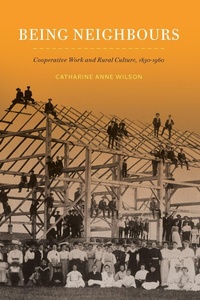
Being Neighbours
Cooperative Work and Rural Culture, 1830-1960
1st Edition
Published on 28. October 2022
448 pages
978-0-2280-1588-8 (ISBN)
Description

Throughout history, farm families have shared work and equipment with their neighbours to complete labour-intensive, time-sensitive, and time-consuming tasks. They benefitted materially and socially from these voluntary, flexible, loosely structured networks of reciprocal assistance, making neighbourliness a vital but overlooked aspect of agricultural change.
Being Neighbours takes us into the heart of neighbourhood - the set of people near and surrounding the family - through an examination of work bees in southern Ontario from 1830 to 1960. The bee was a special event where people gathered to work on a neighbour's farm like bees in a hive for a wide variety of purposes, including barn raising, logging, threshing, quilting, turkey plucking, and apple paring. Drawing on the diaries of over one hundred men and women, Catharine Wilson takes readers into families' daily lives, the intricacies of their labour exchange, and their workways, feasts, and hospitality. Through the prism of the bee and a close reading of the diaries, she uncovers the subtle social politics of mutual dependency, the expectations neighbours had of each other, and their ways of managing conflict and crisis. This book adds to the literature on cooperative work that focuses on evaluating its economic efficiency and complicates histories of capitalism that place communal values at odds with market orientation.
Beautifully written, engaging, and richly detailed and illustrated, Being Neighbours reveals the visceral textures of rural life.
Being Neighbours takes us into the heart of neighbourhood - the set of people near and surrounding the family - through an examination of work bees in southern Ontario from 1830 to 1960. The bee was a special event where people gathered to work on a neighbour's farm like bees in a hive for a wide variety of purposes, including barn raising, logging, threshing, quilting, turkey plucking, and apple paring. Drawing on the diaries of over one hundred men and women, Catharine Wilson takes readers into families' daily lives, the intricacies of their labour exchange, and their workways, feasts, and hospitality. Through the prism of the bee and a close reading of the diaries, she uncovers the subtle social politics of mutual dependency, the expectations neighbours had of each other, and their ways of managing conflict and crisis. This book adds to the literature on cooperative work that focuses on evaluating its economic efficiency and complicates histories of capitalism that place communal values at odds with market orientation.
Beautifully written, engaging, and richly detailed and illustrated, Being Neighbours reveals the visceral textures of rural life.
Reviews / Votes
"Catharine Wilson renders visible the social bonds of neighbouring and the complexity of rural life. Her in-depth examination allows a greater understanding of the inherent tensions in these work arrangements and the neighbourhoods that sustained them, dismantling some of the romantic glow of rural culture in a 'simpler time.' One of the most important works on rural culture in many years." Joe Anderson, Mount Royal University and author of Capitalist Pigs: Pigs, Pork, and Power in America "This very welcome and richly exampled book provides a vivid and thought-provoking account of the life of 'bees' -moments of co-operative labour - on the farms of southern Ontario from the mid nineteenth to the mid-twentieth century." Family & Community History "This deeply researched and well-documented book skillfully reflects on rural farm life and the concept of a neighborhood. Wilson's expertise is evident as she maintains a connection to the individual people within the network even as she examines the larger context of cooperative work, rural life, and neighborhood. ...[T]hough the diaries used are specific to rural Ontario, the themes, struggles, and successes postulated by Wilson will resonate with readers across North America interested in historical rural culture. This is a great read for those interested in cooperative work, rural life, and the concept of neighborhoods." H-Net Reviews "[Being Neighbours] explores bees' economic and social significance, ground rules and aberrations, moral and technological dimensions. It skillfully situates the story within broader literature on rural order, dispute resolution and cooperative labour. Engaging writing and plentiful photographs add to the appeal of this groundbreaking Work." Champlain Society Floyd S. Chalmers Award juryMore details
Series
Language
English
Place of publication
Canada
Canada
Target group
Professional and scholarly
Illustrations
44 photos, 9 tables, 3 diagrams
File size
11,59 MB
ISBN-13
978-0-2280-1588-8 (9780228015888)
Copyright in bibliographic data and cover images is held by Nielsen Book Services Limited or by the publishers or by their respective licensors: all rights reserved.
Schweitzer Classification
Other editions
Additional editions

Book
10/2022
McGill-Queen's University Press
€172.61
Shipment within 15-20 days

Book
10/2022
McGill-Queen's University Press
€42.50
Shipment within 15-20 days
Person
Catharine Anne Wilson, FRSC, is Francis and Ruth Redelmeier Professor in Rural History at the University of Guelph and founder, director of the Rural Diary Archive website, and the author of Tenants in Time: Family Strategies, Land, and Liberalism in Upper Canada, 1799-1871.
Content
- Cover
- BEING NEIGHBOURS
- Title
- Copyright
- Dedication
- CONTENTS
- Tables and Figures
- Acknowledgments
- Introduction Bee-ing Neighbours
- 1 Busy Bees The Types of Bees, Their Frequency, and Work Processes
- 2 The Bee Network Inclusion, Household Engagement, and Equalizing the Exchange
- 3 The Quilting Bee Time, Space, Neighbourhood Aesthetics, and Collective Memory
- 4 "Yo Heave" - The Spirit of Increase Raising the Barn, Agricultural Practise, Hospitality, and Collective Memory
- 5 Threshing Bees New Technologies and Business Arrangements
- 6 "If There Is Honey, the Bees Will Come" Foodways and Foodscapes of Plenty
- 7 Killer Bees Accidents, Violence, and Timely Resolutions
- 8 Buzzing Off The Decline of Bees
- Conclusion Wrap-Up and Legacy
- Appendix A: Table of Diarists
- Appendix B: Tables
- Notes
- Bibliography
- Index
