

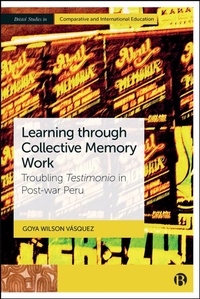
Learning through Collective Memory Work
Troubling Testimonio in Post-war Peru
1st Edition
Published on 30. January 2025
248 pages
978-1-5292-3788-7 (ISBN)
Description

This book traces the process of producing testimonio with the children of the Tupac Amaru Revolutionary Movement (MRTA), an insurgent group during Peru's internal war (1980-2000). It examines how the group navigates post-war struggles over memory while dealing with the 'children of terrorists' stigma.
Drawing on a cycles of inquiry approach, the book theorizes three movements for memory work: a realist presentation of testimonial narratives, a 'politics of memory' engaging with the conditions of production and a 'poetics of memory' that troubles memory, voice and representation for qualitative inquiry in post-war contexts.
Challenging the notion of war-torn countries as pure devastation, the author invites readers to see them as sites of knowledge and creativity, with much to offer for education, peace studies and social justice research.
Drawing on a cycles of inquiry approach, the book theorizes three movements for memory work: a realist presentation of testimonial narratives, a 'politics of memory' engaging with the conditions of production and a 'poetics of memory' that troubles memory, voice and representation for qualitative inquiry in post-war contexts.
Challenging the notion of war-torn countries as pure devastation, the author invites readers to see them as sites of knowledge and creativity, with much to offer for education, peace studies and social justice research.
Reviews / Votes
"This is an utterly astonishing read. Moving in its content. Flowing in its style. And breathtaking in its ambition. You will forever think very differently about the politically difficult questions of memory, testimonials and truth." Susan L. Robertson, University of Cambridge "Framed by a deep engagement with spatial awareness, Goya Wilson Va?squez walks and talks with the participants in her study, visiting places of their choosing, including prisons and graves. Throughout, she brings her compassion and imagination to this activist research, presenting a moving counter-history." Molly Andrews, Co-director Association for Narrative Research and PracticeMore details
Series
Edition
First Edition
Language
English
Place of publication
Bristol
United Kingdom
Target group
Professional and scholarly
Product notice
Reflowable
Illustrations
2 Illustrations, black and white
File size
1,53 MB
ISBN-13
978-1-5292-3788-7 (9781529237887)
Copyright in bibliographic data and cover images is held by Nielsen Book Services Limited or by the publishers or by their respective licensors: all rights reserved.
Schweitzer Classification
Other editions
Additional editions
Book
approx. 07/2026
1st Edition
Bristol University Press
€35.00
Not yet published
Book
01/2025
1st Edition
Bristol University Press
€129.50
Shipment within 3-4 weeks
Person
Goya Wilson Vasquez is a researcher affiliated to the University of Bristol. She works on memory struggles and creative/radical methodologies from Latin America by examining the dilemmas of writing violence, the intersections between research and activism, and the uses of creativity/imagination in memory work.
Content
1. Introduction
2. The Story of the Inquiry
Part 1: The First Movement - Testimonial Narratives
3. Adelin: Political Prisoners in the Family
4. Miguel: Experiences of Exile
5. Iris: Growing Up Visiting Prison
6. Rafael: Living under Silence
7. Abel: Knowing More than You Should
8. Willy: Remembering Torture
Part 2: The Second Movement - Politics of Memory
9. Spaces/Places: Working Out Testimonial Spaces
10. Silences, Secrets and Clandestine Lives
Part 3: The Third Movement - Poetics of Memory
11. Troubles with Fiction, Writing and Memory
12. Writing (about) Violence
13. Epilogue: Testimonio as Pedagogy
2. The Story of the Inquiry
Part 1: The First Movement - Testimonial Narratives
3. Adelin: Political Prisoners in the Family
4. Miguel: Experiences of Exile
5. Iris: Growing Up Visiting Prison
6. Rafael: Living under Silence
7. Abel: Knowing More than You Should
8. Willy: Remembering Torture
Part 2: The Second Movement - Politics of Memory
9. Spaces/Places: Working Out Testimonial Spaces
10. Silences, Secrets and Clandestine Lives
Part 3: The Third Movement - Poetics of Memory
11. Troubles with Fiction, Writing and Memory
12. Writing (about) Violence
13. Epilogue: Testimonio as Pedagogy
