

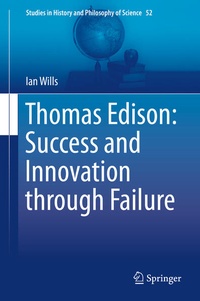
Thomas Edison: Success and Innovation through Failure
Description

This book develops a systematic approach to the role of failure in innovation, using the laboratory notebooks of America's most successful inventor, Thomas Edison. It argues that Edison's active pursuit of failure and innovative uses of failure as a tool were crucial to his success. From this the author argues that not only should we expect innovations to fail but that there are good reasons to want them to fail. Using Edison's laboratory notebooks, written as he worked and before he knew the outcome we see the many false starts, wrong directions and failures that he worked through on his way to producing revolutionary inventions. While Edison's strengths in exploiting failure made him the icon of American inventors, they could also be liabilities when he moved from one field to another. Not only is this book of value to readers with an interest in the history of technology and American invention, its insights are important to those who seek to innovate and to those who employ and finance them.
More details
Other editions
Additional editions
Person
Ian turned to the history and philosophy of science after a career in engineering. His PhD dissertation focused on the history and philosophy of technology using Thomas Edison's laboratory notebooks to understand the processes by which novel artefacts are created.
Subsequent work included industrial heritage in Australia; the science of F W Taylor's Scientific Management; and the Great Strike of 1917. His current interests include Australia's failed attempt to build nuclear weapons; the history of manufacturing in Australia; and manufacturing's interaction with Australian history more broadly.
