

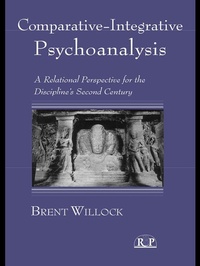
Comparative-Integrative Psychoanalysis
A Relational Perspective for the Discipline's Second Century
Published on 20. May 2011
256 pages
978-1-136-87150-4 (ISBN)
Description

Finalist for the 2007 Goethe Award for Psychoanalytic Scholarship!
This exceptionally practical and insightful new text explores the emerging field of comparative-integrative psychoanalysis. It provides an invaluable framework for approaching the currently fractious state of the psychoanalytic discipline, divided as it is into diverse schools of thought, presenting many conceptual challenges. Moving beyond the usual borders of psychoanalysis, Willock usefully draws on insights from neighboring disciplines to shed additional light on the core issue.
Comparative-Integrative Psychoanalysis is divided into two sections for organizational clarity. Part I is an intriguing investigation into the nature of thought and its intrinsic problems. It convincingly builds a case for the need, after a century of disciplinary development, to move beyond delineated schools, and proposes a method for achieving this goal. The succeeding section elaborates this desideratum in detail, exploring its implications with respect to theory, organizations, practice, and pedagogy. This second portion of the volume is most applicable to everyday concerns with improving work in the field, be it in the consulting room, classroom, or in and between various psychoanalytic organizations.
This exceptionally practical and insightful new text explores the emerging field of comparative-integrative psychoanalysis. It provides an invaluable framework for approaching the currently fractious state of the psychoanalytic discipline, divided as it is into diverse schools of thought, presenting many conceptual challenges. Moving beyond the usual borders of psychoanalysis, Willock usefully draws on insights from neighboring disciplines to shed additional light on the core issue.
Comparative-Integrative Psychoanalysis is divided into two sections for organizational clarity. Part I is an intriguing investigation into the nature of thought and its intrinsic problems. It convincingly builds a case for the need, after a century of disciplinary development, to move beyond delineated schools, and proposes a method for achieving this goal. The succeeding section elaborates this desideratum in detail, exploring its implications with respect to theory, organizations, practice, and pedagogy. This second portion of the volume is most applicable to everyday concerns with improving work in the field, be it in the consulting room, classroom, or in and between various psychoanalytic organizations.
Reviews / Votes
"The challenge we face as psychoanalytic educators is how to foster conviction without stultifying conformity and encourage creativity in our candidates. [Dr. Willock's] answer is the comparative-integrative approach. His book convincingly presents the theoretical, philosophical, and clinical foundations for this approach. An added bonus is his first hand account of how he presents this approach in his classroom. The challenge for our discipline is the same - how to preserve what we have learned and to continue to break new ground. I have Dr. Willock's book and I am sure it will have the wide and interested audience that it deserves."- Arnold Richards, M.D., Training and Supervising Analyst, New York Psychoanalytic Institute, USA
"Brent Willock has written something totally unique in our field: Imagine a book that grapples seriously with how to train 21st century analysts in the context of the most vital theoretical and clinical issues that we all live and breathe each day. Imagine an effort of the magnitude brought off without leaving playfulness and humor behind. Imagine, too, an author who clearly understands and addresses what lies at the deeper philosophical fault line beneath the surface tensions and cliches around classical and relational paradigms. Once experienced analysts and candidates read his engaging book, Willock will get invitations to dialogue with any Institute that wants a fresh, bracing look at its working assumptions and training controversies - a dialogue that promises to open our students, our patients, and ourselves to change."
- Malcolm Owen Slavin, Ph.D., Faculty and Supervising Analyst, Massachusetts Institute for Psychoanalysis
More details
Series
Language
English
Place of publication
London
United Kingdom
Publishing group
Taylor & Francis Ltd
Target group
Professional and scholarly
Product notice
Reflowable
File size
0,44 MB
ISBN-13
978-1-136-87150-4 (9781136871504)
Copyright in bibliographic data and cover images is held by Nielsen Book Services Limited or by the publishers or by their respective licensors: all rights reserved.
Schweitzer Classification
Other editions
Additional editions
Brent Willock
Comparative-Integrative Psychoanalysis
A Relational Perspective for the Discipline's Second Century
Book
06/2014
1st Edition
Routledge
€69.00
Shipment within 10-20 days
Brent Willock
Comparative-Integrative Psychoanalysis
A Relational Perspective for the Discipline's Second Century
Book
06/2007
1st Edition
Analytic Press,U.S.
€90.55
Shipment within 3-4 weeks
Person
Content
Part I: Innovations and Tradition in the Evolution of Psychoanalytic Thought. Revelations from a Triptych of Dreams. Toward Integrative Understanding. Mangy Mongrels or Marvelous Mutts? The Question of Mixed Models. Part II: The Comparative Integrative Point of View. Implications for Psychoanalytic Theory (and Organizations). Significance for Psychoanalytic Practice. Implications for Psychoanalytic Education. The Class Struggle. The Comparative Integrative Spirit. Last Words.
