

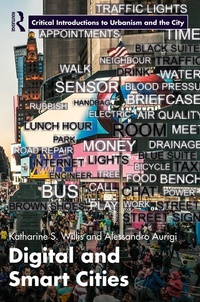
Digital and Smart Cities
Published on 12. October 2017
250 pages
978-1-317-49498-0 (ISBN)
Description

Digital and Smart Cities presents an overview of how technologies shape our cities. There is a growing awareness in the fields of design and architecture of the need to address the way that technology affects the urban condition. This book aims to give an informative and definitive overview of the topic of digital and smart cities. It explores the topic from a range of different perspectives, both theoretical and historical, and through a range of case studies of digital cities around the world.
The approach taken by the authors is to view the city as a socially constructed set of activities, practices and organisations. This enables the discussion to open up a more holistic and citizen- centred understanding of how technology shapes urban change through the way it is imagined, used, implemented and developed in a societal context. By drawing together a range of currently quite disparate discussions, the aim is to enable the reader to take their own critical position within the topic.
The book starts out with definitions and sets out the various interpretations and aspects of what constitutes and defines digital cities. The text then investigates and considers the range of factors that shape the characteristics of digital cities and draws together different disciplinary perspectives into a coherent discussion. The consideration of the different dimensions of the digital city is backed up with a series of relevant case studies of global city contexts in order to frame the discussion with real world examples.
The approach taken by the authors is to view the city as a socially constructed set of activities, practices and organisations. This enables the discussion to open up a more holistic and citizen- centred understanding of how technology shapes urban change through the way it is imagined, used, implemented and developed in a societal context. By drawing together a range of currently quite disparate discussions, the aim is to enable the reader to take their own critical position within the topic.
The book starts out with definitions and sets out the various interpretations and aspects of what constitutes and defines digital cities. The text then investigates and considers the range of factors that shape the characteristics of digital cities and draws together different disciplinary perspectives into a coherent discussion. The consideration of the different dimensions of the digital city is backed up with a series of relevant case studies of global city contexts in order to frame the discussion with real world examples.
Reviews / Votes
"Bravo! Smart cities are the latest craze with city governments and industry, yet their guiding vision is often limited to big data analytics and urban science. Willis and Aurigi's book provides a more holistic picture: a thorough yet accessible coverage of the theoretical, historical and practical contributions made by architecture, human geography, media studies, urban sociology, and other critical fields too often ignored by technocrats. This is required reading for everyone committed to a citizen-centred understanding of digital and smart cities." - Marcus Foth, Professor of Urban Informatics, QUT Design Lab, Australia"Finally! A volume that demystifies the smart city phenomenon through systematic and careful evaluation of its application in practice. It also provides a rare and solid genealogy of this oft misinterpreted term." - Nancy Odendaal, Associate Professor at School of Architecture, Planning and Geomatics, University of Cape Town, South Africa
More details
Series
Language
English
Place of publication
London
United Kingdom
Publishing group
Taylor & Francis Ltd
Target group
College/higher education
Product notice
Reflowable
Illustrations
4 Tables, black and white; 5 Line drawings, black and white; 29 Halftones, black and white; 34 Illustrations, black and white
File size
6,33 MB
ISBN-13
978-1-317-49498-0 (9781317494980)
Copyright in bibliographic data and cover images is held by Nielsen Book Services Limited or by the publishers or by their respective licensors: all rights reserved.
Schweitzer Classification
Other editions
Additional editions
Katharine Willis | Alessandro Aurigi
Digital and Smart Cities
Book
10/2017
1st Edition
Routledge
€60.10
Shipment within 10-20 days
Katharine Willis | Alessandro Aurigi
Digital and Smart Cities
Book
10/2017
1st Edition
Routledge
€237.68
Shipment within 10-20 days
Persons
Katharine S. Willis is Associate Professor (Reader) in the School of Art, Design and Architecture at Plymouth University, UK. She is the author of Netspaces: Space and Place in a Networked World (Routledge, 2016).
Alessandro Aurigi is Professor of Urban Design and Associate Dean for Research at the University of Plymouth. He has previously worked at Newcastle University and UCL, UK. His research focuses on the relationships between our increasingly digital society and the ways we conceive, design and manage urban space to enhance and support place quality. He has previously published Making the Digital City and Augmented Urban Spaces (Ashgate).
Alessandro Aurigi is Professor of Urban Design and Associate Dean for Research at the University of Plymouth. He has previously worked at Newcastle University and UCL, UK. His research focuses on the relationships between our increasingly digital society and the ways we conceive, design and manage urban space to enhance and support place quality. He has previously published Making the Digital City and Augmented Urban Spaces (Ashgate).
Content
List of Figures
Acknowledgements
Part One
01 Chapter One: Definitions and Approaches
02 Chapter Two: Historical Context
Part Two
03 Chapter Three: Techno-centric Cities
04 Chapter Four: Socially constructed digital and smart cities
Part Three
05 Chapter Five: Social, cultural and political
06 Chapter Six: Economics, globalisation and development
07 Chapter Seven: Planning, design and architecture
08 Chapter Eight: Mobilities
09 Chapter Nine: Governance and participation
10 Chapter Ten: From Digital to Smart and Beyond
Index
Acknowledgements
Part One
01 Chapter One: Definitions and Approaches
02 Chapter Two: Historical Context
Part Two
03 Chapter Three: Techno-centric Cities
04 Chapter Four: Socially constructed digital and smart cities
Part Three
05 Chapter Five: Social, cultural and political
06 Chapter Six: Economics, globalisation and development
07 Chapter Seven: Planning, design and architecture
08 Chapter Eight: Mobilities
09 Chapter Nine: Governance and participation
10 Chapter Ten: From Digital to Smart and Beyond
Index
