

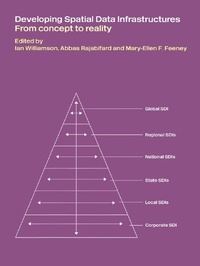
Developing Spatial Data Infrastructures
From Concept to Reality
1st Edition
Published on 10. July 2003
338 pages
978-1-134-41479-6 (ISBN)
Description

Expert perspectives on SDI theory and practice
The spatial data infrastructure (SDI) concept continues to evolve and become an increasingly important element of the infrastructure that supports economic development, environmental management, and social stability. Because of its dynamic and complex nature, however, it remains a fuzzy concept
The spatial data infrastructure (SDI) concept continues to evolve and become an increasingly important element of the infrastructure that supports economic development, environmental management, and social stability. Because of its dynamic and complex nature, however, it remains a fuzzy concept
More details
Edition
1. Auflage
Language
English
Place of publication
London
United Kingdom
Publishing group
Taylor & Francis Ltd
Target group
Professional and scholarly
ISBN-13
978-1-134-41479-6 (9781134414796)
Copyright in bibliographic data and cover images is held by Nielsen Book Services Limited or by the publishers or by their respective licensors: all rights reserved.
Schweitzer Classification
Other editions
Additional editions
Ian P. Williamson | Abbas Rajabifard | Mary-Ellen F. Feeney
Developing Spatial Data Infrastructures
From Concept to Reality
Book
08/2018
1st Edition
CRC Press
€96.40
Shipment within 10-20 days
Ian P. Williamson | Abbas Rajabifard | Mary-Ellen F. Feeney
Developing Spatial Data Infrastructures
From Concept to Reality
Book
07/2003
1st Edition
CRC Press
€261.80
Shipment within 15-20 days
Persons
Professor Ian P. Williamson, is the Professor of Surveying and Land Information, Head, Department of Geomatics, and Director, Centre for Spatial Data Infrastructures (SDI) and Land Administration, at The University of Melbourne. His teaching and research is in the areas of cadastral, land and geographic information systems, land administration and SDI and he advises state and federal government, UN agencies and The World Bank in these areas. He was Chairperson of Commission 7 (Cadastre and Land Management) of the International Federation of Surveyors 1994-98, and is the current Director for United Nations Liaison for the FIG. He is also Chairperson of Working Group 3 (Cadastre) of the United Nations-sponsored Permanent Committee on Geographic Information Systems Infrastructure for Asia and the Pacific 2001-2004.
Dr Abbas Rajabifard, is Deputy Director of Centre for SDI and Land Administration, and a Research Fellow in the Department of Geomatics, The University of Melbourne. He holds PhD (Melb), MSc (ITC), Postgrad-Dipl (ITC), and BSurv (Tehran). He worked for the National Cartographic Centre (NCC), Iran (1990-98), where he was Head of the GIS Department, managing the National Topographic Database and National GIS in Iran. From 1994-1999 he has been an Executive Board member and National representative to the Permanent Committee on GIS Infrastructure for Asia and the Pacific (PCGIAP). Since then he has been an active member of WG2 and is now Research coordinator in PCGIAP-Working Group 3. He has also been a member of the International Steering Committee for Global Mapping 1997-2001.
Ms Mary-Ellen F. Feeney, is completing her PhD at the Centre for SDI and Land Administration, The University of Melbourne. She is involved in lecturing, tutoring and course development in a number of subjects and has research interests in the development of SDI to support decision making at local through national levels. She is a member of the Global SDI and Decision Support System (DSS) Working Group. She holds BSc App.Geog.(Hons) (NSW), completing her research with the Commonwealth Science and Industry Research Organisation (CSIRO) and University of NSW in 1997. She has held positions as CSIRO Research Assistant (1996-1997), Australian Hydrographic Service Cartographer (1998) and Technical Development Officer (1998-1999), and has been involved in the development of the Australian Digital Hydrographic Database, GIS infrastructure and capacity building for the Department of Defence.
Dr Abbas Rajabifard, is Deputy Director of Centre for SDI and Land Administration, and a Research Fellow in the Department of Geomatics, The University of Melbourne. He holds PhD (Melb), MSc (ITC), Postgrad-Dipl (ITC), and BSurv (Tehran). He worked for the National Cartographic Centre (NCC), Iran (1990-98), where he was Head of the GIS Department, managing the National Topographic Database and National GIS in Iran. From 1994-1999 he has been an Executive Board member and National representative to the Permanent Committee on GIS Infrastructure for Asia and the Pacific (PCGIAP). Since then he has been an active member of WG2 and is now Research coordinator in PCGIAP-Working Group 3. He has also been a member of the International Steering Committee for Global Mapping 1997-2001.
Ms Mary-Ellen F. Feeney, is completing her PhD at the Centre for SDI and Land Administration, The University of Melbourne. She is involved in lecturing, tutoring and course development in a number of subjects and has research interests in the development of SDI to support decision making at local through national levels. She is a member of the Global SDI and Decision Support System (DSS) Working Group. She holds BSc App.Geog.(Hons) (NSW), completing her research with the Commonwealth Science and Industry Research Organisation (CSIRO) and University of NSW in 1997. She has held positions as CSIRO Research Assistant (1996-1997), Australian Hydrographic Service Cartographer (1998) and Technical Development Officer (1998-1999), and has been involved in the development of the Australian Digital Hydrographic Database, GIS infrastructure and capacity building for the Department of Defence.
Content
SDIs. Spatial Data Infrastructures: Concept, Nature And SDI Hierarchy. Global Initiatives. Regional SDIs. Regional SDI Diffusion. National SDI Initiatives. State SDI Initiatives. State SDI Development: A Victorian Perspective. SDI Development: Roles of Local and Corporate SDIs. Sustainable Development, the Place for SDIs and the Case for E-Governance. Spatial Data Infrastructures and Decision-Support. Financing Spatial Data Infrastructure Development: Examining Alternative Funding Models. Developing Evaluation and Performance Indicators for SDIs. Administrative Boundary Design in Support of SDI Objectives. SDI and Location Based Wireless Applications. SDI and Positional Accuracy. Future Direction for SDI Development.
