

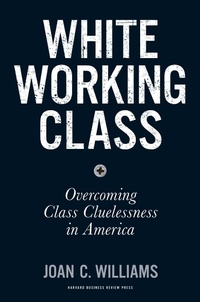
White Working Class
Description

"I recommend a book by Professor Williams, it is really worth a read, it's called White Working Class." -- Vice President Joe Biden on Pod Save America
An Amazon Best Business and Leadership book of 2017
Around the world, populist movements are gaining traction among the white working class. Meanwhile, members of the professional elite-journalists, managers, and establishment politicians--are on the outside looking in, left to argue over the reasons. In White Working Class, Joan C. Williams, described as having "something approaching rock star status" by the New York Times, explains why so much of the elite's analysis of the white working class is misguided, rooted in class cluelessness.
Williams explains that many people have conflated "working class" with "poor"--but the working class is, in fact, the elusive, purportedly disappearing middle class. They often resent the poor and the professionals alike. But they don't resent the truly rich, nor are they particularly bothered by income inequality. Their dream is not to join the upper middle class, with its different culture, but to stay true to their own values in their own communities--just with more money. While white working-class motivations are often dismissed as racist or xenophobic, Williams shows that they have their own class consciousness.
White Working Class is a blunt, bracing narrative that sketches a nuanced portrait of millions of people who have proven to be a potent political force. For anyone stunned by the rise of populist, nationalist movements, wondering why so many would seemingly vote against their own economic interests, or simply feeling like a stranger in their own country, White Working Class will be a convincing primer on how to connect with a crucial set of workers--and voters.
More details
Other editions
Additional editions
Person
Joan C. Williams is Distinguished Professor of Law and Hastings Foundation Chair at the University of California, Hastings College of the Law. Williams's work includes What Works for Women at Work, coauthored with Rachel Dempsey (New York University Press, 2014); Unbending Gender: Why Family and Work Conflict and What To Do About It (Oxford University Press, 2000); and such widely read reports as "The Three Faces of Work-Family Conflict," coauthored with Heather Boushey. Williams is frequently featured as an expert on social class. For more information, visit JoanCWilliams.com.
Content
- Intro
- Contents
- Chapter 1: Why Talk About Class?
- Chapter 2: Who Is the Working Class?
- Chapter 3: Why Does the Working Class Resent the Poor?
- Chapter 4: Why Does the Working Class Resent Professionals but Admire the Rich?
- Chapter 5: Why Doesn't the Working Class Just Move to Where the Jobs Are?
- Chapter 6: Why Doesn't the Working Class Get with It and Go to College?
- Chapter 7: Why Don't They Push Their Kids Harder to Succeed?
- Chapter 8: Is the Working Class Just Racist?
- Chapter 9: Is the Working Class Just Sexist?
- Chapter 10: Don't They Understand that Manufacturing Jobs Aren't Coming Back?
- Chapter 11: Why Don't Working-Clas Men Just Take "Pink-Collar" Jobs?
- Chapter 12: Why Don't the People Who Benefit Most from Government Help Seem to Appreciate it?
- Chapter 13: Can Liberals Embrace the White Working Class without Abandoning Important Values and Allies?
- Chapter 14: Why Are Democrats Worse at Connecting with the White Working Class than Republicans?
- Conclusion
- Acknowledgments
- Notes
- Additional Reading
- Index
- About the Author
